Democratic Forest Trusts (PDF)in Watson, Alan; Dean, Liese; Sproull, Janet, comps. 2006. Science and stewardship to protect and sustain wilderness values: Eighth World Wilderness Congress Symposium; 2005 September 30-October 6; Anchorage, AK.Democratic trusts with leadership elected by citizen-members promise to solve many of the problems afflicting both traditional government and corporate ownership of forestlands. This article explores these issues in some depth.Complexity and the Dream of Human Control of Eco-Systems (PDF)in Watson, Alan; Dean, Liese; Sproull, Janet, comps. 2006. Science and stewardship to protect and sustain wilderness values: Eighth World Wilderness Congress Symposium; 2005 September 30-October 6; Anchorage, AK.The title captures it. I then explore the kinds of institutions compatible with both nature and the modern world that are implied from this analysis.Rethinking the Obvious: Modernity and Living Respectfully With Nature (PDF)The Trumpeter: Journal of Ecosophy, Winter, 1997.Modernity is usually considered a wrong turn in terms of respect for and sustaining the environment. I argue the reality is more complex, for modernity has freed us from personal dependence on agriculture, ended the economic value of children, radically reduced the likelihood of large scale wat, and shifted much production to intellectual rather than material capital. This partially decouples society from nature, which gives us important opportunities as well as problems.Towards an Ecocentric Political Economy (PDF)The Trumpeter, Fall, 1996.This paper begins my effort at showing how liberal modernity can be harmonized with an ecocentric perspective on our relationship with the natural world. It is a corrective to much “free market environmental” literature that sacrifices Nature to money as well as to anti-liberal attacks by well-meaning but economically naïve environmentalists.Unexpected Harmonies: Self-Organization in Liberal Modernity and Ecology (PDF)The Trumpeter, Journal of Ecosophy, 10:1, Winter 1993This is my initial paper exploring how what I term ‘evolutionary liberal’ thought can be an important means by which society and nature can be brought into greater harmony. The other Trumpeter papers build on it.Deep Ecology and Liberalism: The Greener Implications of Evolutionary Liberalism (PDF)Review of Politics, Fall, 1996.Liberal thought and deep ecology are usually regarded as mutually exclusive. But the “evolutionary” tradition offers a way to integrate the two through commonalties in the work of David Hume, Michael Polanyi, Arne Naess, and Aldo Leopold, providing a stronger foundation for liberalism while strengthening the case for an ecocentric ethic.(Related subjects: Ecology)Saving Western Towns: A Jeffersonian Green Proposal (PDF)in Writers on the Range, Karl Hess and John Baden, eds., University Press of Colorado, 1998.Developmental pressures in the rural and small town West involve three groups: long term residents, new arrivals, and environmentalists. Today their interests often conflict. This conflict is in part the outcome of institutions which prevent harmonizing competing interests. The concept of developmental trusts, both for rural regions and for small communities offers a means whereby these interests can be harmonized for the benefit of all concerned.(Related subjects: Politics)Social Ecology, Deep Ecology, and Liberalism (PDF)Critical Review, 6: 2-3, 1992.Murray Bookchin is considered a leading radical environmental theorist. However, his analysis is incapable of leading humankind towards a more respectful and sustainable relationship with the natural world. Criticisms of Bookchin from both the deep ecology and evolutionary liberal perspective complement one another, pointing the way towards a better understanding of how modernity relates to the environment.The paper as a whole offers an early discussion of issues that are more clearly addressed in later papers, particularly Deep Ecology and Liberalism (1996) and the three Trumpeter articles in 1997, 1996, and 1993. However, there are other ideas in the article which have not been developed more thoroughly elsewhere.
UPDATE below
New conservative folk hero James O’Keefe is turning out to have been a
long time habitué of white supremacist gatherings and an associate of anti-Semites
and racists according to a new report at Salon. If so he is a perfect representative for a disturbingly big current within
modern “conservatism.” O’Keefe’s racist behavior long preceded his being busted
at Senator Landrieu’s office or his undercover film of Acorn. It seemed as if Acorn was breaking the
law, although it wasn’t. Further, there is plenty of evidence
that the film itself was deceptive. But that did not slow down his conservative cheerleaders. So current efforts to wash their
hands of Mr. O’Keefe after their collective orgasm over his Acorn stunt seem to be only because he was caught, and not because his views were held as
noxious. And yes, there is a
spiritual side to this.
A few years ago I began trying to figure out in some depth why
the modern “conservative” movement was so virulently opposed to so many of
America’s genuine traditions and to our Constitution and the principles of the
Declaration of Independence. At
one time Conservatives held a particular interpretation of their meaning, but one with
genuine substance, agree or not.
But not any longer. Now they ignore it. As I explored
the history of all this over and over again I discovered the cultural hand of the
ante-bellum South to be deeply involved. Attitudes developed in our first
“counter culture,” that of the pro-slavery South, have continued to infect the
politics, religion, and morality of the area and now our country.
Southern pro-slavery leaders had explicitly denied the
principles of our Founding. For
example, Alexander Stephens, Vice President of the Confederacy, said in 1861:
The prevailing view entertained by [Thomas Jefferson]
and most of the leading statesmen of the time of the formation of the old
constitution, were that the enslavement of the African was in violation of the
laws of nature, that it was wrong in principle, socially, morally, and politically. It was an evil they knew not well how
to deal with, but the general opinion of the men of that day was that, somehow
or other in the order of Providence, the institution would be evanescent and
pass away. . . . These ideas, however, were fundamentally wrong. They rested upon the assumption of the equality
of races. That was an error….
Our new government is founded upon exactly the
opposite idea; its corner-stone rests upon the great truth, that the negro is
not equal to the white man; that slavery – subordination to the superior race -
is his natural and normal condition.
Thus our new government, is the first, in the history
of the world, based upon this great physical, philosophical, and moral truth.
After the Civil War and slavery’s abolition, many white
Southerners practiced widespread murder and terrorism against their black
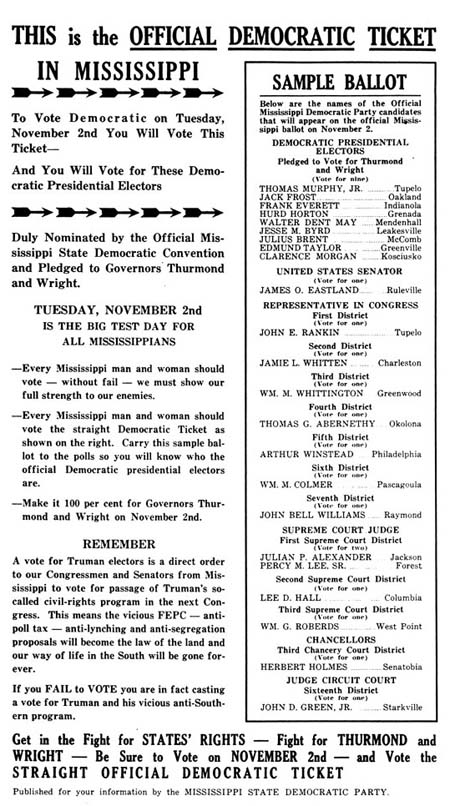
neighbors for over 100 years, all the way into the 1960s. In 1948 the Southern “Dixiecrat” Party
won Alabama, South Carolina, Mississippi, and Louisiana on a platform that
opposed federal anti-lynching laws, and argued for perpetual white supremacy
and denying Black Americans the vote. To see these views explicitly stated on
the Party’s documents, it wasn’t subtle, see here.
With Richard Nixon’s “Southern strategy” these folks (who
until the advent of Civil Rights issues had automatically voted Democratic
because Lincoln was a Republican)
were deliberately appealed to in the name of “values,” eventually
becoming a dominant force in the Republican Party and the conservative movement
considered more generally.
The Southern Baptists are the leading denomination in the religious right. They have their roots in the split within
American Christendom between Northern Christians opposed to slavery and those
in the South who thought it part of God’s Will. The split has never fully healed although in 1995 the
Southern Baptists formally repented of their defense of slavery, about 130 years after its
abolition. But insofar as it
differs from Northern Christianity, much Southern religion still proudly wears attitudes towards Biblical literalism once used to defend slavery.
This heritage is why someone like Rush Limbaugh can become a major figure in American conservatism. If Limbaugh stands for anhything, one of those things is contempt for black Americans.
I suspect their openness to the spirit behind scriptural writings and the need for their interpretation is
why many Pagans have had pleasant encounters with more liberal Northern
churches. I also suspect their commitment to so-called literal meanings is why Pagans have had such unpleasant experiences with one with Southern origins,
wherever their congregations might be located. From a Pagan perspective they worship different Gods, one a defender of slavery, the other its critic.
James O’Keefe seems to be a proud son of this anti-American
tradition.
UPDATE
Controversy has emerged as to how deeply O’Keefe was involved with the racist conference. Did he participate or simply attend?
His supporters called out Blumenthal as a liar, which was picked up all around the conservative blogosphere.
Three follow up stories are in the Washington Independent, a piece at Salon’s ‘War Room,’ and an older piece indicating an unusual concern for race evidenced in O’Keefe’s since removed blog. When I was associated with conservative groups (yes, I was) maybe 40 years ago the only people I met who talked like this were serious racists.
At this point it is difficult for me to determine how deeply O’Keefe was involved.
Needless to say, this has relatively little bearing on the points I wanted to make as I used him as an entry point for a more fundamental discussion.


posted February 3, 2010 at 4:57 pm
I am a Christian. I know the Bible quite well. I am far from perfect. I feel very close to Jesus. I am confused sometimes when I listen to other people claiming to be Christians. I wonder if they’re reading the same book as I am? Do they even know the same God I do? Does reading a book from the Bible that we consider to be historical fact-does that mean that we are permitted to do the same (wrong) things? Do these Christians notice that often God chastises the hero of the story. Sometimes He rewards those who would be considered immoral today as well as yesterday, because of their positive traits recognized by Him alone. I’m not educated, but I strongly sense that most who are loudest in these days, professing to be Christians, are spending far more time talking than actually listening to what Jesus is trying to tell them. I hate being judged by their actions. If we aren’t going to try to behave more “Christ-like”, we need to quit claiming to be Christian while speaking and acting out in public. I find it very annoying when a non-Christian exposes our sins to us.
posted February 3, 2010 at 7:25 pm
Gulia-
That is one really good thing about having a country with a variety of religious paths – including folks with none. Left to our own devices we get complacent and self righteous, especially when we talk mostly with one another. Having outsiders calling us on our stuff helps us. Pagans are as prone to this kind of complacency as anyone else, but at the moment there are so few of us it is hard for us to get that insulated. But if we grow in numbers a lot we’ll benefit from Christians calling us on our failings.
Gus
posted February 6, 2010 at 8:52 pm
And also when Mary Landrieu ran against Woody Jenkins in the run off election, Jenkins actually bought up David Duke’s mailing list to race bait the election. Maybe OKeefe viewed her as a race traitor?
posted January 11, 2012 at 12:22 pm
Show us the proof if your story that he was at these meetings.
Otherwise stop spitting your vitrial.
posted January 11, 2012 at 2:04 pm
If you have the ability to use the internet you have the ability to trace links. I provided them. Do so.