


 This is Part I of an article that will conclude tomorrow. The planetary bodies in our solar system are engaged in a never-ending series of cycles that while repeating on a regular basis, continually unfold into a totally new experience of their effect on humanity. An opposition of Saturn to Uranus now will have a very different influence than it did 100 years ago because of the way human beings continue to change.
Saturn is now, in mid-October 2008, moving into an alignment with Uranus that will perfect on November 4 just in time for election day in the US. Saturn is the outermost of what we call the “personal” planets – the planets that describe the basic psychological experiences and needs that motivate us as individuals. Uranus is the first of the outer, or transpersonal planets which exert their effect on us from outside, creating experiences in our life that demand that we grow and evolve and transform.
In ancient and medieval astrology, and n Vedic astrology still, the outer planets are not considered, For these practitioners, Saturn is the most powerful of the planets – the Lord of Death and Karma, a “malefic” planet that would generally bring about bad things. Modern astrology tends to take a different view of Saturn – one that recognizes his ability to create form and structure, to organize humans into social bodies using customs, morality and rules of law, and to offer up the mundane virtues of discipline, hard work and a desire to achieve something in the physical world. In his guise as the Lord of Time he reminds us that life is fleeting and we’d better do something that will make our lives amount to something.
Uranus was not discovered until 1781 (coincidentally, Pluto at the time was in the sign of Aquarius which is ruled by Uranus). Uranus is the first of the “outer planets” and is associated with experiences that urge us to be free of the shackles of moral responsibility that Saturn enforces – to find our own personal and individual liberty in pursuit of an ideal life. The discovery of Uranus coincided with the spread of these concepts that resulted in revolutions in the New World and in France. These successful revolutions gave rise to a wave of revolutionary (Uranian) fever that spread to Russia, China, France, Peru, Serbia, Mexico, Argentina, Paraguay, Korea, Spain, Portugal, Greece and the Ottoman Empire over the next 30 years.
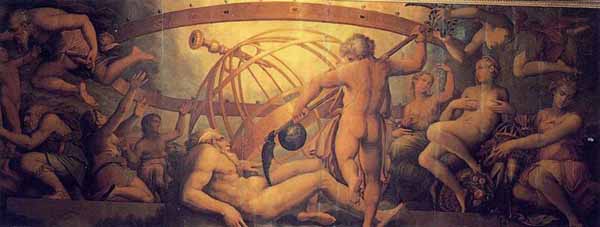
There is a dark side to the idealism of Uranus – in mythology, the god Uranus, Lord of the Sky, was horrified at the monstrous children that were the result of his union with Gaia, and banished them all to Tartarus (a form of the Underworld). He became a cruel and despotic tyrant, hated by all of his children. Saturn, one of the offspring of Uranus, conspired with Gaia to castrate Uranus and Saturn then inherited the government of the world.
The two planets are old enemies and fiercely competitive. Where Uranus urges us to seek the perfection of ideals, Saturn reminds us that the world we live in is full of challenge and shattered dreams. Where Uranus wants to break free of restrictions that bind us, Saturn binds us to our responsibilities and social morality. Uranus prefers chaos and the unlimited scope of new ideas and visions – Saturn requires that we crystallize these visions into solid structures that are acceptable to the society in which we live.
This opposition cycle will last longer than most as Saturn and Uranus face off a total of five times between November 2008 and July of 2010. Saturn and Uranus have opposed each other twice in the past 100 years: between 1917 and 1920, and between 1964 and 1967.
 Read Previous Post