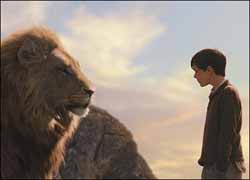
by Lynn Hayes I fell in love with The Chronicles of Narnia
while I was in college - the spirituality and hope that they offer interweave with the fantastic realms through which the Narnia Chronicles take the reader. They are really wonderful books for people of any age.
A new BBC documentary called the Narnia Code to be shown on Easter of next year elaborates on a theory by Dr. Michael Ward, author of Planet Narnia: The Seven Heavens in the Imagination of C. S. Lewis
:
Dr Ward made his discovery in 2003 after reading The Planets, a poem by Lewis which refers to the influence of Jupiter in "winter passed / And guilt forgiv'n" - a theme echoed in The Lion, The Witch and The Wardrobe.
He claims Lewis' knowledge of medieval history, of which he was one of the leading scholars, made him familiar with the characteristics attributed to the seven planets during the period. Each of these planets gives one of the books its theme. Prince Caspian, for example, is a story ruled by Mars, who is manifested by soldiery and battle, while The Voyage of the Dawn Treader focuses on the Sun, with its light and gold themes. In The Horse and His Boy, based on Mercury, the planet that rules the star sign Gemini and is associated with the power of communication, the characters include twins and a talking horse.
This theory doesn't surprise me in the least, because it's clear from the fabulous Perelandra trilogy that C.S. Lewis was fascinated by the stars and planets. A Christian theologian, he also had a fascination with Paganism and the occult as he wrote in his biography:
"And that started in me something with which, on and off, I have had plenty of trouble since--the desire for the preternatural, simply as such, the passion for the Occult. Not everyone has this disease; those who have will know what I mean. I once tried to describe it in a novel. It is a spiritual lust; and like the lust of the body it has the fatal power of making everything else in the world seem uninteresting while it lasts." ("Surprised by Joy," Harcourt Brace, 1955, pages 58-60.)
The Planet Narnia theory assigns one planet to each of the seven books in the series. (See the review of Ward's book here.)
For an astrological profile of C.S. Lewis and the Narnia series, visit Jeffrey Kishner's article on his old blog, Astrology at the Movies.

Add to Newsvine
Add to StumbleUpon
Hello, this is Devin Brown checking in. Thanks for this update. Below I have pasted a review of Planet Narnia which I wrote for Narniaweb.com.
Let’s say that with the coming release of the second Narnia film, you decide to read or reread Prince Caspian. You get to the scene in chapter ten where Trumpkin and the four children are asleep beside the fire, and Lucy wakes to hear a voice calling her name. Lewis’s narrator makes a point of telling us, “She was looking straight up at the Narnian moon, which is larger than ours.” As you come across these two seemingly random details about Lucy and the size of the Narnian moon, you might briefly pause and wonder why Lewis chose to include them.
Later, in chapter fifteen, after the great victory feast, everyone again nods off by the fire, and we find another somewhat odd inclusion: “But all night Aslan and the Moon gazed upon each other with joyful and unblinking eyes.”
At this point you might wonder whether Lewis just threw in these two sets of images haphazardly or if he intended to give Prince Caspian a special association with the moon. If you favored the second explanation, you would be thinking along somewhat the same lines as Lewis expert, Michael Ward, but with a major difference.
In his book Planet Narnia and at his website planetnarnia.com, Ward argues that C. S. Lewis deliberately based each of the seven Chronicles of Narnia on the imagery (or characteristics) of a different one of the seven medieval planets: Jupiter, Mars, Sol, Luna, Mercury, Venus, and Saturn. One difficulty is that Ward disregards these two prominent moon images in Prince Caspian. For him, The Silver Chair is the Chronicle which Lewis gave a special association with the moon.
All right, you say—despite these two prominent moon images, Prince Caspian is not associated with the moon. You continue reading and get to chapter eleven where Aslan returns to Narnia with the two most jovial characters in all of literature—Bacchus and Silenus. Their appearance leads to a huge romp that goes on for three pages and then starts up again in chapter fourteen where it goes on for another eight pages. And so, you might speculate, given all this joviality, maybe it was Jupiter that Lewis wanted to associate Prince Caspian with.
Wrong again. Ward argues that The Lion, the Witch and the Wardrobe is the book that Lewis associated with Jupiter, and as part of his evidence points to Father Christmas—“the Jovial character par excellence”—who appears there for three pages.
So, according to Ward, which of the seven heavens is Prince Caspian associated with?
Ward claims that Lewis used characteristics from the planet Mars to guide his writing of Prince Caspian, and as evidence points to the military theme which appears at various times in the story. But, you might wonder, isn’t there a military theme in other Chronicles? And aren’t many of the chapters in Prince Caspian not very martial but rather quite pastoral?
The answer is yes to both questions. And here lies the first main problem with Michael Ward’s thesis: planet-related imagery does not stay rooted in its “home” book, but appears scattered randomly in all seven Chronicles. For every image that fits Ward’s scheme, we can find one that does not. Ward proposes his Planet Narnia system as a solution to what he calls the “hodge-podge” of Narnia, but in fact, his hunt for planet imagery only proves the series to be even more hodge-podge than previously thought.
It should be noted Michael Ward is one of the world’s best Lewis scholars, and a very fine writer to boot, and that his description of Lewis’s works itself is easily worth the price of the book. It should also be pointed out that Ward himself graciously acknowledges that imagery from any planet may appear in any book—not just in the one his theory says it should be in. He admits that Lewis “was unlikely to have been perfectly successful” in carrying out his secret plan. Ward’s argument then is one of degree, that while in each of the stories there will be characteristics from other planets, there is always one certain planet that will dominate so that its imagery is “pervasive and governing.”
For this claim to be convincing, however, Ward must do more than anecdotally choose certain images to mention (and certain ones to ignore). To prove that one planet’s imagery is pervasive or governing in any given book, he must first define what it would take for us to declare this and then provide some sort of quantitative evidence. In the end he might tell us that, for example, 59 percent of the imagery in a certain book can be associated with one of the medieval planets.
If the first problem with Ward’s thesis is the jumble of planet images that appear in each book, the second problem is deciding what counts as a planet image. For example, under Jupiter images, we find the expected association with kingliness (which, by the way, seems to be at least as present in Prince Caspian as in The Lion, the Witch and the Wardrobe). But Ward also insists that the passing of winter, festal garments, lions, revels, justness, gentleness, long fur coats, and minotaurs must be associated with the planet Jupiter and no other. Ward finds ways to use Lewis’s other writings to make these connections, but even with the references he provides, many of his associations may seem farfetched to some. For example, oak trees are connected with Jupiter, but tree imagery in general is connected with Mars (as are woodpeckers, horses, and, believe it or not, Edmund’s flashlight).
There is a third and final problem with Ward’s argument. Even if we accept his premise, for many readers it may not pass the “So what?” test. So what if Lewis used mostly Jupiter imagery in The Lion, the Witch and the Wardrobe? Does it make any difference in our enjoyment? Does it change our understanding of the story? Does it change the role that the Narnia stories have played and continue to play in our lives? For many readers the answers may be no, no, and no.
Now that Ward has boldly claimed to be the one person on earth to have realized “the secret, governing imaginative scheme underlying the Narnia Chronicles,” we may expect other scholars to come forward with their own claims of having discovered the hidden secret to Narnia. Perhaps someone will attempt to show that the color white was Lewis’s clandestine governing scheme in the first Narnia book.
Someone else may point out the wardrobe, the war in England, Narnia’s winter, the woods, the great wolf, the White Witch, her wand, and the Wooses, Wraiths, and White Stag, and claim that the first Chronicle is secretly dominated by the letter W. No matter that we can find other colors and letters in the first book—in particular the color red and the letter L. No matter that white and W’s both appear throughout the other volumes.
These two imaginary proposals of Color Scheme Narnia and Alphabet Narnia do not justice to Michael Ward’s thoughtful and carefully detailed look at Lewis’s imagery. But, for those who remain unconvinced of his premise, they may not seem any less plausible.
In a recent interview, Lewis’ stepson Douglas Gresham stated, “A very nice man and a friend of mine, Michael Ward, has recently written and published a book all about how Narnian Chronicles are all based on the seven planets of the medieval astronomical system. I like Michael enormously, but I think his book is nonsense.” Gresham further suggested, “People do go out of their way to try to find all kinds of hidden meanings. We seem to be a species that loves conspiracy theories.”
Devin, thanks for posting this review. I sadly admit that I don't remember enough about the books to be able to comment with any real intelligence. It is interesting to me though that below the Christian symbolism in Lewis's books there is an undercurrent of esoteric thought.
Post a Comment
By submitting these comments, I agree to the beliefnet.com terms of service, rules of conduct and privacy policy (the "agreements"). I understand and agree that any content I post is licensed to beliefnet.com and may be used by beliefnet.com in accordance with the agreements.