- All Things Catholic
- American Buddhist Perspective
- Bible Belt Blogger
- Bill’s “Faith Matters” Weblog
- Blogging Religiously
- Bold Faith Type
- Christianity Today
- Civil Religion
- CNN’s Belief Blog
- Episcopal Café
- Faith & Reason
- FaithWorld
- GetReligion
- HuffPost Religion
- Muslimah Media Watch
- MuslimMatters
- On Faith
- Religion Blog
- Religion Clause
- RNS Blog
- The God Blog
- The Seeker
- Whispers in the Loggia
My post here last week about Boston University professor Stephen Prothero’s appearance on The Colbert Report to discuss his new book, God Is Not One: The Eight Rival Religions That Run The World — and Why Their Differences M
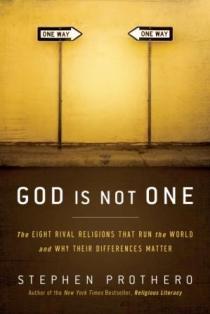
atter, has made news of its own: fellow Beliefnet blogger Rod Dreher, then GetReligion’s Terry Mattingly, then Dreher again, and most recently Beliefnet newcomer Mark Silk have now weighed in on my casual remark about finding it more interesting to explore the similarities between different belief systems, beyond the obvious sources of conflict that usually get covered.
Who knew this would be such a controversial sentiment?!
After attempting to clarify my point of view in GetReligion’s Comments section, I decided it was silly to continue the conversation until I had a chance to read the book in question. So, I’m halfway through God Is Not One, and have arranged to speak with Prothero for a Q&A to be posted here early next week.
In addition to Stephen Colbert’s interview, which can be viewed from my original post, here are some links to recent Q&As with the author. Take a look, and share your thoughts in the Comments section below on what kind of follow-up questions or new angles you would like me to pursue — particularly as they pertain to interfaith perspectives.
- 10 Minutes With… Stephen Prothero (Religion News Service)
- Stephen Prothero: All Religions Are Not The Same (Religion & Ethics Newsweekly)
- One way to God? No way, says author (Charlotte Observer)
- Questions for Stephen Prothero (Huffington Post)
*Click here to subscribe to Belief Beat and click here to follow Belief Beat on Twitter.


posted June 22, 2010 at 2:44 pm
Nicole, before you have your sit down with Prothero please check out this review by Georgetown Theology prof Leo D. Lefebure:
http://www.christiancentury.org/article.lasso?id=8479
Lefebure is very sympathetic to Prothero’s point of view, but feels that Prothero simply fails to make a good case (to put it mildly).
Another very thoughtful and substantial critical was written by Alec Solomita for the Boston Globe on Sunday May 23:
http://www.boston.com/ae/books/articles/2010/05/23/an_attempt_to_debunk_the_idea_that_all_religions_are_brothers/
The punchline of Solomita’s review is “Yet, despite his promise that he will look at the great religions critically and comparatively, Prothero avoids honest contrasts through a series of logical contortions that make him look as if he’s playing the game Twister.”
Most of the reviews and interviews connected with Prothero’s recent book have been puff-pieces that appear to be arranged by his publicist and/or publisher — in essence, advertisements.
posted June 23, 2010 at 8:17 am
I imagine something like cognitive dissonance is involved. So the more invested you are in your religion the more difference you see between it and others. Conversely, the less invested probably see more similarities.
Basically how sure are you that you’re right? If you are really sure, then others must be wrong in some way. To say that they are similar to you is fighting words.
posted June 23, 2010 at 7:05 pm
I am definitely not religion savvy – and to some I might be considered “religion illiterate” – but I do see similarities amongst different religions … could it be that I am less invested in my own religion?? Perhaps!
posted June 27, 2010 at 4:11 pm
Stephen Prothero says that he believes in the Christian Trinity, but that other religions do not. There are “trinities,” of sorts, in various faiths. The e-book at http://www.suprarational.org summarizes five of them.
Mahayana and Vajrayana vehicles of Buddhism speak of Trikaya, or three bodies: Nirmanakaya is the Buddha in human form, Sambhogakaya is celestial Buddha and Dharmakaya is the formless essence, or Buddha-nature. The Theravada primarily addresses the historic Buddha. The “Three Jewels” are the Buddha, the dharma (his teachings) and the sangha (the community of monks and nuns).
Christianity has its Trinity: Father, Son and Holy Spirit referring to God, Jesus Christ and their spiritual bond of unity (some say the Godhead). Interpretation of the essential nature of each, and their relationship, differed among the churches. In Christian mysticism, the three ways of the spiritual life are the purgative in being purified from sin, the illuminative in true understanding of created things, and the unitive in which the soul unites with God by love.
Hinduism’s trimurti are the threefold activities of Brahman: in Brahma as creator, in Vishnu as sustainer and in Shiva as destroyer. Saccidananda are the triune attributes or essence of Brahman: sat, being, cit, consciousness and ananda, bliss. The three major schools of yoga are bhakti, devotion, and jnana, knowledge and karma, the way of selfless action. Raja yoga can apply to, and integrate, all three in mental and spiritual concentration.
In Islam, nafs is the ego-soul, qalb is heart and ruh is spirit. Heart is the inner self [soul], hardened when it is turned toward ego and softened when it is polished by dhikr, remembrance of the spirit of Allah. This is a three-part foundation for Sufi psychology. Initiation guides them from shari`a, religious law, along tariqa, the spiritual path, to haqiqa, interior reality. It is a gradual unveiling of the Real.
In the Kabbalah of Judaism, sefirot – sparks from the divine – have three fulcrums to balance the horizontal levels of the Tree of Life: Da`at (a pseudo-sefirot) is knowledge combining understanding and wisdom; Tiferet is beauty, the midpoint of judgment and loving kindness; Yesod is the foundation for empathy and endurance. They also vertically connect, through the supreme crown, the infinite and transcendent Ein Sof with its kingdom in the immanent Shekhinah.