Benedictions: The Pope in America

Benedictions: The Pope in America

John Paul’s “white martyrdom”

posted by David Gibson | 8:14am Wednesday April 2, 2008

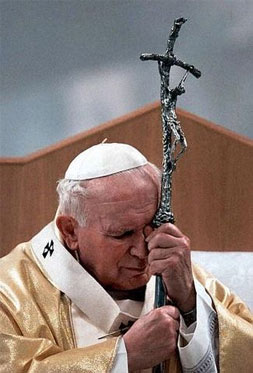
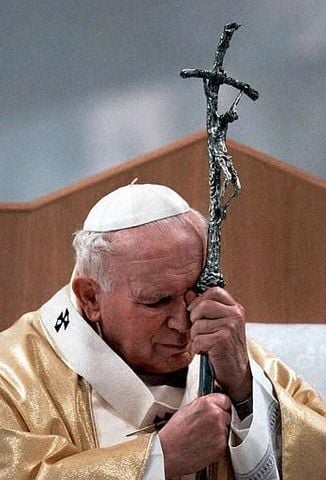
JohnPauloncrucifix2.jpg
<!–John%20Paul%20on%20crucifix.jpg–> Wednesday marks the third anniversary of the death of John Paul II, a passing that provoked such an enormous outpouring that the world—and even the College of Cardinals who gathered with the unenviable task of choosing his successor—was transfixed for weeks. We hardly need much prompting to remind us of the emotions and images of the “avvenimenti di Aprile”—the events of April—as Vatican officials, in their reflexively understated curial way, took to describing them. Almost immediately, crowds in the piazza beneath the late pope’s window started with chants of “Santo Subito,” calling for John Paul’s instant canonization. Many commentators dubbed him (as a few die-hards had for years before his death) John Paul the Great, conferring an honorific granted to just two other pontiffs, and none since the Dark Ages when Barbarian armies threatened the Eternal City.
This anniversary, coming in the run-up to Benedict’s own inaugural visit to the United States (during which he will mark his own 81st birthday, on April 16, and the third anniversary of his election, on April 19), would seem to shadow once again Benedict’s papacy, as John Paul’s legacy was perhaps bound to do. Many commentators lament that comparisons between the two popes, apparently unfavorable to Benedict, continue to be made. Yet such contrasts are inevitable, I think, and justifiable in that these are two different men, and should be judged on their own merits. Americans should also know what to expect of Benedict, so that they can better appreciate what he says (or does not say).
What I think too few stop to appreciate is that for all their notable differences, there is a great continuity between John Paul and Benedict in the amount of energy they bring to the papacy. Why is that the case?


Because of the length of John Paul’s pontificate (26 years, the third-longest in history) and the grandezza of his early years as pope—leaping the Berlin Wall, surviving a near-assassination in St. Peter’s Square, etc—it is often hard to remember that the last half of his pontificate was marked by illness and growing immobility. The man who chafed at being a prisoner of the Vatican spent much of his reign as a prisoner of his own body.
That he bore his sufferings with such dignity and even joy—ever the “Happy Warrior” of Longfellow’s poem, as George Weigel wrote in his biography of the pope—was as important to the acclaim and affection that accompanied his later years as the obvious heroism of his early years in Rome and abroad. Indeed, John Paul bore his condition with such grace that too few realize how difficult it was for him.
I was always struck by a story that John Paul told in a little-known 1982 biography by a French journalist, André Frossard, of the moment of his election as pontiff in 1978. John Paul told Frossard that at that instant, in the brief seconds before Karol Wojtyla became Pope John Paul II, he plunged his face in his hands at the gravity of what had befallen him, and his first thought was of his long-ago pastoral work as a priest in Poland working with bed-ridden patients, “those incurable invalids condemned to the wheelchair or chained to their sick bed; people who are often young and conscious of the implacable advance of their illness, prisoners in their sufferings for weeks, months or years.” John Paul found in the “terrible irreversibility” of their condition a parallel to his own new circumstances as pope.
Yet it was also a foretaste of his own physical decline decades later. None of us, I think it is safe to say, will ever know the drama—or trauma—of becoming pope. As the conclave vote swung inexorably toward Joseph Ratzinger in April 2005, the cardinal said he prayed not to be chosen. “As slowly the balloting showed me that, so to speak, the guillotine would fall on me, I got quite dizzy,” Benedict, told an audience of German pilgrims a few days after his election. Little wonder that the sacristy off the Sistine Chapel where a new pope is first vested is called the Sala della Lacrime, the Hall of Tears.
Yet the fear, or reality, of losing control to illness can seem a fate worse than death, and is all-too familiar for many of us. As John Paul grew more frail, he made many moving efforts to underscore the value of the elderly, and to encourage them by his example much as he invigorated the church with his energy in earlier years. “It is important to speak of suffering and death in a way that dispels fear,” he told hospice workers in Austria in 1998. In a letter addressed to the elderly for the 1999 World Day of the Sick, he described the achievements of the elderly Moses: “It was not in his youth but in his old age that, at the Lord’s command, he did mighty deeds on behalf of Israel,” he wrote. In August 2004, during a visit to the Marian shrine at Lourdes that commemorates miraculous healings. John Paul directly addressed his own condition in speaking to the ill: “With you I share a time of life marked by physical suffering, yet not for that reason any less fruitful in God’s wondrous plan.”
They are moving words. But it is how John Paul lived those words, in his “white martyrdom,” that makes them resonate. And in his own way, the octogenarian (but still vigorous) Benedict faces similar challenges, both because of his age and energy level, but also because of the papal legend he follows, and, in his own way, mirrors. Inspiring others while living within the limits of our temporal conditions is perhaps the greatest grace the elderly give to those who will inevitably come after them.


Previous Posts

Archbishop Chaput weighs in against "Obama Catholics"--and for...?
Denver's Archbishop Charles Chaput combines an intellectual's depth with the doughty persona of a politicker, which is what he used to be--he worked for the RFK campaign and later, even as a priest, was a campaign volunteer for Jimmy Carter. Some say he's still a political operative, though for the

posted 11:18:53am May. 20, 2008 | read full post »

The Hagee-Donohue ticket: "Liberals' worst nightmare"
The elaborate courtship of Texas televangelist John Hagee--who is covering McCain's evangelical flank--and the Catholic League's Bill Donohue, who accused Hagee of anti-Catholicism for his "Great Whore" sermonizing and other standard anti-papist barbs, always seemed to hold about as much suspense as

posted 10:54:05am May. 19, 2008 | read full post »

An olive branch to divorced-and-remarried Catholics?
An item in the current edition of The Tablet of London hints at a possible opening for divorced and remarried Catholics to receive communion--even though many do, obviously, their ban from the altar under church law remains one of the sorest pastoral points in the US church. It is also a sore point

posted 6:00:00am May. 17, 2008 | read full post »

The key to Benedict...
It is summed up in a response recounted by Father Jim Martin, a Jesuit and author who posts (and edits) at America magazine's blog. Father Martin has a post on "Three Unreported Papal Stories" from last month's visit. The third is the payoff: Third: Another priest friend serving as a secretary to on

posted 5:12:35pm May. 16, 2008 | read full post »

Guerilla tactics and the "Communion Wars"...Doug Kmiec is denied communion for backing Obama
It seems that the former Reagan adviser and Catholic conservative legal scholar from Pepperdine, Doug Kmiec--heretofore a man with impeccable judicial and pro-life credentials--has been barred from communion for his support for Barack Obama. In a posting yesterday, Kmiec did not give details, but wr

posted 12:37:21pm May. 16, 2008 | read full post »

Advertisement
Comments read comments(10)
post a comment
Mari Musante

posted April 2, 2008 at 12:12 pm


This is beautifully written! In the “evening years” of our
lives, we often have to contend with declining health. This is not
always an easy transition to make if we have been vigorous and
healthy in youth and our middle years.
Certainly Pope John Paul II was an amazing role-model for living
life to the fullest, despite the constraints of disease, increasing
weakness and frailty. Our past Pope taught us by example that life
always has dignity, and that much can be accomplished even though we
no longer have the strength and stamina we once had.
I can understand Pope Benedict praying not to be selected “Pope”.
I will pray for him as his job is not an easy one, and he follows
a Pope who left big shoes to fill…


report abuse
 

RelicMM

posted April 2, 2008 at 1:29 pm


I do not believe that the ultimate role of Pope Benedict XVI will be overshadowed by his predecessor. It appears that he is trying to regain control of the universal church that was lost when Magisterial authority was fractionalized by giving autonomy to national organizations of national bishops that have been rather lax in their obedience to discipline, doctrine and Magisterial truths. Reports of aberrations in the chaotic wake of The Second Vatican Council that were sent to Rome were returned with the suggestion to take up the grievance with the local authorities that often perpetrated them. it didn’t take too long for scandals to begin that were never honestly reported to Rome. Never in my rather long lifetime have so many innocent parishioners in America had to pay so much for so many violators of Catholic doctrine. Too often, it was too easy to attack, blame, and sue the Church for the actions of renegade priests. I hope Pope Benedict VXVI throws down the gauntlet against the so-called Catholic colleges that flaunt Catholic doctrine and precepts, and applies the necessary discipline if they will not listen.


report abuse
 

Biaggio

posted April 2, 2008 at 5:52 pm


Catholic colleges are real places of learning because of Ted Hesburgh and Paul VI who were not afraid of learning and provided that autocrats in the Vatican would not determine what is true but that prayerful learning is preferred.
John Paul II was very charismatic but he was a very unwise pope who deliberately chose to ignore the pedophilia crisis, especially on its greatest perpetrators, Maciel, whom the pope admired. He was a flawed pope in many ways who confused the problems of Poland with the Universal Church. And even the Polish people ignored him when they achieved their freedom.
John Paul set back the advancement of women and stagnated theology in the church. He did some very good things with the Jews and ecumenism. He had a great moment in Assisi. Benedict to his discredit went against John Paul on Assisi.
Benedict has serious shortcomings and we should face them truthfully instead of continuing useless mythology about him.


report abuse
 

AERabon

posted April 3, 2008 at 12:42 am


I am not a Catholic. I am a Baptist but I must state that John Paul II was one of the greatest Christian leaders the world has had since Jesus. I wish many times that I had traveled to see him. I watched with great emotion his end and funeral, and felt as a member of my own family had passed. I know he is also at the right-hand of God.


report abuse
 

StHilarious

posted April 3, 2008 at 3:34 am


2 Cor 12:12 The things that mark an apostle signs, wonders and miracles were done among you with great perseverance.
Could someone inform us of signs, wonders and miracles which JPII did among us before the RCs crown him as another powerless saint.


report abuse
 

eneubauer

posted April 3, 2008 at 1:23 pm


St. Hilarious,
This is why there is a vigorous investigation before someone is declared a “saint.”


report abuse
 

StHilarious

posted April 11, 2008 at 9:11 pm


eneubauer did not answer my question, but prefers an investigation by the biased.


report abuse
 

StHilarious

posted April 11, 2008 at 9:19 pm


AERabon states that John Paul II was one of the greatest Christian leaders the world has had since Jesus. However JPII kissed a book which denied the deity of Christ and prefers (totus tuus) giving attention to a demon posing as Mary, instead of worshipping Jesus with all his strength. The Holy Spirit did not manifest miracles and sins and wonders thru the ministry (?) of JPII. JPII displayed all the sins of a false teacher.


report abuse
 

Mary Lou

posted April 13, 2008 at 8:53 pm


it doesn’t seem possible that it is 3 years already for the anniversary of the dealth of the the great Pope John Paul 11,This Pope was one of a kind whenever he was on TV or just spoke you were drawn in to his precesence even if you weren’t there in person he touched you in such a way. No matter what trouble you were going through he made you feel at peace.There will never be a Pope like him he was one of a kind, He was the Pope of the people maybe because he felt a nd acted like he was one of us. He was like Jesus, This Pope needs to become a saint. For he was one when he was alive.John Paul is truly missed but never forgotten. We love you you always.


report abuse
 

Joe Delgado

posted April 16, 2008 at 8:17 am


They had been elected great popes, who preserved the continuity of the Word of the Lord, but the world needs another Peter for the coming of the living God in the hearts of everybody.


report abuse
 

Post a Comment

By submitting these comments, I agree to the beliefnet.com terms of service, rules of conduct and privacy policy (the "agreements"). I understand and agree that any content I post is licensed to beliefnet.com and may be used by beliefnet.com in accordance with the agreements.

Share this story


About Beliefnet

Our mission is to help people like you find, and walk, a spiritual path that will bring comfort, hope, clarity, strength, and happiness. More about Beliefnet.

Help

Media Kit

Subscribe

Legal

Copyright © Beliefnet, Inc. and/or its licensors. All rights reserved. Use of this site is subject to Terms of Service and to our Privacy Policy. Constructed by Beliefnet.

Advertisement

Report as Inappropriate

You are reporting this content because it violates the Terms of Service.

All reported content is logged for investigation.