

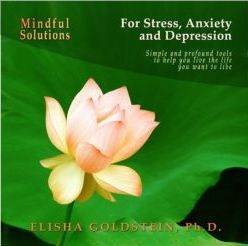
I’ve been pursuing a better understanding mindfulness–and trying to practice it–for a good six months now. In the last few weeks, though, I think I’ve made some progress due to a CD I’ve been listening to by Dr. Elisha Goldstein called “Mindful Solutions for Stress, Anxiety, and Depression.” I have been listening to the CD in the car on my way to pick up the kids from camp or run an errand (I don’t close my eyes, though, like you are supposed to).
At any rate, his four step model to mindfulness has helped me divide the awesome job of becoming more mindful into a few steps that are easier to process. He breaks mindfulness into four categories: calming exercises, mindfulness of thoughts, mindfulness of emotions, and the wandering mind.
1. Calming Exercises
For calming exercises, Dr. Goldstein (who has a very soothing voice I might add!) offers two strategies: breath work and a body scan. He starts with the breath because it is something that is always with us, and because it provides oxygen to all of our major organs, including our brain. It’s the source of life, and so often we breathe from our chest, not getting the full oxygen our body needs.
Lately, when I grow anxious or have had a fourth cup of coffee in an hour, I have noticed my breath turn shallow. It moves from my belly or diaphragm to my chest. So I’ll try to concentrate on it–to begin counting with each breath–and to try to get it back to the belly.
Dr. Goldstein claims that the body scan is another way we can regulate our stress. He says:
By taking time to focus on the body part by part we begin to realize that we are more than our busy minds. We give our bodies the acknowledgment it rightfully deserves, possibly noticing pleasant or unpleasant sensations that we are carrying with us throughout the day. We may also become more aware as thoughts or emotions rise up in connection with particular body parts. Connecting with the body in this way is often where deep healing can occur.
2. Mindfulness of Thoughts
In learning how to be mindful of our thoughts, we simply take a backseat to our brain, like we’re chilling out with a box of popcorn watching The Rocky Horror Picture Show, and observe all the freaky thoughts that arrive. We assure ourselves that our thoughts are “mental events” not “permanent facts,” that the buggers are transient, on the go, driving faster than a Dominos pizza delivery boy. So we don’t have to fret over them! Goldstein promises us that if we loosen our grip on our thoughts … and remind ourselves of their impermanent status, we can free ourselves from the fear and anxiety that they produce. He says:
Mindfulness of Thoughts is different from the normal route of reacting or getting caught up in the storm of our mind. In watching the mind we’re simply observing all the images and thoughts that care to float on by. As we get caught up in the thoughts themselves, as we will, we can then take note that we’ve been thinking. If it is negative self-talk or a certain style of thinking such as catastrophizing or blaming, we may just acknowledge that. As soon as we do this we are present again and can then make the choice to gently pull ourselves back from the thoughts and continue to witness. This gives us the experience that thoughts are simply impermanent mental formations that come and go, that we do not have to attach to, and that we actually have the ability to control our minds.
3. Mindfulness of Emotions
This is where I usually get into trouble. Because emotions seem so vague and so unpredictable and so powerful. I have an easier time observing my thoughts than I do my emotions, because I’m usually too absorbed in the emotion to have enough distance to label it.
But the way Dr. Goldstein instructs us on the CD is to simply expand our vocabulary of emotions. That, to me, is an easier assignment than being their watchdog. So, if you’re like me, you have your “love” emotion and your “hate” emotion, your “happy” emotion and your “sad” emotion. And that’ about it.
Goldstein thinks there may be a few other categories we’re missing, that most of us don’t have a vocabulary to adequately express our emotions. So there are times when our anger is actually stemming from fear, or our anxiety was masking our sadness. But we only had four boxes, so we’re shoving everything in the “sad” box. What happens when we have four words to process our emotions? Says Goldstein:
The result is that we feel detached from our emotions, they seem foreign, and what we don’t understand, we feel disconnected from, and are often afraid of. In mindfulness of emotions we learn to gently feel into where the emotions are in the body, simply observing and describing them as they come and go.
4. The Wandering Mind
I always laugh when when he introduces this section because my mind is usually off in a far and distant place as he begins this segment. Dr. Goldstein describes this part better than I can. This is what he says:
Part of the practice is to notice when the mind has wandered and acknowledge where it has wandered to. It maybe wandered to negative self-talk, or maybe to a habitual pattern of thinking like catastrophizing, or things you should be doing, or even wondering why you are doing this practice in the first place. As soon as we are aware that it has wandered we are present and can now choose what we want to do. We want to actually turn our attention to where it has wandered to, acknowledge it, then let it be and gently bring our awareness back to what we want to be focusing on in the moment.
So, there you have it. Four steps to mindfulness. I still feel so new to all this, but I suggest if you have some free time in the car you might put those moments to good use and learn how to be mindful (as long as you aren’t closing your eyes, of course).
To read more Beyond Blue, go to http://blog.beliefnet.com/beyondblue, and to get to Group Beyond Blue, a support group at Beliefnet Community, click here.
To subscribe to “Beyond Blue” click here.

 Read Previous Post