The Bible and Culture

The Bible and Culture

Q AND A WITH BISHOP WRIGHT ON ‘JUSTIFICATION’

posted by Ben Witherington | 7:25am Wednesday June 3, 2009


Q: Tom you have been challenged repeatedly by some of yourReformed critics on the issue of imputed righteousness and the glory of God.Would you say these are the main problems when you have a discussion about justificationwith these critics?


A.Iwouldn’t say they are the two main problems, no. I set out what I see as theprimary questions in the preface. Underneath even those there is the challengeabout whether one reads scripture as a set of proof-texts to dogmas alreadygiven — prooftexts detached from their contexts — or whether one allowsscripture itself to set, and re-set, the terms of what we’re talking about. Andscripture itself suggests that the whole western tradition, from mediaevalcatholicism onwards, has dangerously skewed the focus of discussion to ‘me andmy getting to heaven’ rather than to ‘God and God’s kingdom coming on earth asin heaven’. The irony is that Piper’s concern for the glory of God reflectsexactly this biblical emphasis but he doesn’t allow it to do what it should,but instead distorts it into a particular sub-variant of the reformationtradition of imputed righteousness…


Q. If you were actually able to have a conversation with theReformers, particularly Luther and Calvin what would you want to ask them?


A.  The first question I’dwant to discuss with Luther, Calvin etc is the actual line of thought inGalatians and Romans — i.e. what is Paul actually talking about? They wereexegetes to a man, and insisted on that, and I think they’d be open to thatdiscussion… I would then want to ask whether they think it possible that theymay be still asking a mediaeval question to which they’re trying to give abiblical answer, rather than reframing the question itself. That, too, I thinkthey would understand.

 The New Perspective has been helpful in all sorts of ways but also a hindrance.There are as many New Perspectives as there are people writing about it. Itgets muddled up with quite different agendas. As I’ve often said, the trick toaim for is to recover the first-century questions and try to give twenty-firstcentury answers, rather than taking sixteenth-century questions and givingnineteenth-century answers…


Q.What were you trying to accomplish in your discussion and relating of God’srighteousness and covenant faithfulness?


A.I tried to show that the two go together. The basic ‘lawcourt’ theme is thehome base and the ‘covenant’ theme a particular extension of it: when God makesthe covenant he will then be true to it etc. Paul was, I believe, demonstrablyusing the phrase in the sense it has in many of the Psalms and, particularly,in Isaiah 40-55.  This isn’t ‘covenantfaithfulness’ versus ‘character’. God’s faithfulness is part of his character,and both fall under the rubric of his righteousness.


Q.Why does there seem to be such a disconnect between the way systematicians readPaul’s discussion of the Law and the way most exegetes do?  And why has there been such animus towardsthe New Perspective when it comes to Paul’s view of the Law?


A.I think it’s simply the pragmatic fact that when you read Paul within hisfirst-century Jewish context he ends up saying things the tradition didn’t wantto hear — so they try to rule the context out of order. Frankly, if that studyhad shown up some kind of Reformed meaning as deeply embedded in the texts readwithin first-century Judaism they would be just as quick to hail it.

 Systematicians have long given up on serious exegesis having (in some cases)waited for ages to see it produce ‘useable’ results, only to wait in vain.Hence the scattered approach. I look forward to a day when utterly serioushistorical exegesis of whole texts, not just prooftexts, will be seen bysystematicians as the real blessing it is. Bauckham’s work is of course a modelhere.

 Q. Share with us briefly about your take on Romans 3.21 and why you translate it as you do?


A.  I think we should translate ‘apart from thelaw THE righteousness of God has been revealed’ — despite the absence of thedefinite article in the Gk of 3.21.

 I don’t think it’s as easy as ‘how many covenants’. That’s an oversystematizedway of looking at it. Clearly Paul and Hebrews — and Jesus himself — draw onthe Jeremiah New Covenant theme, but equally clearly all of the above also seewhat is accomplished through Jesus’ death and resurrection and the gift of the Spiritas the fulfilling of the promises to Abraham and of the real intent of evenTorah itself.

 The reason it’s ‘apart from the Torah’ is because only so can Gentiles come in.(But then of course Torah turns round and says, ‘That’s what I wanted but couldn’tachieve’ — compare Ro 3.27-31 with 7.7-8.11 and 9.30-10.13).

Q. It becomes clearer in this new book that Dan. 9 is crucial to your reading of the situation in Jesus’ day, namely the view that Jews still saw themselves as in exile due to the occupation of their land by Rome and its puppets.  But when I look at Jesus’ own teaching on himself and these matters it seems to have much more to do with Dan. 7.  Would you not also agree that particularly in Paul, the new covenant is seen as the fulfillment of the Abrahamic covenant, and indeed the covenant that replaces the Mosaic covenant?


A.I agree Dan 7 is vital but Dan 9 is also up there — that’s where you get thechronology, plus the ‘abomination of desolation’, and the making ofatonement…

 I basically agree about Abraham and Moses. Certainly that is exactly what’sgoing on in Gal 3.

Q. You seem to argue that initial justification and final justification are on the same basis, but you also take seriously that there will be a judgment of human works, including the works of Christians.  Are you saying that apostasy is possible for Christians, or do you take the more Reformed view that those who fall away were probably not Christians in the first place, being self-deceived?


A. The initial verdict is the true anticipation of the final one because God will complete the good work he has begun (Philippians 1). That doesn’t lead Paul to a careless, oh-well-I’m-going-to-make-it-so-who-cares stance, because there is always the possibility that he is self-deceived and that having preached to others he himself will be a castaway (1 Cor 9). But I see that possibility as self-deception about genuine faith rather than faith today and apostasy tomorrow. Pastorally this may be a hard call for oneself and for others, which is why all the time the focus has to be away from oneself and towards God. Which is why the disciplines of scripture, sacrament and service to the poor are all vital…


Q.Say a bit more about the relationship between God’s righteousness and theredemption of creation, as well as about mercantile image of exchange—Abraham’s faith was credited as Abraham’s righteousness, according to Rom. 4.


A.God’s righteousness is his faithfulness to creation, not just to (and actuallyprior to) covenant — a point E. Kasemann got right, though he eliminatedcovenant in order to do so! God rescues Abraham so that through him and hisfamily he can rescue humankind and hence creation. That link is vital tounderstand Paul. The mercantile image is important but is ‘nested’ within thelarger covenantal framework. And yes, this does generate a Pauline ecclesiologysuch as we find, splendidly, throughout Ephesians. I appreciate that liberal Protestantswho don’t like this conclusion are at liberty to say that Paul didn’t writeEphesians. But it’s surprising to find conservative Protestants, who ought tobelieve that Ephesians is just as important as Galatians and Romans, simplyignoring the way in which justification there (2.8-10) forms part of the largerwhole of chapters 1-3 . . .


Previous Posts

This blog is no longer active
This blog is no longer being actively updated. Please feel free to browse the archives or: Read our most popular inspiration blog See our most popular inspirational video Take our most popular quiz

posted 10:36:03am Jan. 14, 2011 | read full post »

The John Wesley Fellows Meeting at Candler---- The Senior Fellows
The John Wesley Fellowship began in 1977, with Steve Harper and yours truly being two of the first John Wesley Fellows chosen.  I have told the story of Ed Robb and AFTE  this past Fall on the blog so I will not repeat it.   Here are some of the senior fellows attending the meeting.

posted 5:46:30am Jan. 11, 2011 | read full post »

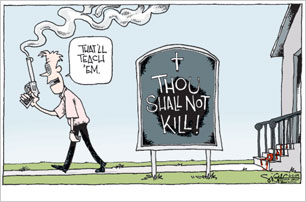
Guns and Religion--- Enough is Quite Enough
I was sitting at the traffic light when a pickup pulled up next to me.  On the back of the cab window was a bumper sticker saying 'Guns and religion. Now more than ever.'   Then I found the picture you see above, and then this one below......   My response to this nonsense above

posted 7:05:08pm Jan. 10, 2011 | read full post »

Revival 2011--- At My Home Church in Charlotte

posted 9:58:02am Jan. 10, 2011 | read full post »

The John Wesley Fellows Meeting at Candler---- The Art of Theology
The John Wesley Fellows meeting this January was held in Atlanta at Candler School of Theology, and its Dean,  Dean Love is a collector of art for the seminary, with some 50 or so paintings now gracing the walls of their beautiful new seminary building.  The art of choice comes from a West

posted 5:30:50am Jan. 10, 2011 | read full post »

Advertisement
Comments read comments(6)
post a comment
George

posted June 3, 2009 at 8:36 am


Great Q&A. I really hope there can be some sort of breakthrough in understanding, as, IMO, Wright is bringing out some vital things in this book.


report abuse
 

steven hamilton

posted June 4, 2009 at 11:36 am


“Systematicians have long given up on serious exegesis having (in some cases) waited for ages to see it produce ‘useable’ results, only to wait in vain. Hence the scattered approach. I look forward to a day when utterly serious historical exegesis of whole texts, not just prooftexts, will be seen by systematicians as the real blessing it is. Bauckham’s work is of course a model here.”
i will definitely have to pick bishop wright’s book up. i suppose this is why i tend to like the exegete and be suspicious of systematicians. i also think some of your work, ben, is a model of a more even-handed approach of bringing together serious historical exegesis of whole texts, and traditions, like in Jesus the Sage and Jesus the Seer…great stuff. i am actually re-working my way through Jesus the Sage preparing to write a paper for the first Society of Vineyard Scholars conference.
peace


report abuse
 

Geoff

posted June 4, 2009 at 12:36 pm


It would seem that Wright’s exegesis of Romans and Galatians is much more fully orbed and concerned with the stated concerns of those documents than many other interpreters of Paul. Not that as a systematic and pastoral theological(the only real kind of theology) point of view imputation isn’t a helpful concept for applying Paul’s theology to the individual believer or the entire believing community, it just does not seem to be the content of Paul’s own texts.
Anyhow, I find this interview helpful. Especially because when I was reading Wright’s book I kept if he had read much of Piper’s work…seeing as how he continually implied that Piper was not concerned enough with God’s centrality. Now I realize that this was simply a clever rhetorical device.


report abuse
 

Devin

posted June 5, 2009 at 10:10 am


“And scripture itself suggests that the whole western tradition, from mediaeval catholicism onwards, has dangerously skewed the focus of discussion to ‘me and my getting to heaven’ rather than to ‘God and God’s kingdom coming on earth as in heaven’. The irony is that Piper’s concern for the glory of God reflects exactly this biblical emphasis but he doesn’t allow it to do what it should, but instead distorts it into a particular sub-variant of the reformation tradition of imputed righteousness…”
I’m reading Piper’s book right now (close to the end) in preparation to read Wright’s on this subject (which I am truly excited to read, I find Wright’s commentaries to be incredibly interesting and helpful). I know an interview doesn’t allow for fully thought out arguments but it is frustrating that Wright has relied on straw man rather than actually engaging the arguments themselves.
Piper’s arguments on justification center on God and God’s dogged faithfulness to his own glory (the way Piper defines God’s righteousness)as the ground for imputated rightousness. I see very little of “me and my getting into heaven” in Piper’s argument, instead I see “God, God’s glory, and the obedience of Christ”, the latter being the king of the kingdom. But it is politically expedient in the course of an interview to deploy rhetoric like this to make one’s point.
…so is “As I’ve often said, the trick to aim for is to recover the first-century questions and try to give twenty-first century answers, rather than taking sixteenth-century questions and giving nineteenth-century answers…”. Piper pretty well grounds his interpretations in the scholarly work around those first-century questions, and I think that the 2 Corinthians 5:21 has relevance outside the 19th century.
But perhaps Wright would say I’m proof-texting – it’s an easy claim to make, I hope he is making it responsibly.


report abuse
 

Your Name

posted June 8, 2009 at 9:40 am


JUSTICE AND JUSTIFICATION ARE RELEVANT TO EACH OTHER,BUT FOR ANYONE
SEEKING JUSTICE THROUGH COURT PROCEEDINGS COST A LOT OF MONEY,TIME
ENERGY,ETC.WHEN WE UNDESSERVELY WRONGED SOMEONE BECAUSE OF OUR SELFISH
MOTIVES AND IRRESPONSIBLE RESPONSE TO OUR OWN NEEDS,WE INFLICT HURT,PAIN AND BURDEN TO THE PERSON.WE NEED TO ASK FORGIVENESS TO GOD
FOR THIS ACTION AND ASK ALSO ENLIGHTENMENT THAT NO MATTER WHAT OUR SITUATIONS IN LIFE,WE ARE NOT TO FORGET THAT WE ARE NOT ALONE IN OUR
BATTLE,EVERYONE HAVE THEIR OWN SHARE OF BURDENS,WE CAN EXAMINE OURSELVES AND SEEK THE STRENGTH THAT COMES FROM WITHIN TO OVERCOME
OUR OWN BURDENS,MOST OF ALL,WE ARE TO KEEP IN MY MIND THAT A LIFE OF DOING RIGHT IS THE BEST LIFE THERE IS.BY LIVING INTO THIS PRINCIPLE,
WE DON’T NEED TO SEEK JUSTICE OR JUSTIFICATION BECAUSE OUR LIVES ARE
IN THE BALANCE SCALE OF JUSTICE.
THANK YOU.


report abuse
 

Jeff Young

posted June 28, 2009 at 7:09 am


So is NTW saying apostasy is self-deception and not a legitimate – had faith, lost it? Or is that just his analysis of Paul in 1 Cor. 9? And, while justification in Paul is his basic subject, ultimately, don’t we need a full canonical reading – including Hebrews 3-4? While one does not want to participate in an easy cross-reference that eliminates tensions that need to be respected, eventually that cross reference has to take place in a canonical reading.
I love and appreciate what NTW has done in so many areas and the benefit he has been to my faith. However, this answer is typical of a lack of clarity on this subject. One always wants to provide support for an answer but he really doesn’t seem to answer the question very clearly.
Indeed, as he has said, the writers of the NT weren’t necessarily responding to the same question we are (or asking them). But, I don’t think there is any doubt that some of these questions of losing salvation were, in fact, in the minds of the Hebrew writer. And, that he is warning his readers that though they have been saved – they can make decisions to “fall away” (Heb. 3-4, 6:4-6; 10:26-31). These were brothers in Christ in danger of that very thing.
What’s your take on NTW’s response here, Ben?


report abuse
 

Post a Comment

By submitting these comments, I agree to the beliefnet.com terms of service, rules of conduct and privacy policy (the "agreements"). I understand and agree that any content I post is licensed to beliefnet.com and may be used by beliefnet.com in accordance with the agreements.

Share this story


About Beliefnet

Our mission is to help people like you find, and walk, a spiritual path that will bring comfort, hope, clarity, strength, and happiness. More about Beliefnet.

Help

Media Kit

Subscribe

Legal

Copyright © Beliefnet, Inc. and/or its licensors. All rights reserved. Use of this site is subject to Terms of Service and to our Privacy Policy. Constructed by Beliefnet.

Advertisement

Report as Inappropriate

You are reporting this content because it violates the Terms of Service.

All reported content is logged for investigation.