Casting Stones

Casting Stones

Mark DeMoss: Candidates’ Faith Has Played Too Big a Role in White House Race

posted by dgilgoff | 1:39pm Monday December 31, 2007

demoss.jpg
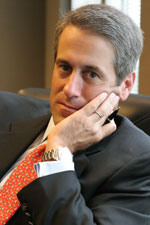
By Mark DeMoss, president of The DeMoss Group and a supporter of Mitt Romney for President
I have something in common with Jimmy Carter, Bill Clinton, Al Gore, and, Mike Huckabee—we all claim affiliation with the Southern Baptist Convention, meaning we would all profess to be “born again” Christians. Personal faith has moved front and center in this presidential primary season thanks in large part to the candidacies of Mike Huckabee, who has run as much as a Southern Baptist preacher and a “Christian leader” as a former governor, and Mitt Romney, a former governor with a now well-known Mormon heritage.
Nothing is more important to me than my personal relationship with Jesus Christ—not my family, not my career, and certainly not this upcoming election. I can say with Mike Huckabee that my faith “defines me.” In fact, I wrote a book this year telling others how they could know Jesus Christ, and I would be thrilled if every American president had a genuine, personal relationship with Christ. But I have at least four problems with expecting or requiring my personal faith in a candidate for public office—be it a Republican or a Democrat.
First, Article VI of the United States Constitution prohibits it: “No religious test shall ever be required as a qualification to any public office or public trust under the United States.” This spring, I was speaking to a group of pastors in a southern state and one of spoke up, saying he was “concerned about Mitt Romney’s faith tradition,” and was therefore waiting for Fred Thompson to enter the race. “Let me ask you a question,” I said. “What do you know about Senator Thompson’s faith tradition?” After a brief pause, he looked back at me and said, “Well, I know he’s a Protestant.” In the span of two short sentences this Baptist pastor seemed to rule out one candidate while selecting another on the basis of their faith alone. I submit that a more complete vetting process is in order when evaluating potential American presidents.
Second, we don’t apply this spirituality test to any other aspect of our lives. If I were to choose a candidate based primarily on a personal faith most like mine, I would have endorsed the former Arkansas governor long ago. But I don’t choose a doctor using this test, I didn’t choose my architect or homebuilder this way, and the Christian university where I sit on the trustee board didn’t hire our new athletic director solely because he was “one of our own” spiritually. Why then would we use this criterion alone, or even primarily, when choosing something as important as the president of the United States?
It was religious conservatives who catapulted another Southern Baptist, Jimmy Carter, from relative obscurity to the White House in 1976, primarily on the basis of his public pronouncements of his “born again” Christian faith. Ironically, most mainstream Southern Baptists don’t consider Mr. Cater to have been a good president and now don’t even claim him as a fellow-Southern Baptist. Indeed, while one’s faith determines his salvation, it should not determine his electability
Third, our political system and election process tempts both the exploitation and the selective use of a candidate’s personal faith. For example, Mike Huckabee ran a TV ad in Iowa and South Carolina that identified him as a “Christian leader” and showed him telling potential voters, “Faith doesn’t just influence me, it really defines me.” Curiously, however, this ad wasn’t running in New Hampshire, a critical early primary state which lacks the evangelical fervor of Iowa and South Carolina.
The Wall Street Journal reported that during a recent three-day campaign swing through the Granite State, where economic conservatives outnumber religious ones, Gov. Huckabee did not mention his faith, abortion, or marriage unless he was specifically asked. While this politically astute strategy may have been the work of a campaign consultant rather than the candidate himself, I believe the governor would agree that our faith should define us in all 50 states, or not at all.
Finally, candidates often develop a sense of religious entitlement which is both dangerous and unfair. For example, Mr. Huckabee expressed his frustration at some fellow Southern Baptists who had not endorsed him, telling the New York Times Magazine, “They make ‘electability’ their criterion. But I am a true soldier for the cause. If my own abandon me on the battlefield, it will have a chilling effect.”
Dismayed that Focus on the Family founder James Dobson has yet to publicly signal his choice for 2008, Huckabee had this to say: “I just don’t understand his neutrality. I’d be an obvious choice for his endorsement. We’re old friends. I love him, and I love his wife Shirley. I just don’t know how to explain it.” I can think of a few possible explanations: Dr. Dobson intends to support someone else, or no one, or perhaps to support the governor later—all of which he is entitled to do.
To the extent that faith has played too big a role in this election cycle, the blame can probably be shared among certain campaigns, the media, religious leaders, and an electorate often content to settle for one-dimensional descriptions of candidates.
Personally, I would like a president to be a man or woman of faith, whether or not it mirrors my own. But I also want them to have relevant executive experience, proven management experience, intellectual capital, crisis-tested decision-making skills, enough government experience to understand how government works—but not so much that they only know how to work for the government. In other words, as with every other personnel choice in life, I want competence.
I believe faith plus character plus experience plus competence is a recipe for the ideal presidential candidate. But faith alone should neither disqualify one from getting my vote, nor guarantee that they will. A candidate’s character cannot be overstated; his or her faith can be, and in this election probably has been. Specifically, Mitt Romney’s faith should not cost him votes, and Mike Huckabee’s faith should not assure him votes.
A few days ago, Mike Huckabee weighed in on this very issue, telling a television journalist, “I don’t think a person’s faith ought to be a plus or a minus. It ought to be their character.” Amen!
The DeMoss Group is an Atlanta-based public relations firm which works primarily with evangelical organizations and causes. DeMoss, a former chief of staff to Jerry Falwell, is author of The Little Red Book of Wisdom.


Previous Posts

Same-Sex Marriage: Are the People Sovereign, or is it to be the Courts?
On Nov. 4, 2008, the people of California, Florida and Arizona joined the ranks of the nearly 40 of the United States that have outlawed same-sex marriage either by amending their respective state constitutions or by passing appropriate legislation. The three states mentioned above amended their sta

posted 4:11:30pm Nov. 14, 2008 | read full post »

Traditional Marriage Wins Big
Social conservatives and defenders of traditional marriage won tremendous strategic victories in ballot initiatives on Nov. 4. First and foremost, the defenders of traditional marriage overturned the California Supreme Court's legalization last June of same-sex marriage. Despite being outspent nearl

posted 11:35:03am Nov. 07, 2008 | read full post »

America: Fulfilling her promises
All Americans should take great pride and satisfaction in the election of an African-American as president of the United States. Given our nation's tragic racial history, it says something noble and fine about America that Barack Obama, both a product of a biracial marriage and the son of a Kenyan f

posted 2:03:21pm Nov. 06, 2008 | read full post »

The Party Platforms: Instructive Guides to Informed Voting - Part 3
Every year (beginning in 1988) the Southern Baptist Ethics & Religious Liberty Commission has published a comparison of the two major party platforms to assist Southern Baptists and other people of faith as they seek guidance in the decision for whom to cast their ballots in the presidential ele

posted 1:44:04pm Oct. 31, 2008 | read full post »

McCain, Obama, and the Military
Which candidate for president enjoys the most support among the military, active and retired? The Military Times recently released the results of a poll of their readership (Active Duty military, Reserve-National Guard members, and "military retirees"). They found that among "Active Duty" military J

posted 4:15:25pm Oct. 29, 2008 | read full post »

Advertisement
Comments read comments(36)
post a comment
Mike

posted December 31, 2007 at 2:09 pm


Finally someone who makes knows what he is talking about!!


report abuse
 

Joey

posted December 31, 2007 at 5:09 pm


Mr. Gilgoff makes some good points, but his second point is flawed. Religion does not affect skill much, but it does affect decisions. To use his example of a doctor, a Christian doctor and an atheist doctor will do just as well in the operating room; however, the two would likely have different opinions on whether or not a patient should be removed from life support. If it were doctors who made that decision, it’s more likely that people _would_ take religion into consideration.
My opinion is that it does not matter so much what specific religion a person is, but how that religion is likely to impact their actions. In that respect religion is very important, but it takes more than a cursory look at the denomination to ascertain.
God bless.


report abuse
 

DLounsbury

posted January 1, 2008 at 4:34 am


In Mark 9:38 it tells us that Jesus’ disciples saw another person performing miracles in Jesus’ name and the disciples tried to stop him because he didn’t follow them and Jesus. Christ told them not to worry–that any who perform a good work in Christ’s name is with him. Christ’s inclusivity is contrasted starkly against Huckabee’s attempt’s to place Romney outside the tent of Jesus.
As a Mormon, I love my Saviour Jesus Christ with all my heart. I understand my theology about him is substantially different from traditional Christians but we truly have a shared desire to glorify the name of Jesus Christ. Please make the same allowance for others (including Mormons) to do good in Jesus’ name that Jesus said we should make(See Mark 9:39). We can all make the world a better place if we join in the battle for good. Romney has repeatedly tried to stay above the religion issue but had to address it. I agree that Romney has experience, competence and character. Please grant him in his personal life quarter, at a minimum, to be like the man in Mark 9:38 that the disciples thought had gone off the reservation but was actually on the right track.


report abuse
 

Icelander

posted January 1, 2008 at 11:37 am


“Personally, I would like a president to be a man or woman of faith, whether or not it mirrors my own.”
Why? Wouldn’t an atheist who shares your values, has experience, and has tried to live a good and kind life be just as good as a Christian or Muslim with those same attributes?
This is, simply put, bigotry against those for whom religious faith has no attraction.


report abuse
 

Priscilla

posted January 1, 2008 at 12:55 pm


Mr. De Moss seems to want it both ways. He wants to be seen as a person who does not judge presidential candidates by measuring their faith, yet he judges their faith when he writes “one’s faith determines his salvation.”
:


report abuse
 

Shelly

posted January 1, 2008 at 1:03 pm


I believe that if anyone is going to President of our country, he should have christian beliefs. I would never agree with having an atheist President, and since most of Americans are still believers in God, I doubt that would ever happen.


report abuse
 

SuzyW

posted January 1, 2008 at 2:07 pm


I would want a President who kept his religion out of the White House!!! He or she would show she or he was a good person by their actions and truthfulness of their words.


report abuse
 

brightmoon

posted January 1, 2008 at 2:32 pm


“But faith alone should neither disqualify one from getting my vote, nor guarantee that they will.”
ditto …our USA constitution actually forbids using a religious test of public office..it’s called separation of church and state
and that’s the way it should be ..it prevents abuses like what happened to chris comer in texas


report abuse
 

Steve Branks

posted January 1, 2008 at 4:06 pm


Any religion in the White House would be a parlous thing, considering how mutually exclusive most religions are.
What we need is a president more scientifically savvy and less smitten by superstition.
Oh, lordy, when is that ever going to happen!?


report abuse
 

Debrar

posted January 1, 2008 at 7:24 pm


I am a “Mormon” (a member of The Church of JESUS CHRIST of Latter-day Saints) and I would find is offensive to see Huckabee as the next President. He does not respect others faith/views, and he misleads and lies about them — while pretending that he does not. I also would not be surprized if he were behind the anti-Mormon/anti-Romney push poll calls, the false Christmas card mailings which were supposed to be from the Romney family and funded by the LDS church, as well as other things which do not pass the smell test. This recent Romney slam, while pretening not to slam is another example of his inner self. He is as a wolf in sheeps clothing, and I sure hope that Iowans/Evangelicals are not deceived by him. Just because he is a Preacher does not mean he is truthful. Wasn’t Judas Iscariot one of the trusted 12? Things aren’t always as they seem. Remove Huckabee’s abortion views and he is nothing but a liberal Democrat. I find it interesting that he is so closely affiliated with McCain, who is also very liberal. If Huckabee were to be the nominee, I would either not vote, or vote for the least offensive Democrat. It is truly a sad day.


report abuse
 

alley2

posted January 1, 2008 at 8:20 pm


First of all the separation of church and state means there will be no national religion, not that the president cannot have a religion. Our country was founded on religion. That is why the Pilgrims came to America to escape a “state religion.” Now in saying that I will say that I have not committed to any person at this time. God will lead me in the right direction.


report abuse
 

JediMormon

posted January 1, 2008 at 8:41 pm


The religious persuasion of the next president of the United States is of little concern to me. As with Mr. DeMoss, I am far more concerned with the competence of the next president than with his religious beliefs. Unlike Shelly who posted previously, I would indeed vote for an athiest if I knew him to be competent and thought that his moral beliefs lined up more closely with mine than did the rest of the candidates. There is a very good reason article VI is in the constitution. God can, and does, use others besides “Christians” to accomplish His will. Was the Good Samaritan a Christian? Jesus never did say, and the only “religious” person he pointed out in his parable was the priest who crossed to the other side of the road to aviod helping the person who lay there beaten and robbed. Think about it.


report abuse
 

Keith

posted January 1, 2008 at 9:59 pm


Being a member of the Church of Jesus Christ of Latter-day Saints, and having some knowledge of its doctrines and history, I am not suprised at all by the religious flap that Mitt Romney’s candidacy has generated. Afterall, we have been plagued by similar bigotry throughout our history. The very fact that the headquarters of the Church is not in New York, Ohio, Missouri, or Illinois is a witness of that bigotry and calumny. Members of the Church had to actually leave the United States (for a time) and settle in what is now the state of Utah and surrounding environs to escape the relentless persecution.
To paraphrase one of our articles of faith, members of the Church of Jesus Christ of Latter-day Saints believe in being subject to Presidents and in honoring an sustaining the law. Our leaders have also taught us to seek out and vote for honorable men and women who have experience and abilility to fulfill the trust of public office. It does not matter whether or not individual is a member of the Church. Look at Utah’s voting record over the past several years (as an example) and I personally believe that you will see evidence of this commitment.
It’s unfortunate that Mitt Romney is not viewed as a Christian Leader in his personal life. It’s my understanding that he as served (voluntarily) both as a Bishop and a Stake President, which are not trivial positions in the Church, but positions of trust and responsibility. This combined with his undying commitment to value-based personal and family life, his business acumen, and his public service in the Olympics and as Governor of the State of Massachusetts, qualify him as being both honorable and highly able.
May we please have the personal honesty and integrity to evaluate the candidates on these criteria!


report abuse
 

Steve Branks

posted January 1, 2008 at 10:12 pm


Any political candidate who appeals or invokes the supernatural certainly won’t get my vote.


report abuse
 

Paul

posted January 1, 2008 at 10:53 pm


I was initially impressed with Huckabee. He seems like such a down-to-earth man, with the bonus of a sense of humor. After studying his years as governor, however, my opinion has changed. The governor’s views, with the exception of abortion, are liberal. Higher taxes, tuition for illegal immigrants, and going easy on criminals. What bothers me even more, though, is his habit of pretending to be so righteous, even while he plays dirty. Finally, I’m offended that he ordered the destruction of government property (hard drives), his theft of $70,000 of government furniture, and his hunger for power, quoting scripture as he goes. Now I feel like with Huckabee we would see an endless stream of scandals. What happened to the nice preacher I first thought I knew?


report abuse
 

tracey parry

posted January 1, 2008 at 11:00 pm


I am LDS and I am so grateful to all the evangelicals that show great wisdom in their effort to help Mitt Romney become our next President. You are making a difference. I hope Mitt Romney does well in Iowa. Thanks for supporting Mitt Romney.


report abuse
 

Kim Mance

posted January 2, 2008 at 12:41 am


Unfortunately, with 92% of Americans saying they believe in God, none of the candidates seem to have bothered asking which one. To think someone can’t get elected because they’re an atheist, jewish or mormon is ludicrous.
Jesus was Jewish. I wonder if the conservatives would vote for him, or if they’d leave their palm branches at home.
_________________
http://www.religiarchy.com


report abuse
 

Cathy

posted January 2, 2008 at 9:13 am

dan adams

posted January 2, 2008 at 9:29 am


its a shame most Americans are unaware that this nation was created by Christians who envisioned this nation to be governed by men who were christians.One of the first supreme court judges named john jay stated it best ,we should elect Christians to govern this nation.For the first 170 years the christian bible was taught in our schools,politicians took an oath to uphold the beliefs in Almighty God and Jesus christ,what has changed? Our courts upheld Christianity,our government defended it,seems we have lost our way when we ask if one,s faith in God would influence his way of governing this nation…..


report abuse
 

Danny

posted January 2, 2008 at 9:52 am


I honestly do not see anyone who stands out as really christian of this group. I like Obama for his valuve, but his church is very pro black. In God’s kingdom race will not be a real issue, so should all churches speak for all race. But I am not a black man and the black churches did make large active row with in the black communities a cross America.


report abuse
 

recovering ex-Pentecostal

posted January 2, 2008 at 11:09 am


Yes there’s WAY WAY WAAAAAY too much religion in this campaign. There are not supposed to be ANY “religious tests” and here CNN/YouTube goes and asks candidates “Do you believe every word in the Bible.”
Sure doesn’t leave much room for Hindus, Sikhs, Buddhists, Jains, Muslims, atheists, Jews, agnostics,e tc to EVER campaign.
Just reading the words “but his church is very pro black” (or pro-gay, or pro-women, pro-war, or any other pro-) makes me very ill at ease.
A person’s church should not be a marker of their supposed competence as president.
It used to be called “a personal relationship” with one’s Creator. Now it has become so (madatorily) pubic that it’s embarassing. Watching CNN now is like going to Sunday School.


report abuse
 

recovering ex-Pentecostal

posted January 2, 2008 at 11:11 am


Could someone PUHLEEEZE tell me what “In Mark 9:38 it tells us” has to do with an election??? ANYTHING???


report abuse
 

recovering ex-Pentecostal

posted January 2, 2008 at 11:14 am


“I believe that if anyone is going to President of our country, he should have christian beliefs.”
But WHY?
“I honestly do not see anyone who stands out as really christian of this group.”
It isn’t supposed to matter. GWB proclaimed his “christianity” loudly and ofetn and look at the mess he got the US into.


report abuse
 

Malcolm

posted January 2, 2008 at 12:56 pm


“its a shame most Americans are unaware that this nation was created by Christians who envisioned this nation to be governed by men who were christians.One of the first supreme court judges named john jay stated it best ,we should elect Christians to govern this nation.For the first 170 years the christian bible was taught in our schools,politicians took an oath to uphold the beliefs in Almighty God and Jesus christ,what has changed? Our courts upheld Christianity,our government defended it,seems we have lost our way when we ask if one,s faith in God would influence his way of governing this nation…..”
Actually the country was founded by Deists to exclude all religion from state. If you want a christian to rule you join the catholic church.


report abuse
 

Joel

posted January 2, 2008 at 1:36 pm


In his attempt to persuade voters to his Mormon candidate, Mark DeMoss’ has used words that, unfortunately, could be interpreted that the Constitution prohibits individuals from establishing their own faith test for office. Any voter, Christian or not, certainly may vote for a candidate based on any criterion, be it faith, state of origin, hair color or whatever. The Constitution establishes only that the law of the land impose no religious qualification for office. Voters may do so if they choose. If a Christian voter wants to support Governor Huckabee because he is a Christian, so be it; or, likewise, if one wants to support Governor Romney because he is not a Christian, that is the voter’s choice as well. Having said that, I agree with Mr. DeMoss that voting strictly based on a candidate’s faith is naïve. I currently support neither the Baptist former governor of Arkansas nor the Mormon former governor of Massachusetts in this presidential race, although, I would vote for either if he were the nominee, based on each stands on the issues at hand. For example, I’d prefer to have a conservative Mormon like Orrin Hatch for my senator any day, than a liberal Methodist like Hillary Clinton or a liberal Catholic such as Ted Kennedy.


report abuse
 

Alicia

posted January 2, 2008 at 2:06 pm


What did Jesus say, over and over again? “My kingdom is not of this world.” Those who try to inject their religion into politics in the way that Huckabee has in this election are interested in power in the earthly kingdom, not in the “Kingdom of Heaven.”


report abuse
 

Annie Turner

posted January 3, 2008 at 5:46 am


Religion & Politics what a mixture. Some people say they don’t but in my opinion they do because one has to believe in a higher power to understand that the Country needs Faith & Hope & definily Pray to run it.


report abuse
 

doug

posted January 3, 2008 at 7:02 am


Thanks Me. DeMoss for your comments, many of which I agree, however I do recall that when the Lord went searching for the king of Israel He found David a man after His own heart, and when the people made their search for king they selected Saul. Most know the difference between the two. Also throughout the scripture we can’t help but notice when the nation of Israel, be it Judah or Israel was lead by a Godless leader that the nation was also Godless and suffered as the result. And when led by one that feared God and upheld the law of God they were a God fearing nation and were blessed. Futhermore, I realize that there were “sucessful” nations under godless leaders such as Babylon and even Rome, but all these evenually fell and yet Isreal still stands. I still believe that the US is a God fearing and Christian nation, and if we expect our leaders in the Church to be Christian, not just people of “faith” (this could describe many faiths), then I also expect our leaders to be Christian, and God fearing searching for the will of God and the heart of God in this nation’s future.
Finally at the end it will be Jesus Christ to establish His final Kingdom, what will all those who belive that faith is not important think then? Will they “vote” for Him?
As for me I have not decided who I am voting for yet, but you can believe the Christian has a leg up, if he seems to be sincere.


report abuse
 

Mark

posted January 3, 2008 at 9:04 am


From what I have seen the candidates espouse, it seems to me that any of the democrats have ideals closer to what Jesus espoused than any of the republicans. If you disagree, then look at who wants to protect the children with universal health care, who wants to protect the environment, and who wants to end the war!


report abuse
 

Anonymous

posted January 3, 2008 at 2:51 pm


The single worry I have regarding the religion of presidential candidates is that they will make faith based decisions that exclude many residents of the United States. It is not so much that I am voting against a Mormon or Baptist, but that I am voting for gay civil unions and reproductive rights.


report abuse
 

Steve Strang

posted January 3, 2008 at 3:08 pm


I have known and respected Mark DeMoss for many years. When I was asked to write the other essay I was told he was writing something but I had not read it until now. He did a fine job. And I can agree with most of his points.
But I did not write my piece for Mike Huckabee. I wrote about how my faith influences my vote. Because of that, I can’t help but back Mike Huckabee.
As far as the argument that we don’t check on the faith of a doctor or architect, so why the president? I don’t think you can compare the importance on the direction of our nation on such a superficial comparison. I don’t check the faith of the waitress who serves me at a cafe, or the flight attendant on a plane. But when it came to choosing a wife, it was the number one priority to have a godly Christian woman as my lifelong helpmeet.
We’ve seen that whoever is president sets the direction for our nation and makes important decisions such as who is appointed to fill a vacancy on the Supreme Court. I believe Mike Huckabee is the type of man who would make the right decisions. I could go on but I merely wanted to respond to Mark’s well-written essay.
Steve Strang


report abuse
 

Marvin L. Stewart

posted January 3, 2008 at 4:55 pm


To begin with politics is the intersection of faith and reason. The question that is presented whose faith will be applied to the reasoning? Secularist; Atheist; Buddhism; Mohammedanism etc, whose?
Article 3 of the Northwest Ordinance was quite clear to the founders of this nation and unto (Chief Justice Rehnquist in Wallace v. Jaffree).
Remember the saying, “The end doesn’t justify the means.”
In the Northwest Ordinance, the “end” is religion and morality, and the “means” are public schools. The Founding Fathers believed that the end required the means, that public schools served the purpose of advancing religion.
The Northwest Ordinance is one of the nation’s “organic laws,” along with the Constitution and the Declaration of Independence (see West’s edition of the U.S. Code, vol. 1, which lists them as among the “organic laws of the United States.”). Douglas says this Ordinance “antedated the First Amendment,” by which he hopes to make us think that it came long before some great revolution of thought embodied in the First Amendment. The Ordinance was approved by the House on July 21, 1789, and by the Senate on Aug 4, 1789. This was the same Congress that was simultaneously framing the religion clauses of the First Amendment. And for decades after the Bill of Rights was passed, this Ordinance was extended by Congress to new states admitted to the Union. For example,
When the Ohio territory applied for statehood in 1802, Congress framed an “enabling act” which required that Ohio form its state government in a manner “not repugnant to the [Northwest] Ordinance.” As a result, Ohio’s constitution declared:
[R]eligion, morality, and knowledge, being essentially necessary to the good government and the happiness of mankind, schools and the means of instruction shall forever be encouraged by legislative provision.
When Mississippi applied for statehood in 1817, Congress required that its government be formed in a manner “not repugnant to the principles of the Ordinance.” Hence, Mississippi’s constitution declared:
Religion, morality, and knowledge, being necessary to good government, the preservation of liberty and the happiness of mankind, schools and the means of education shall forever be encouraged in this State.
The Constitutions of Missouri, Arkansas, Kansas (1858), Nebraska (1875), and many other territorial papers and state constitutions make clear that government had a duty to promote Christianity. The Northwest Ordinance was signed by President Washington on Aug 7, 1789. “History must judge whether it was the Father of his Country in 1789, or a majority of the Court today, which has strayed from the meaning of the [First Amendment].”
(Justice Rehnquist in Wallace v. Jaffree.)
God-Given Human Rights
Human rights find their basis in the Bible. The Scripture’s recurring theme is that man is created in the image of God (Gen. 1:26-27; 9:6). God’s image entails human dignity. Certain human rights come with that dignity.
God also confers certain positive rights through the negative commands of Scripture. The commandment, “Thou shalt not kill” (Ex 20:13), confers a right to life. The command not to kidnap or enslave confers a right to liberty (Ex 21:16; Deut. 24:7). The command, “Thou shalt not steal” (Ex 20:15) confers a right to property. The three rights of life, liberty, and property by John Locke come from the Bible.
John Locke summarized the God-given rights as “life, liberty, and property.” This phrase is found in the Fifth and Fourteenth Amendments to the Constitution; in the Declaration of Independence Jefferson expanded “property” to pursuit of happiness.” With certain unalienable rights, that among these are Life, Liberty, and the pursuit of Happiness. “Pursuit of Happiness did not mean the seeking of hedonistic pleasure.
According to the Declaration, rights are “endowed by their Creator.” There is no real basis for believing in human right, unless one also believes in a Creator God. Jefferson’s words, engraved on the Jefferson Memorial in Washington, D.C., say it well, “God who gave us life, gave us liberty at the same time. Can the liberties of a nation be secure when we have removed their only sure basis, a conviction in the minds of the people that those liberties are the gift of God?”
Governments Secure Rights
The Declaration continues: “That to secure these rights, Governments are instituted among Men.” The Preamble of the Constitution declares that one of its purposes is to “secure the Blessings of Liberty to ourselves and our Posterity.”
The founding fathers recognized that governments do not grant rights, nor do they have legitimate authority to take rights away. Rights are God-given, and for that reason they are “unalienable.” Governments merely “secure,” or make it possible for men to enjoy, the rights that God has given.


report abuse
 

J. C. Ganus

posted January 3, 2008 at 5:36 pm


I am in total agreement with Marvin L. Stewart.
But unfortunately, many of our rights have been and are being
taken away from us, one by one.
What can we, as citizens, under the constitution and the first
amendment, do to reverse this trend?


report abuse
 

Linda Dew

posted January 3, 2008 at 9:08 pm


Yes,Many people call themselves Christians!Yet if we actually were to read the last book of the Bible we would discover that in the church message to the Philadelphia Church tells us that there was and will be those that call themselves Christians but are liars! The God of our founding forefathers says that he knows all about their lies and goes on to promise those, he calls (considers)Christians, to make those who say they are Christians, to bow down and admit to who are the true Christians !! After all, in the book of James it says not to boast on ourselves. Keep the Faith!!!Become The Winner!!! BE SLOW TO SPEAK &(QUICK TO LISTEN)……TO THE WORD OF GOD!!! Trust No Man,Pray for Power from on High!!!


report abuse
 

dan adams

posted January 4, 2008 at 9:41 am


as i said many people do mot know their own countrys spiritual heritage.They are taught from revisionists teachers our founders were deists.Sorry but true history proves them wrong everytime…


report abuse
 

recovering ex-Pentecostal

posted January 4, 2008 at 11:26 am


“many of our rights have been and are being
taken away from us, one by one.”
Blame Mr. Bush – he’s the one takin’ ‘em away.
“What can we, as citizens, under the constitution and the first
amendment, do to reverse this trend?”
Stop electing theocrats, especially since there isn’t supposed to be any religious test to hold public office in America.


report abuse
 

Post a Comment

By submitting these comments, I agree to the beliefnet.com terms of service, rules of conduct and privacy policy (the "agreements"). I understand and agree that any content I post is licensed to beliefnet.com and may be used by beliefnet.com in accordance with the agreements.

Share this story


About Beliefnet

Our mission is to help people like you find, and walk, a spiritual path that will bring comfort, hope, clarity, strength, and happiness. More about Beliefnet.

Help

Media Kit

Subscribe

Legal

Copyright © Beliefnet, Inc. and/or its licensors. All rights reserved. Use of this site is subject to Terms of Service and to our Privacy Policy. Constructed by Beliefnet.

Advertisement

Report as Inappropriate

You are reporting this content because it violates the Terms of Service.

All reported content is logged for investigation.