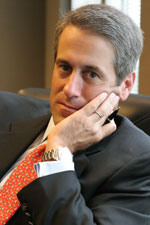
By Mark DeMoss, president of The DeMoss Group and a supporter of Mitt Romney for President
I have something in common with Jimmy Carter, Bill Clinton, Al Gore, and, Mike Huckabee—we all claim affiliation with the Southern Baptist Convention, meaning we would all profess to be “born again” Christians. Personal faith has moved front and center in this presidential primary season thanks in large part to the candidacies of Mike Huckabee, who has run as much as a Southern Baptist preacher and a “Christian leader” as a former governor, and Mitt Romney, a former governor with a now well-known Mormon heritage.
Nothing is more important to me than my personal relationship with Jesus Christ—not my family, not my career, and certainly not this upcoming election. I can say with Mike Huckabee that my faith “defines me.” In fact, I wrote a book this year telling others how they could know Jesus Christ, and I would be thrilled if every American president had a genuine, personal relationship with Christ. But I have at least four problems with expecting or requiring my personal faith in a candidate for public office—be it a Republican or a Democrat.
First, Article VI of the United States Constitution prohibits it: “No religious test shall ever be required as a qualification to any public office or public trust under the United States.” This spring, I was speaking to a group of pastors in a southern state and one of spoke up, saying he was “concerned about Mitt Romney’s faith tradition,” and was therefore waiting for Fred Thompson to enter the race. “Let me ask you a question,” I said. “What do you know about Senator Thompson’s faith tradition?” After a brief pause, he looked back at me and said, “Well, I know he’s a Protestant.” In the span of two short sentences this Baptist pastor seemed to rule out one candidate while selecting another on the basis of their faith alone. I submit that a more complete vetting process is in order when evaluating potential American presidents.
Second, we don’t apply this spirituality test to any other aspect of our lives. If I were to choose a candidate based primarily on a personal faith most like mine, I would have endorsed the former Arkansas governor long ago. But I don’t choose a doctor using this test, I didn’t choose my architect or homebuilder this way, and the Christian university where I sit on the trustee board didn’t hire our new athletic director solely because he was “one of our own” spiritually. Why then would we use this criterion alone, or even primarily, when choosing something as important as the president of the United States?
It was religious conservatives who catapulted another Southern Baptist, Jimmy Carter, from relative obscurity to the White House in 1976, primarily on the basis of his public pronouncements of his “born again” Christian faith. Ironically, most mainstream Southern Baptists don’t consider Mr. Cater to have been a good president and now don’t even claim him as a fellow-Southern Baptist. Indeed, while one’s faith determines his salvation, it should not determine his electability
Third, our political system and election process tempts both the exploitation and the selective use of a candidate’s personal faith. For example, Mike Huckabee ran a TV ad in Iowa and South Carolina that identified him as a “Christian leader” and showed him telling potential voters, “Faith doesn’t just influence me, it really defines me.” Curiously, however, this ad wasn’t running in New Hampshire, a critical early primary state which lacks the evangelical fervor of Iowa and South Carolina.
The Wall Street Journal reported that during a recent three-day campaign swing through the Granite State, where economic conservatives outnumber religious ones, Gov. Huckabee did not mention his faith, abortion, or marriage unless he was specifically asked. While this politically astute strategy may have been the work of a campaign consultant rather than the candidate himself, I believe the governor would agree that our faith should define us in all 50 states, or not at all.
Finally, candidates often develop a sense of religious entitlement which is both dangerous and unfair. For example, Mr. Huckabee expressed his frustration at some fellow Southern Baptists who had not endorsed him, telling the New York Times Magazine, “They make ‘electability’ their criterion. But I am a true soldier for the cause. If my own abandon me on the battlefield, it will have a chilling effect.”
Dismayed that Focus on the Family founder James Dobson has yet to publicly signal his choice for 2008, Huckabee had this to say: “I just don’t understand his neutrality. I’d be an obvious choice for his endorsement. We’re old friends. I love him, and I love his wife Shirley. I just don’t know how to explain it.” I can think of a few possible explanations: Dr. Dobson intends to support someone else, or no one, or perhaps to support the governor later—all of which he is entitled to do.
To the extent that faith has played too big a role in this election cycle, the blame can probably be shared among certain campaigns, the media, religious leaders, and an electorate often content to settle for one-dimensional descriptions of candidates.
Personally, I would like a president to be a man or woman of faith, whether or not it mirrors my own. But I also want them to have relevant executive experience, proven management experience, intellectual capital, crisis-tested decision-making skills, enough government experience to understand how government works—but not so much that they only know how to work for the government. In other words, as with every other personnel choice in life, I want competence.
I believe faith plus character plus experience plus competence is a recipe for the ideal presidential candidate. But faith alone should neither disqualify one from getting my vote, nor guarantee that they will. A candidate’s character cannot be overstated; his or her faith can be, and in this election probably has been. Specifically, Mitt Romney’s faith should not cost him votes, and Mike Huckabee’s faith should not assure him votes.
A few days ago, Mike Huckabee weighed in on this very issue, telling a television journalist, “I don’t think a person’s faith ought to be a plus or a minus. It ought to be their character.” Amen!
The DeMoss Group is an Atlanta-based public relations firm which works primarily with evangelical organizations and causes. DeMoss, a former chief of staff to Jerry Falwell, is author of The Little Red Book of Wisdom.

Add to Newsvine
Add to StumbleUpon
Diana Butler Bass is a religion scholar and author of Christianity for the Rest of Us: How the Neighborhood Church is Transforming the Faith. She blogs at
Tony Campolo is Professor Emeritus at Eastern University and author of The God of Intimacy and Action: Reconnecting Ancient Spiritual Practices, Evangelism, and Justice, with Mary Darling. He blogs at
Rod Dreher is a columnist for The Dallas Morning News and author of Crunchy Cons: The New Conservative Counterculture and Its Return to Roots. He blogs at
Bruce Feiler is the author of seven books, including Walking the Bible: A Journey by Land Through the Five Books of Moses. He blogs at
Dan Gilgoff is Politics Editor at Beliefnet and author of The Jesus Machine: How James Dobson, Focus on the Family, and Evangelical America are Winning the Culture War. He blogs at
David Kuo served as a special assistant to President George W. Bush and is the author of Tempting Faith: An Inside Story of Political Seduction. He blogs at
Dr. Richard Land is president of The Southern Baptist Convention's Ethics & Religious Liberty Commission and author of The Divided States of America? What Liberals AND Conservatives are missing in the God-and-country shouting match!
Michele McGinty is a mom and a student at Westminster Theological Seminary in Philadelphia. She blogs at
Brian McLaren is a pastor, musician, and author of Everything Must Change: Jesus, Global Crises, and a Revolution of Hope. He blogs at
Steven Waldman is co-founder, CEO, and Editor-in-Chief of Beliefnet. His book Founding Faith will be published in March, and he can be reached through
Jim Wallis is executive director of Sojourners/Call to Renewal and author of God’s Politics: Why the Right Gets It Wrong and the Left Doesn’t Get It. He blogs at
To begin with politics is the intersection of faith and reason. The question that is presented whose faith will be applied to the reasoning? Secularist; Atheist; Buddhism; Mohammedanism etc, whose?
Article 3 of the Northwest Ordinance was quite clear to the founders of this nation and unto (Chief Justice Rehnquist in Wallace v. Jaffree).
Remember the saying, "The end doesn't justify the means."
In the Northwest Ordinance, the "end" is religion and morality, and the "means" are public schools. The Founding Fathers believed that the end required the means, that public schools served the purpose of advancing religion.
The Northwest Ordinance is one of the nation's "organic laws," along with the Constitution and the Declaration of Independence (see West's edition of the U.S. Code, vol. 1, which lists them as among the "organic laws of the United States."). Douglas says this Ordinance "antedated the First Amendment," by which he hopes to make us think that it came long before some great revolution of thought embodied in the First Amendment. The Ordinance was approved by the House on July 21, 1789, and by the Senate on Aug 4, 1789. This was the same Congress that was simultaneously framing the religion clauses of the First Amendment. And for decades after the Bill of Rights was passed, this Ordinance was extended by Congress to new states admitted to the Union. For example,
When the Ohio territory applied for statehood in 1802, Congress framed an "enabling act" which required that Ohio form its state government in a manner "not repugnant to the [Northwest] Ordinance." As a result, Ohio's constitution declared:
[R]eligion, morality, and knowledge, being essentially necessary to the good government and the happiness of mankind, schools and the means of instruction shall forever be encouraged by legislative provision.
When Mississippi applied for statehood in 1817, Congress required that its government be formed in a manner "not repugnant to the principles of the Ordinance." Hence, Mississippi's constitution declared:
Religion, morality, and knowledge, being necessary to good government, the preservation of liberty and the happiness of mankind, schools and the means of education shall forever be encouraged in this State.
The Constitutions of Missouri, Arkansas, Kansas (1858), Nebraska (1875), and many other territorial papers and state constitutions make clear that government had a duty to promote Christianity. The Northwest Ordinance was signed by President Washington on Aug 7, 1789. "History must judge whether it was the Father of his Country in 1789, or a majority of the Court today, which has strayed from the meaning of the [First Amendment]."
(Justice Rehnquist in Wallace v. Jaffree.)
God-Given Human Rights
Human rights find their basis in the Bible. The Scripture’s recurring theme is that man is created in the image of God (Gen. 1:26-27; 9:6). God’s image entails human dignity. Certain human rights come with that dignity.
God also confers certain positive rights through the negative commands of Scripture. The commandment, “Thou shalt not kill” (Ex 20:13), confers a right to life. The command not to kidnap or enslave confers a right to liberty (Ex 21:16; Deut. 24:7). The command, “Thou shalt not steal” (Ex 20:15) confers a right to property. The three rights of life, liberty, and property by John Locke come from the Bible.
John Locke summarized the God-given rights as “life, liberty, and property.” This phrase is found in the Fifth and Fourteenth Amendments to the Constitution; in the Declaration of Independence Jefferson expanded “property” to pursuit of happiness.” With certain unalienable rights, that among these are Life, Liberty, and the pursuit of Happiness. “Pursuit of Happiness did not mean the seeking of hedonistic pleasure.
According to the Declaration, rights are “endowed by their Creator.” There is no real basis for believing in human right, unless one also believes in a Creator God. Jefferson’s words, engraved on the Jefferson Memorial in Washington, D.C., say it well, “God who gave us life, gave us liberty at the same time. Can the liberties of a nation be secure when we have removed their only sure basis, a conviction in the minds of the people that those liberties are the gift of God?”
Governments Secure Rights
The Declaration continues: “That to secure these rights, Governments are instituted among Men.” The Preamble of the Constitution declares that one of its purposes is to “secure the Blessings of Liberty to ourselves and our Posterity.”
The founding fathers recognized that governments do not grant rights, nor do they have legitimate authority to take rights away. Rights are God-given, and for that reason they are “unalienable.” Governments merely “secure,” or make it possible for men to enjoy, the rights that God has given.
I am in total agreement with Marvin L. Stewart.
But unfortunately, many of our rights have been and are being
taken away from us, one by one.
What can we, as citizens, under the constitution and the first
amendment, do to reverse this trend?
Yes,Many people call themselves Christians!Yet if we actually were to read the last book of the Bible we would discover that in the church message to the Philadelphia Church tells us that there was and will be those that call themselves Christians but are liars! The God of our founding forefathers says that he knows all about their lies and goes on to promise those, he calls (considers)Christians, to make those who say they are Christians, to bow down and admit to who are the true Christians !! After all, in the book of James it says not to boast on ourselves. Keep the Faith!!!Become The Winner!!! BE SLOW TO SPEAK &(QUICK TO LISTEN)......TO THE WORD OF GOD!!! Trust No Man,Pray for Power from on High!!!
as i said many people do mot know their own countrys spiritual heritage.They are taught from revisionists teachers our founders were deists.Sorry but true history proves them wrong everytime...
"many of our rights have been and are being
taken away from us, one by one."
Blame Mr. Bush - he's the one takin' 'em away.
"What can we, as citizens, under the constitution and the first
amendment, do to reverse this trend?"
Stop electing theocrats, especially since there isn't supposed to be any religious test to hold public office in America.
Post a Comment
By submitting these comments, I agree to the beliefnet.com terms of service, rules of conduct and privacy policy (the "agreements"). I understand and agree that any content I post is licensed to beliefnet.com and may be used by beliefnet.com in accordance with the agreements.