Catholic by Choice

Catholic by Choice

I am Glad to Be Back at Beliefnet: It is Time to Begin Again

I have not written a column for Beliefnet in a long time. I have been writing a lot – just in other venues. As is the case with all of us, my life just seems to get busier and busier. However, I have not been able to get Beliefnet – and its potential for good – out of my mind or my heart. So, I begin again, I start anew with this column.At every new beginning I am reminded of one of my favorite passages from the Bible.

“The one who sat on the throne said, “Behold, I make all things new.” (Jesus to St John, recorded in the Bible, in the Book of Revelation 21:5).

Those five words from the Book of Revelation or the “Apocalypse” hold out the promise of the Gospel of Jesus Christ to all men and women in every Nation under the sun. They were spoken to the beloved disciple John on the Island of Patmos when he received a vision of the new heaven and new earth where the completion of the Redemption of Jesus Christ will be fully manifested.

Those words “Behold I make all things new” took on new meaning for me several years ago when I watched a powerful scene in the Mel Gibson masterpiece, “The Passion of the Christ.” In it Mary, the Mother of the Lord, runs to her wounded Son. He has fallen for the third time from the weight of the Cross. There is a flash back to an earlier day when that same son, as a child, is seen playing in the dusty streets of Nazareth and is about to fall.

With the tender love of a mother, Mary reaches out to her Son. Then the viewer sees her hand touch the wounded face of the Adult Son and Savior who looks at her, and through words addressed to her – He speaks to every human person – from the beginning of time until the end – saying: “Behold, I make all things new.” That is the hunger in the heart of every person.

Every New Year’s eve, many of us resolve to “be better” in the coming year. Very quickly thereafter we are confronted with the reality of our human condition and our fractured freedom. We know that our resolutions to change often end in failure. We are prone to making wrong choices in daily life. We sin. Classical theology speaks of this inclination as “concupiscence”.

The Apostle Paul wrote about this experience to the early Christians in Rome in the seventh chapter of his letter: “For I do not do the good I want, but I do the evil I do not want. Now if (I) do what I do not want, it is no longer I who do it, but sin that dwells in me… Miserable one that I am! Who will deliver me from this mortal body Thanks be to God through Jesus Christ our Lord.”

Our freedom is a reflection of the Image of God within us. However, it was fractured by the effects of the first sin. Our ability to exercise it properly by choosing the good has been undermined as a result. In the words of Blessed John Paul II taken from his marvelous letter entitled “The Splendor of Truth”, our “freedom itself needs to be set free.” Through the Incarnation, Saving Life, Death and Resurrection of Jesus Christ it can be. By grace we are capacitated to live our lives differently now. Jesus can make all things new! Life is about beginning again, and again, and again. 

Every New Year we read numerous articles about the efficacy of New Year’s Resolutions. However, the fact remains, we all make them. The experience is nearly universal. The question is why? I suggest that they reveal something of our universal longing.

So too do our calendars. Some Nations use different calendars, but the passing of one year to another is marked by a deliberate period of reflection over the past year and a pledge to begin anew, to change, in the year to come. This is because we all hunger to be made new!

GK Chesterton wrote: “The object of a New Year is not that we should have a new year. It is that we should have a new soul and a new nose; new feet, a new backbone, new ears, and new eyes. Unless a particular man made New Year resolutions, he would make no resolutions.”

“Unless a man starts afresh about things, he will certainly do nothing effective. Unless a man starts on the strange assumption that he has never existed before, it is quite certain that he will never exist afterwards. Unless a man be born again, he shall by no means enter into the Kingdom of Heaven.”

We all want to change, to be better, to live our lives more fully and learn to love one another more selflessly. As we end one year and look to a new one, we pause and take inventory. In a rare moment of near universal reflection and honest self assessment, we admit our failures.

We pledge to learn from them and move toward a better future. In Little Gidding written by T.S. Eliott we find these often quoted words: “For last year’s words belong to last year’s language and next year’s words await another voice. What we call the beginning is often the end. And to make an end is to make a beginning.”

Over the years I have realized that every end really can become a beginning, for the man or woman who has faith in the God who invites us to begin again, again and again. He alone makes it possible by sharing His very Life with us. This gift is called grace and through receiving it we become what the Apostle Peter called “Partakers of the Divine Nature”.(2 Peter 1:4)

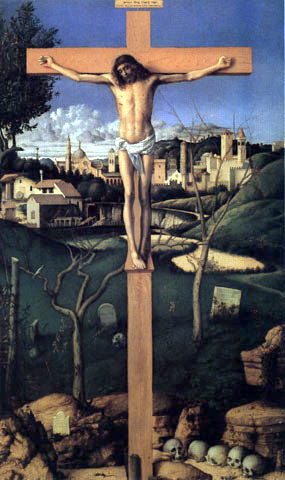
The older I get the more grateful I am that the promise to begin again is always available. The choice to receive the grace to begin again is also waiting, at the foot of the cross, for those who ask. In fact, we are always beginning again in life.One of my heroes of the faith is St. Jose Maria Escriva once wrote these words:

‘For a son of God each day should be an opportunity for renewal, knowing for sure that with the help of grace he will reach the end of the road, which is Love. That is why if you begin and begin again, you are doing well. If you have a will to win, if you struggle, then with God’s help you will conquer. There will be no difficulty you cannot overcome.’ (St. Jose Maria Escriva, The Forge, 344)

In and through Jesus Christ, there is a way to be made new. We can always begin again. That is at the heart of the Gospel, the Good News!  St. Paul reminded the Christians in the City of Corinth – and reminds every one of us “whoever is in Christ is a new creation: the old things have passed away; behold, new things have come.” (2 Cor. 5:17)

So, I am back at Beliefnet, beginning again. I look forward to sharing with my readers, once again, all the reasons I am, a Catholic by Choice.

Pope Enters a Monastery – to Teach us All How to Pray in the ‘Real World’

On Sunday, October 9, 2011, Pope Benedict XVI presided over Second Vespers with the Carthusian monks at Serra San Bruno. From the Chapel of that Carthusian monastery he shared beautiful  insights on silence and prayer which should be considered by all who bear the name Christian. His words brought me back to the days surrounding his election to the Chair of Peter.

Those who study the early days of Popes often watch for two things at the beginning of their service, the name they choose and the content of their first homily for clues to their pontificate. When Joseph Cardinal Ratzinger chose the name Benedict he sent a signal concerning the centrality of prayer. He has spent his pontificate teaching about that centrality.

One of the young priests offering commentary during those historic days noted that then Joseph Cardinal Ratzinger visited Subiaco before all the events in Rome began. He prayed and rededicated himself to the work of the Church for the future. Interestingly, a short while later he was called to occupy the chair of Peter. He took the name Benedict.

Saint Benedict is the father of Western Monasticism.  As a young man he fled a decadent and declining Rome to give his life entirely to God and went to Subiaco. The cave that became his dwelling is now a shrine called “Sacro Speco” (The Holy Cave). It is still a sanctuary for pilgrims. The Pope who took his name went to that same cave for prayer just before he was elected. He has not stopped showing us the way of prayer ever since. 

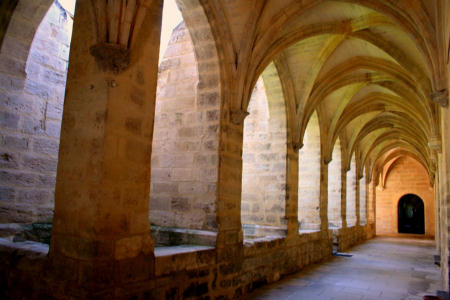
The Pope did not enter the monastery for the rest of his life. He entered the monastery to make a point. He told the monks: “Dear brothers you have found the hidden treasure, the pearl of great value (cf. Mt 13:44-46); you have responded radically to Jesus’ invitation: “If you would be perfect, go, sell what you possess and give to the poor, and you will have treasure in heaven; and come, follow me” (Mt 19:21). Every monastery — male or female — is an oasis in which the deep well, from which to draw “living water” to quench our deepest thirst, is constantly being dug with prayer and meditation. …

“Technical progress, markedly in the area of transport and communications, has made human life more comfortable but also more keyed up, at times even frantic. Cities are almost always noisy, silence is rarely to be found in them because there is always a lingering background noise, in some areas even at night… Some people are no longer capable of remaining for long periods in silence and solitude…”

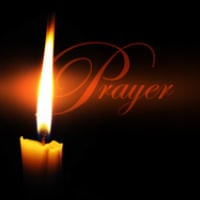
We are all called to prayer, no matter what our state in life or vocation. We are invited to build a virtual monastery in the midst of a world which has lost its soul. However, we need to grow in our understanding of what prayer is and grow in our understanding of who we are called to become in Christ. Prayer is an ongoing dialogue of intimate communion with God, through Christ and in the Holy Spirit. In an age of fast food, fast cars and fast internet, we seem to be running all the time. Yet, even with our digital calendars, we risk missing the most important meeting of all, our appointment with the Lord. We place our very selves at risk. 

That is not to say that these technological advances have to be an impediment to the encounter with the Lord called prayer. Rather, when we allow them to become our measuring stick for satisfaction in every area of our lives, we will look for quick prayer and quick “results”, from what we believe are “our” efforts. Prayer is not about results or even our efforts, but about love.

In fact, prayer is really not about us at all, but about the “One” who hungers to be known and loved, the “Other”, who calls us into the intimacy of communion with Himself, in and through His Son and lives His life within us – and through us – by His Spirit. The Lord whom we seek is outside of time, having given time as a gift to those whom he now prepares for eternity. He dwells in the eternal now and invites us through prayer along a path to the fullness of life.

Preparing ourselves for prayer means learning to silence the clamor of the age, stop the ever accelerating pace of the futile quests that so often occupy our hearts, and live in the eternal now by surrendering ourselves – and even our best aspirations- to the One who created us –and now re-creates us- in His Son Jesus Christ. It is there, in the emptied place, in the stillness of the eternal now, where we prepare a room for the King of all hearts. And, in that encounter, we soon find the longing of our heart fulfilled.

The Holy Spirit is calling for a generation of contemplatives in every state in life and vocation in Christ. We tend to believe that the contemplative life is reserved for those who, by special vocation, can “leave” the world, such as contemplative monks and nuns. They are a true treasure and a prophetic sign of the life to come. However, all who are baptized into Christ are called to the same encounter with a different response.

Isaac of Ninevah was an early eighth century monk, Bishop and theologian. For centuries he was mostly revered in the Eastern Christian Church for his writings on prayer. In the last century the beauty of his insights on prayer are being embraced once again by both lungs, East and West, of the Church. He wrote these words in one of his many treatises on Prayer:

“When the Spirit dwells in a person, from the moment in which that person has become prayer, he never leaves him. For the Spirit himself never ceases to pray in him. Whether the person is asleep or awake, prayer never from then on departs from his soul. Whether he is eating or drinking or sleeping or whatever else he is doing, even in deepest sleep, the fragrance of prayer rises without effort in his heart. Prayer never again deserts him.

“At every moment of his life, even when it appears to stop, it is secretly at work in him continuously, one of the Fathers, the bearers of Christ, says that prayer is the silence of the pure. For their thoughts are divine motions. The movements of the heart and the intellect that have been purified are the voices full of sweetness with which such people never cease to sing in secret to the hidden God.”

There is a growing fascination with books about prayer and the monastic life across the entire Christian community. There is also a resurgence of interest in the Rule of Benedict and the writings of the early fathers of the Church about prayer. It all reflects the deep hunger in our hearts for God. We were made for communion with Him. Pope Benedict XVI entered the monastery to show us athe way we can all find the intimacy of that communion in the midst of our daily lives and be changed in the encounter. That way is prayer.

A Catholic Activist Looks at the US Presidential Campaign of 2012 and the ‘Catholic Vote’

After Labor Day, the US Presidential campaign of 2012 will move into high gear. Clearly, this is one of the most important elections of my lifetime.  The economy is in a free fall and the sense of fear in the United States is palpable. A majority of people have lost confidence in our elected leaders. The moral decline in the Nation is obvious to anyone who has any moral compass left – after decades of such a decline. the connection between our economic and our moral decline is similarly obvious to anyone who understands the integrated human person and the social order.

As a Catholic Christian who has labored side by side for decades in building alliances with protestant evangelicals, other Christians, other people of faith and all people of good will on the issues and concerns which matter most, I know that this is the time the pundits begin to specualte about the “Catholic Vote” and which candidate will secure such a vote. I have written for many years as to whether such a “Catholic vote”, in the sense of a discernible “bloc” of voters, actually even exists. The fact is Catholics are very diverse in many political matters which call for prudential judgement. However, with the growing renewal in the faith of many Catholics and the consequential growing awareness of what their Church actually teaches, we may be reaching a point where such a ‘Catholic Vote” is becoming discernible.

Given their numbers, U.S. Catholics can determine the outcome of the 2012 Presidential election in the United States. That is if we act in a manner which, in the words of the Vatican’s Congregation for the Doctrine of the Faith, is “morally coherent.”  That phrase was used in an instruction released in 2002 entitled a “Doctrinal Note on some questions regarding the Participation of Catholics in Political Life”. It was directed to “the Bishops of the Catholic Church and, in a particular way, to Catholic politicians and all lay members of the faithful called to participate in the political life of democratic societies.”

The teaching in the instruction informs another important work of great importance to understanding the catholic way of viewing many policy and political issues entitled the “Compendium of the Social Doctrine of the Church”. In particular, the sections pertaining to the political participation of Catholics. (See, e.g. #565-574) Anyone who thinks the teachers of the Catholic Church are not clear on the duty to vote in a manner which is morally coherent has not read Catholic teaching. Here is an excerpt:

“The social doctrine of the Church is not an intrusion into the government of individual countries. It is a question of the lay Catholic’s duty to be morally coherent, found within one’s conscience, which is one and indivisible. ‘There cannot be two parallel lives in their existence: on the one hand, the so-called ‘spiritual life’, with its values and demands; and on the other, the so-called ‘secular’ life, that is, life in a family, at work, in social responsibilities, in the responsibilities of public life and in culture. The branch, engrafted to the vine which is Christ, bears its fruit in every sphere of existence and activity.

“In fact, every area of the lay faithful’s lives, as different as they are, enters into the plan of God, who desires that these very areas be the ‘places in time’ where the love of Christ is revealed and realized for both the glory of the Father and service of others.  Living and acting in conformity with one’s own conscience on questions of politics is not slavish acceptance of positions alien to politics or some kind of ‘confessionalism’, but rather the way in which Christians offer their concrete contribution so that, through political life, society will become more just and more consistent with the dignity of the human person.”

That is NOT to say that the Catholic Church ever endorses a specific candidate. However, the Church does call all of her members to inform their conscience and then exercise their citizenship. I write this article as a private citizen. I cannot and will not remain silent as the Nation I love continues down the wrong path. I believe that the American founders got it right in that Declaration and there are Truths which can be held and rights which are inalienable.

Our insistence as Catholic citizens upon recognition in the positive law of the fundamental Human Right to Life is not about one political issue; it is about the very foundation of freedom itself. Human rights – such as the Natural Law Right to Life – and human freedoms such as the freedom to be born – are goods of human persons. When there is no human person to exercise them all the rhetoric extolling them is nothing but empty air and sloganeering.

Nor is our Pro-Life position simply a matter of our adherence to our “religious” beliefs. It is a response to the truth revealed by the Natural Law and confirmed by medical science. The Child in the womb is our neighbor. It is always and everywhere wrong to take innocent human life. The child in the womb is innocent human life. It is thus wrong to intentionally kill him or her through procured abortion.

Our faith gives us further insights into that truth and calls us to a greater obligation to insist upon the role of the Natural Law in the formation of the positive law. It also calls us to active participation on the political process.  Rights are not ethereal concepts floating around in the cosmos somewhere. Rights are endowed by a Creator not conferred by the State. They are goods of the human person. Our opposition to the judicial manufacture of a “right” to take innocent human life in the womb must never take a back seat to any other concern in the public policy arena. Freedom must be exercised with reference to what is true and good in any just and moral society.

Abortion, in the words of Blessed John Paul II, is only the “cutting edge of the culture of death.” Any time human persons are treated as “products” to be used, aborted, discarded, manipulated, enslaved, traded, made a means rather than an end.. there we find the “culture of death.” We must expose, oppose and replace it. Catholics will be judged the most severely if we fail to act. The Biblical adage should echo in our ears, “To those, to whom much is given, much more will be required!” Catholics, I mean really faithful catholics, are Pro-Life-Period.

In addition, faithful catholics defend true and authentic marriage and the family and society founded upon it. Marriage, a lifelong union between one man and one woman open to the bearing and raising of children, is accepted across cultures.The effort to give an enforced legal equivalency to non-marital relations and force all of us to call what can never be a marriage to be a marriage, such as homosexual partnerships, is unjust. It can never serve the true common good.

The defense of marriage is also a defense of the blueprint for a just, healthy and happy society where children’s rights are also respected. Marriage – and the family founded upon it- is the first government, first hospital, first economy, first school, first mediating institution and the foundation of our life together as a truly free people. Our insistence upon defending the institution of marriage is also not only because of our religious faith.  Yes, for those of us who have faith, our faith informs our position. However, the truth about marriage is also confirmed in the Natural Law which is written on every human heart and knowable through the exercise of reason.

We are living under what Pope Benedict XVI called a “Dictatorship of Relativism” in the West. The culture stumbles, drunken on the false notion of freedom as giving some people a “right” to kill the innocent, divorced from norms to guide the exercise of human choice and govern our behavior. When there is a wholesale effort to deny the existence of anything objectively true which can be known by all and form the basis of our common life, then there is no real freedom. Instead, we teeter on the brink of anarchy.

September 12, 2011 will mark the fifty-first anniversary of John F Kennedy’s address to the Houston Ministerial alliance. In that speech he opened the door to moral incoherence by “privatizing” the truths informed by faith and failing to acknowledge the existence of a Natural Law which can be known by all men and women through the exercise of reason. In the wake of his catastrophic mistake too many Catholics in public life, like Esau of the Old Testament, have sold their birthrights for a bowl of porridge and helped to construct the current culture of death. Morally coherent Catholics are the ones who must now expose their errors and replace them in office.

We were never comfortable in what was once called the “religious right”, although we are less comfortable in what masquerades as “liberal” or “progressive” these days. However, though those who understand the principle of subsidiarity certainly respect the American founders’ vision of a limited government, most of us get very concerned when candidates start misreading the 10th Amendment to the US Constitution and talk “States Rights”. We do not want to see States which “allow” the killing of children in the womb as some sort of “right”. The Right to life is a non-negotiable.

Similarly we get very concerned when candidates seem to endorse an approach to marriage which would allow for a patchwork approach, allowing States to decide how to define it. Marriage and the family are not some social construct which can be changed by cultural revolutionaries. The family is the first church, the first school, the first economy, the first hospital, the first government and the first mediating institution.

Catholics are not one more “interest group” which can be polled, pandered to and bought. Our social obligation is to promote the true common good, not just use the slogan to sound “catholic” as happened in the last political cycle. Our political participation will be committed to human life and dignity, marriage and the family, authentic human freedom, and solidarity directed by the application of the principle of subsidiarity, which presents a bottom up approach to governance, beginning with the family and moving out from there to mediating associations and then higher forms of governance.

Catholics are emerging as a very important segment of the voting public in the 2012 US Presidential election.

The Christian Vocation and Living in the ‘Fourth Watch of the Night’

As a Deacon in the Catholic Church, I have the joy of proclaiming the Gospel during Holy Mass. The Gospel account two Sundays ago is one of my favorites. It is also one which is familiar – almost too familiar – to most of us. I say “too familiar” because we can tend to simply stop listening when it is proclaimed because we have heard it so often!

We make the mistake of thinking it is only about Peter and the disciples – something distant which happened over two millenia ago. The fact is this story is meant for you and for me – for the here and now! We live much of our daily life in the “fourth watch of the night”, at the time just before daybreak.

Our daily lives seem to be lived in the midst of tumultuous waves of struggle. We are often filled with fear and crippled as a result and unable to see the Lord right there, on the horizon of hope. This story shows us the way to overcome fear through faith. It invites us to live differently, to walk on the waters of daily life by dynamic, living faith:
 
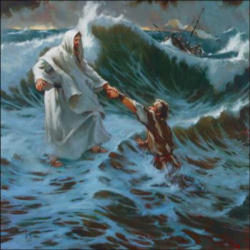
“After he had fed the people, Jesus made the disciples get into a boat and precede him to the other side, while he dismissed the crowds. After doing so, he went up on the mountain by himself to pray. When it was evening he was there alone. Meanwhile the boat, already a few miles offshore, was being tossed about by the waves, for the wind was against it. During the fourth watch of the night, he came toward them walking on the sea. When the disciples saw him walking on the sea they were terrified. “It is a ghost,” they said, and they cried out in fear.

“At once Jesus spoke to them, “Take courage, it is I; do not be afraid.” Peter said to him in reply, “Lord, if it is you, command me to come to you on the water.” He said, “Come.” Peter got out of the boat and began to walk on the water toward Jesus. But when he saw how strong the wind was he became frightened; and, beginning to sink, he cried out, “Lord, save me!” Immediately Jesus stretched out his hand and caught Peter, and said to him, “O you of little faith, why did you doubt?” After they got into the boat, the wind died down. Those who were in the boat did him homage, saying, “Truly, you are the Son of God.”(Gospel of St. Matthew 14: 22-33)

It is important to remember these wonderful Gospel stories within the context. The disciples had just returned from experiencing the miracle of the multiplication of the loaves.

They had seen the Lord take what little bread that they had, multiply it, and give it back to them – so that they could feed the very crowd they had suggested be sent away. They knew that he was able to work miracles – and that they had been invited to participate in this extraordinary act of love, by simply giving the little they had.

After it was all over, they even collected up twelve baskets full! Now, He just wanted to pray, to commune with the Father. So He placed them in the boat, which the early Christian Fathers saw as an image of the Church, the new Ark of the New Covenant. It was the “fourth watch of the night”, the last four hours right before dawn.

That “fourth watch” always included the darkest hour. The winds and sea raged and they became horribly afraid. Their fear was so crippling that they did not even recognize Him as He came toward them. They thought that God Incarnate was a “ghost”. “Take Courage, it is I; do not be afraid.” He spoke with such reassurance and tenderness.

How often do we live our lives in the fourth watch of the night? Our fears so cripple us that we are unable to even recognize the Lord, the One who is always there, always coming to guide us on His way. He invites us to respond in faith as well. When we do, faith helps us to overcome our fear and walk into freedom.

That is what we see happening with Peter in this wonderful account. He responded in faith to the voice of His Lord. When he kept his eyes focused on Jesus he was able to do what seemed to be impossible. When he walked by faith, he walked into the freedom that comes from Jesus, the Lord of the winds and the sea.

We live our lives now in Jesus Christ and we are at home in the Boat of the Church. We can always find Him in the fourth watch of the night, if we choose to respond in faith. When we turn our faith into a verb, we too get our “sea legs” as they say in the nautical culture.

We also learn a new way of living- and of loving. Fear simply becomes a field of choice, an occasion for trust. Even in the fourth watch of the night, there is a bridge between fear and freedom, it passes through Jesus who tells all who will fix their eyes upon Him “Take Courage; it is I; Be Not Afraid.”

Previous Posts

I am Glad to Be Back at Beliefnet: It is Time to Begin Again
I have not written a column for Beliefnet in a long time. I have been writing a lot - just in other venues. As is the case with all of us, my life just seems to get busier and busier. However, I have not been able to get Beliefnet - and its potential for good - out of my mind or my heart. So, I begi

posted 4:06:55pm Jan. 19, 2012 | read full post »

Pope Enters a Monastery - to Teach us All How to Pray in the ‘Real World’
On Sunday, October 9, 2011, Pope Benedict XVI presided over Second Vespers with the Carthusian monks at Serra San Bruno. From the Chapel of that Carthusian monastery he shared beautiful  insights on silence and prayer which should be considered by all who bear the name Christian. His words brought

posted 10:59:44am Oct. 13, 2011 | read full post »

A Catholic Activist Looks at the US Presidential Campaign of 2012 and the 'Catholic Vote'
After Labor Day, the US Presidential campaign of 2012 will move into high gear. Clearly, this is one of the most important elections of my lifetime.  The economy is in a free fall and the sense of fear in the United States is palpable. A majority of people have lost confidence in our elected leader

posted 12:38:32pm Aug. 23, 2011 | read full post »

The Christian Vocation and Living in the 'Fourth Watch of the Night'
As a Deacon in the Catholic Church, I have the joy of proclaiming the Gospel during Holy Mass. The Gospel account two Sundays ago is one of my favorites. It is also one which is familiar - almost too familiar - to most of us. I say "too familiar" because we can tend to simply stop listening when it

posted 12:33:30pm Aug. 11, 2011 | read full post »

Religious Cleansing: Judge Orders Removal of the Ten Commandments Outside of Florida Courthouse
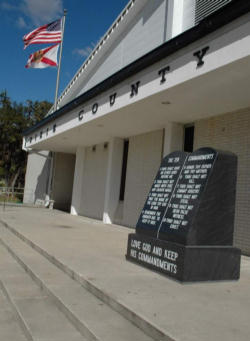
[youtube]http://www.youtube.com/watch?v=c_D6I1iHpiY [/youtube] On July 15, 2011 the United States District Court for the Northern District of Florida ordered that a large Ten Commandments monument - paid for privately by a local businessman and displayed since 2006 - be removed within thirty days

posted 10:39:25am Jul. 28, 2011 | read full post »


About Beliefnet

Our mission is to help people like you find, and walk, a spiritual path that will bring comfort, hope, clarity, strength, and happiness. More about Beliefnet.

Help

Media Kit

Subscribe

Legal

Copyright © Beliefnet, Inc. and/or its licensors. All rights reserved. Use of this site is subject to Terms of Service and to our Privacy Policy. Constructed by Beliefnet.

Advertisement

Report as Inappropriate

You are reporting this content because it violates the Terms of Service.

All reported content is logged for investigation.