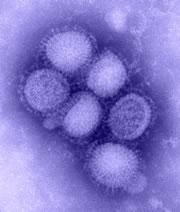
 Here’s a sniffly, sneezy, gross, icky, potentially deadly (but thankfully so far mild) hot topic to talk about.
The ethics of swine flu.
Oh, excuse me, Obama administration and U.S. Pork Industry… H1N1 Influenza.
Vice President Biden stirred up controversy recently with ill-considered and arguably irresponsible remarks about the potential health risks of using public transportation, while Mexico City lay practically frozen and shuttered against the disease, all commerce halted. Here in New York City, in Queens, a high school was shut down and disinfected (probably the first time it had ever been treated to such a thorough scrubbing, if my own high school experience was anything to go by). People began to dither over wearing masks, eating spare ribs, riding the subway. Jokes about swine abounded, and still do.
Law & Order SVU quickly aired one of their ‘ripped from the headlines’ parable-type episodes about a woman whose unvaccinated child gave measles to another, resulting in his death. The mother was prosecuted for allowing her son to play in public and attend school without being vaccinated. The episode, while taking the issue to ridiculous lengths, did ask a great question: do parents have a responsibility to vaccinate their children? If not, must they keep them at home?
Full disclosure: I don’t have children, and I don’t have a deep emotional investment in the arguments that swirl over immunizations and autism, for example. (I’ll confess I’ve had all my shots, and I’ll leave it at that.) For the purposes of this post, I’m less concerned specifically about vaccinating kids against childhood disease and more interested in the general ethics of public health threats, great and small. I think we all have a part to play in this issue, both everyday folks and people in power.
First, let’s take government:
In times of epidemic or pandemic, governments sometimes make sweeping decisions for the rest of us, like keeping us locked down under curfew, forcing us to get immunizations, wear masks or be quarantined. But if we let the government get ahold of such power, are our personal freedoms in danger of flying out the window at the merest whiff of pig sniffles? Or, on the contrary, does government actually have a moral obligation to swoop in? Swine flu certainly seems to be one of those illnesses that merits serious action, though thankfully not global panic/paranoia as yet. In Mexico, the government imposed curfews and took swift central action because of the overweening concern for the greater public good. This, they obviously felt, trumped individual freedoms and even global commerce. Their actions provided much-needed information and vital services to people, such as getting stores of anti-viral medications where they needed to go.
Here in New York, city and state officials broke into my favorite daytime TV with press conferences to tell me of the plans that had been set in motion and to dole out the facts about school closings and new stats as they became available. I didn’t mind missing some of All My Children to hear the latest information. And I don’t mind taking sensible precautions to minimize my risk of catching or passing along a potentially fatal communicable disease. But what ethical limits should keep government from getting out of hand in a public health crisis?
Here’s where I come down on this issue:
- Government SHOULD NOT have the right to hold you down and forcibly medicate you (unless maybe you are rabid and attacking your neighbors)
- Government SHOULD have the right to demand you home-school your kids if you won’t vaccinate (why should you get to participate in a publicly funded school system if you are endangering others and not following its code of conduct?)
- Government SHOULD have the right to curtail non-essential travel by public transit, close public spaces and regulate public hospitals as necessary during a true crisis.
- It SHOULD NOT have the right to force you to use a hanky, though it has every right to try to shame you into it.
All this might seem fairly straightforward. But I see some grayer areas in our own daily lives–our responsibilities as private citizens.
For instance: Must you stay away from public places if you are sick? Sure, it’s a good idea, but is it really practical? I’m thinking about that annoying coworker (you know the one) who comes to the office with a cold and then coughs and dribbles all over the phone, the coffee pot, your keyboard… I mean, is that fair?! Yuck! They shouldn’t force you to get sick just because they are. Yet, what if they have no more sick days left? What if the boss would fire them for taking off, or if their team is counting on them to be there that day? Or what if they didn’t realize they weren’t feeling well until they got to the office?
Hm.
In a perfect world, I think we should all stay home when we’re sick, just as a matter of courtesy and personal responsibility. In this fantasy land, we’d consider it our foremost duty not to infect others, take pledges to that effect upon waking every morning, and carry hand sanitizer by the gallon in backpacks with us everywhere we went. People who infected others would be forced to wear a scarlet “S” for “Sickening” on their chest.
Yeah, you can tell I’m one of those people who gets a lot of colds. And resents it.
In the real world, at least to my mind, curtailing your activities to keep your germs to yourself depends on the severity of the illness in question and the situation in which you find yourself. (One can perhaps be forgiven for giving one’s coworker a case of the sniffles, but bubonic plague is really beyond the pale. I don’t think they make a Hallmark card to say ‘sorry’ for that!)
Personally, I feel that as a member of a greater society, it’s part of our responsibility to think not only of ourselves, but of our fellows. If that means following government health mandates and
putting my hygiene practices into overdrive while H1N1 Flu is making its rounds, I consider that my moral imperative.
putting my hygiene practices into overdrive while H1N1 Flu is making its rounds, I consider that my moral imperative.
The rest of the time…. Well, I’ll still wash my hands eighty times a day.
 Read Previous Post