
Joan Ball is a business professor at St. John’s University in New York and the author of Flirting with Faith: My Spiritual Journey from Atheism to a Faith-Filled Life.
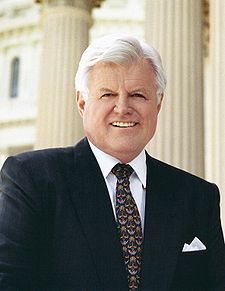
It is seldom that we lose someone of such legendary stature
as Senator Edward M. Kennedy. Though the media may try to play up every death as a
Cronkite or a Mother Theresa, I honestly don’t
feel the need to shed a tear over Michael Jackson in quite the same way as
I do over the man who fought for decades on behalf of the American people (and
in particular the people of Massachusetts) to enact reform and defend our
unique American freedoms. I am genuinely saddened to hear of Kennedy’s loss.
And yet… and yet… there’s no arguing Kennedy was a flawed
man. The mere whisper of the word “Chappaquiddick”
is enough to conjure up scandal and disgrace. One wants to forget those less
savory moments in the rush to lionize the departed… but is that ethical?
I’m not a politico, and while I follow the doings of our
congressmen in the news, I don’t delight in the minutia of their lives the way
the cable TV news networks seem to do. For the purposes of this blog, I’m more
interested in how the flurry over the passing of the larger-than-life “Lion of
the Senate” shows us how we remember, in a more general sense, those who pass
on. And I must say, there’s a great deal of mawkishness going on over Kennedy
that reflects a greater attitude of glossing over reality that seems to occur when
we remember those who’ve passed. The very word “eulogy” comes from the Greek
roots for “eu” (good) + “logos” (word). (I knew those two years of ancient
Greek would come in handy someday!)
Some argue it’s wrong to speak ill of the dead. I disagree;
if the dead were ill people, and we remember only their decent moments, who are we really remembering? Aren’t we
actually doing them a disservice by allowing them to vanish and be replaced by
some artificial construct?
So, what’s the ethical way to approach mourning and
remembrance? Orson Scott Card’s great book, Speaker For the Dead,
comes to mind. In it, Card’s protagonist “Ender” argues for speaking
accurately, dispassionately, of the deceased’s life; speaking for them, in their voice, as a way to
sum up their lives but making no effort
to moralize or judge in any way.
As the frenzy to eulogize the late senator commences, I will
be appreciative of those new and fascinating aspects of his life that are
brought to light–and wary of any false halos appearing over his head.
How do you feel the dead should be remembered?
Subscribe to receive updates from Everyday Ethics or follow us on Twitter!


posted August 26, 2009 at 3:53 pm
In a life that is littered with ironies, here’s the biggest one of all: His three older brothers – Joe, Jack and Bobby – are eternally frozen in our imagination as the personifications of youth and vigor (or “vigah”). How poignant that our final image of the baby of that family will be as an old man, frail and mortally ill.
His was the most impressive evolution in American political history. Let’s be honest; in 1962 the guy was a lightweight. He ran for the Democratic nomination against another young man, Edward McCormick, whose uncle was the speaker of the House of Representatives. During a debate McCormick told him that were it not for his name, his candidacy would be viewed as a joke. It was a point well made. It is obvious when looking at film of that campaign that our boy Ted is in way over his head.
Who would have dared dream all those years ago that this punk kid would one day evolve into the greatest senator ever to walk those halls?
An incredible realization just came to me: Teddy represented the state of Massachusetts for forty-six years, eight months and nineteen days. That is nearly three months longer than all the years his older brother Jack lived on earth. Forgive the cliche that is so overused it has become trite through repetition, but this really is the end of an era.
http://www.tomdegan.blogspot.com
Tom Degan
Goshen, NY
posted August 26, 2009 at 5:39 pm
While I don’t actually think Ted Kennedy was a great man, and I did not feel a lot of admiration for him, I do understand the need of those mourning and grieving to remember him in only the best light. I don’t think the media need to be a part of that of course since it is not really its loss. But as someone who has lost someone for whom I did have a great deal of respect and love, I must say that I see no reason to identify all his flaws. I don’t want to do that for my father, nor do I want other people to do it for me. I understood his flaws when he was alive, and now I wish to remember all that was wonderful about him. And, I don’t think it’s anyone’s business but mine and my mother’s anyway. I know my reaction is not true for everyone, and we all experience and deal with loss in different ways. But, I simply cannot see bestowing high praise on the deceased as unethical. And while there is, of course, an argument for not judging or moralizing, I think it is impossible and almost horrible to attempt to remain, or expect people to remain, dispassionate. That may work in theory, but for most of us not in practice. I honestly think that the glorification of the deceased, for many of us, is a way to handle our grief.
posted August 28, 2009 at 5:13 pm
I am touched by emmabliss’s entry… especially, “I don’t think it’s anyone’s business…” People are who they are, and they get out of life what they put in – whether others know it or agree with it doesn’t matter. “…we all experience and deal with loss in different ways. But, I simply cannot see bestowing high praise on the deceased as unethical…” case in point – My mother was a rather self-righteous and opinionated woman. People who were around her for any length of time soon stopped being around her. She was my Mom and I loved her. After she died, I was packing up her house and a neighbor woman came to the door to tell me not to feel bad… “nobody like her.” Once again I say that Ethics and Compassion go hand in hand, and I do go with the old “don’t speak ill of the dead” thought, because chances are someone who loved them will hear you. Be kind, your turn is coming.
