Flunking Sainthood

Flunking Sainthood

Changes to the Mormon Temple Experience

posted by Jana Riess

51+wjmUFSeL._SL500_AA300_.jpg

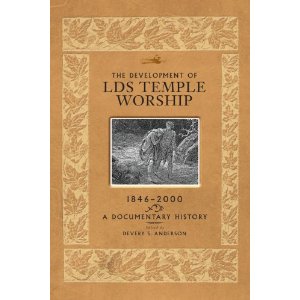
This weekend I perused the first half of Devery Anderson’s The Development of LDS Temple Worship, 1846-2000: A Documentary History. The book will be released on March 24 and it’s quite a scintillating collection of primary source material about how the temple experience has changed over time.

Some of this was familiar to me, like that not keeping the Word of Wisdom was not necessarily a deal-breaker in getting a temple recommend until the early 20th century (61). And Jonathan Stapley has already posted here about the amazing history of the ritual of temple baptisms for health for living Latter-day Saints. But the book describes many other rather mind-blowing changes I never knew about:

  • In the earliest temples, anyone attending to perform an ordinance was expected to make a monetary donation of fifty cents to support temple work (182)
  • Mormons sometimes paid other Mormons to go through the temple for them if they were too sick or poor to go, or if they lived too far from a temple (182)
  • In deference to some of the Arizona Saints who were too poor to travel to the temple, Pres. Woodruff allowed them to set up an ad hoc sealing room in one of their regular buildings (87-88)
  • Temples used to have standing choirs that performed before endowment sessions; sadly, this practice was abandoned in the spring of 1921 (181)
  • There were sometimes lectures in the Garden Room (56)
  • In 1918 you could receive your endowments as early as age 16 (176)

  • President Taylor allowed some people to receive their second anointing in their 20s and 30s, but President Woodruff restricted the ordinance to the aged and the deceased (73, 75). Over time, the ritual became even more restricted, and by 1917 was performed only on Fridays. By the late 1920s, it was reserved for the highest-ranking leaders of the Church, which is where it remains today (xliii-xlv). (Incidentally, I had been a member of the church for years before I even learned of this ritual’s limited continued existence.)

People who have followed with interest the criticism that Mormons have received about performing temple baptisms for Holocaust victims will be interested to learn that it has been church policy for well over a century that members only be baptized for their own family members. Apparently, some things never change:

We must be more strict in enforcing the rule which is here mentioned in regard to heirship in our Temples, and people must not be permitted to follow their whims in being baptized for any and every body whom they may choose to officiate for; and persons should be questioned upon this subject of being baptized for those not of their own kin…. [1887 letter from President Wilford Woodruff to Mariner Wood Merrill, pp. 67-68]

Interestingly, the book demonstrates that Woodruff himself had violated this practice in 1877 when he felt compelled to be baptized for the signers of the Declaration of Independence, as well as John Wesley, Christopher Columbus, and every president up to that point in American history. (p. 41)

Some of the temple policies that have changed over time are ones that would have affected me personally, so of course I read them with particular interest. Here’s one directed toward women whose husbands are not LDS:

The rule of the temple is that a woman who marries outside the Church cannot receive a recommend to go through the temple, because her husband would be very apt to ask her to reveal the temple ordinances and if she refused to do so it would cause contention between them. (1916 letter from Anthon Lund and Charles W. Penrose to Edward H. Snow, p. 172)

It’s certainly great policy to not introduce elements in a marriage that could be contentious, but I’d have an easier time believing that rationale if it had not been enforced by an obvious double standard: LDS men at the time could receive their endowments whether or not their wives were members of the Church. So much for the “it could cause contention” justification.

LDSMormonGarmentAd1927_jpg.jpg

Some of the most interesting sections of the book deal with changes to LDS temple garments, and there are fascinating facsimiles of advertisements from the 1920s, back when private companies could and did produce garments, and they advertised their wares publicly in the Relief Society magazine. For example, the Salt Lake Knitting Store offered a variety of prices and styles–long or short sleeves, ankle length or three-quarter length bottoms–for both men and women. You could pay an additional fifteen cents to have the company mark the garments for you, or you could have them marked right on your body while in the temple (203). In the ad at right for “The Reliable” company, you also had to specify color, which raises the question: what colors were available, other than white?

There’s a terrific story from the oral history of T. Edgar Lyon about going to the temple with the brand-new garment that the First Presidency had just approved in 1923, right before Lyon’s mission, and almost being turned away because the temple workers didn’t know what to make of the newfangled union suit style (203).

Bottom line: this is a mesmerizing compendium of 150 years of primary source material. Take a look.


Previous Posts

The Top Five Reasons Book Authors Should Blog
As I wind up my tenure at Beliefnet and prepare to move my blog next week to the Religion News Service, I've been reflecting on the last couple of years and how blogging has helped me to conne

posted 11:29:28am Jan. 26, 2012 | read full post »

Thank You, Flunking Sainthood Readers!
OK, I admit it. I have a Google Alert on the title Flunking Sainthood, so that the search engine lets me know when there are new reviews or discussions about the book. In the last few weeks it has been exciting -- and humbling -- to see the many different kinds of people who are reading and talking

posted 12:41:10pm Jan. 25, 2012 | read full post »

NYC Conference on Mormonism & American Politics, February 3-4
"First Mitt won Iowa, then he lost Iowa? That's a classic Romney flip-flop." --Stephen Colbert     Working with the theory that there hasn't been nearly enough attention to Mormonism and politics this year, what with it being in the news every single day and all, Randy Balmer and I

posted 11:09:19am Jan. 23, 2012 | read full post »

Writing Retreat
Friends, I will be offline until January 23 for a writing retreat. I'm bringing my computer, but the place where I am going doesn't have email access

posted 8:47:20pm Jan. 14, 2012 | read full post »

Fun with the Book of Lamentations
Actually, no. That title was just a teaser. There really aren't any fun moments in the Book of

posted 11:33:13am Jan. 13, 2012 | read full post »

Advertisement
Comments read comments(14)
post a comment
The Monk

posted March 7, 2011 at 11:33 am


Some of this has been available in other less palatable forms, like John Buerger’s Dialogue articles/book.
Regarding the endowment age, Brigham Young in 1877 said ““At what age can children have their Endowments? If of a naturally ripe and early development of mind and body as early as twelve years. but as a general rule fifteen years old is early enough.”
I’m looking forward to this, have it on preorder.


report abuse
 

Chris

posted March 7, 2011 at 4:44 pm


“So much for the “it could cause contention” justification.”
That’s kind of a flippant response. Please try to apply some of that nuance you seek of those in the present to the past. You may not like it, but the past is the past and things were different then.
Men were looked at by both government and all religions and being the head of the household in a certain sense. The concept of “preside” was and is all-too-often still, taken so far astray from its intent, to mean that a man ruled the house. In that time, then, he would not only have a moral right, but a legal right, to be privy to any oath or obligation his wife made.
So yes, in times like that were divorce was more difficult and a woman potentially faced greater likely hood of abuse, it’s not surprising the church did not want to put them in this situation.
The reasoning is not a lame excuse because they simply wanted to punish those women for not marrying in the faith, but rather a reflection of the unfortunate reality that women were legally subordinate to their husbands back then, more than men were legally subordinate to their wives.


report abuse
 

Chris

posted March 7, 2011 at 4:49 pm


BTW – that picture shows the colors: white, nude, orchid, peach, nile.
But really, look at those prices!?!?!? Adjusted for inflation, garments cost $42 a set back in 1920 (assuming that is when the paper ad was). I’ll never complain about temple garments costing too much again.


report abuse
 

Chris

posted March 7, 2011 at 5:07 pm


The Monk – that’s a cool BY quote. I’m even more inclined to think of the time he gave it. People were making major sacrifices to practice their faith in his day. I’d imagine the youth had very strong testimonies.
I also noticed the garment ad has sizes for Men, “Ladies”, Boys and Girls. I thought perhaps people just bought these for their younger boys and girls without the marks as under clothing, but now thinking about the price, combined with the age observations it could also be for their children to get endowed.
I wonder if there is any data on the average age of the endowment for 2nd generation (non-convert) members? I say 2nd generation, because 1st gen converts would presumably raise the average.
The more cynical (playful ribbing) side a la “so much for….” type remarks would perhaps simply say BY wanted to specify that you could marry 15 year old girls, and as young as 12 if they were mature enough.
Thanks for posting about this book. I think I’ll be getting it at some point, but can you confirm if it reveals aspects of the endowment, which should not be revealed?


report abuse
 

LC

posted March 7, 2011 at 7:08 pm


Since the endowment can be found online, is there still a heavy emphasis on not “revealing” it…just wondering…


report abuse
 

chris

posted March 7, 2011 at 7:28 pm


That’s not really the issue LC. If someone else takes the Lord’s name in vain should I feel obliged to do so? (the examples could continue ad nauseum)
I don’t want to reveal something I consider sacred and withheld specifically for those who are willing and seeking to receive it and making an effort to humble themselves in a way they believe the Lord has asked them to do so. “Secret” certainly sums it up, but not in a dark way, but rather in a way that these things are a part of our eternal progression and are meant to be a personal way for us to take part in the works of salvation and revelation at the same time.
If I have a strong conviction of that, I would like to undergo efforts which bypass the principles I hold sacred merely because it’s already in the public domain. It’s public-ness or privateness has no bearing on what I choose to do.


report abuse
 

chris

posted March 7, 2011 at 7:30 pm


“I would NOT like to undergo efforts…”


report abuse
 

Jana

posted March 8, 2011 at 8:28 am


Hi all — I am only halfway through the book, as I said, but I have not seen anything so far that is explicit about the endowment ceremony. There was one response from a prophet (can’t remember what page #, or if it was Taylor or Woodruff) answering a question about the second half of the second anointing ritual, which was supposed to be performed at home. And the prophet basically didn’t answer the person’s question about the ritual, telling him that it would have already been discussed with him in the temple when he underwent the first half. That cryptic reference is the only thing I’ve seen so far that’s even hinted at the temple ritual.
Oh, and there were a couple of lists of who played which biblical characters in the pre-temple Endowment House, and a memo to temple presidents about choosing mostly biblical names as temple names.


report abuse
 

Derek

posted March 9, 2011 at 12:27 pm


I am a member of the Church who loves to read and learn everything on Church history and doctrine.
I have really enjoyed your posts. Keep up the good work.


report abuse
 

Marvin Folsom

posted March 10, 2011 at 12:12 pm


Did you tell us who the publisher was?


report abuse
 

Loryjean Pratt

posted March 10, 2011 at 12:43 pm


The real point in covenantal obligations is that a woman was to be obedient to her husband, and not he to her. Therefore, a woman who “knew” something her husband did not, and he asked it of her, was under covenant to tell him-whether he was a member or not, he was still her husband; this did not apply to a husband towards his wife. It is the same concern I had when marrying a man who had received a later endowment than mine, after the covenants were changed, although thankfully, they also had changed the obedience covenant, so I did not have to commit to obeying him. I guess women can rejoice over that one, if they want to; hence, “no more double standard”.


report abuse
 

David

posted March 11, 2011 at 2:31 pm


My comment is with regard to the issue of a woman who marries outside of the church not being permitted to go through the temple because of possible contention in the marriage.
Today’s policy on worthy LDS couples who marry civil first outside of the temple are penalized with a one year wait to go the temple. Those couples, who because of their love for all family members and extended family, choose to hold a civil wedding first so that all can participate are deemed unworthy to go to the temple.
Rather than face the stigma and shame, many true blue mormons would rather exclude their family and loved ones from their wedding day and remain loyal to the church. Such a move not only creates contention but is also extremely divisive and hurtful to family relationships.


report abuse
 

Killerbug

posted March 11, 2011 at 5:33 pm


I can understand these being changes to the temple policies over the years but “mind blowing”? Like most apostate/haters, any piddly thing is mind blowing as long as it casts the church in a negative light.
As for David above who believes the temple ceremonies to be exclusionary; I was married in the temple many years ago. I still have friends who are not members from that long ago time who understood that the actual ceremony was a very sacred part of my religious life and didn’t complain. They knew they were welcome at the reception afterward. All of my family members were members although there were a few without recommends who also understood it was not my doing to keep them from the actual spoken words.
I don’t see any contention or problems except those deliberately created here and other venues for publishing hate towards the LDS people.


report abuse
 

Pingback: Signature Books » The Development of LDS Temple Worship, 1846-2000: A Documentary History

Post a Comment

By submitting these comments, I agree to the beliefnet.com terms of service, rules of conduct and privacy policy (the "agreements"). I understand and agree that any content I post is licensed to beliefnet.com and may be used by beliefnet.com in accordance with the agreements.

Share this story


About Beliefnet

Our mission is to help people like you find, and walk, a spiritual path that will bring comfort, hope, clarity, strength, and happiness. More about Beliefnet.

Help

Media Kit

Subscribe

Legal

Copyright © Beliefnet, Inc. and/or its licensors. All rights reserved. Use of this site is subject to Terms of Service and to our Privacy Policy. Constructed by Beliefnet.

Advertisement

Report as Inappropriate

You are reporting this content because it violates the Terms of Service.

All reported content is logged for investigation.