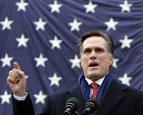
When Mitt Romney stands before the nation tomorrow to deliver his much-anticipated “religion speech,” evangelical Christians will be listening particularly intently. Though polls show that one in four Americans feel squeamish about voting for a Mormon president, an even higher proportion of evangelicals–more than one in three–feel uncomfortable doing so. They view the Church of Jesus Christ of Latter-day Saints, as Mormons are formally known, as a cultish offshoot of “true” Christianity.
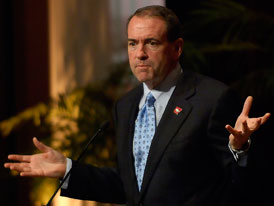
Yet for Romney, winning evangelicals is a must. They constitute the base of the Republican party and are beginning to turn toward former Arkansas Governor Mike Huckabee, a Baptist pastor, as their candidate. Former New York Mayor Rudy Giuliani’s appeal to more moderate Republicans makes conservative evangelicals even more vital in Romney’s battle for the Republican nomination.
The speech, to be given at the George Bush Presidential Library in College Station, Texas, will be the most important of his candidacy. The site is less than 100 miles from where John F. Kennedy delivered his famous 1960 speech about his Catholicism, in which he vowed to keep a high wall of separation between his faith and his politics. Romney’s speech is billed as his most public attempt yet to explain how his Mormon faith would influence him as president.
The big question for evangelicals: Will he own up to the distinctions between Mormonism and traditional Christianity, even as he argues that members of both traditions share many political values? Some evangelicals say that Romney’s refusal to do so up to this point has alienated Christian conservatives who might otherwise support him. They also say that his attempts to paper over differences between Mormons and other Christians have exacerbated his broader authenticity problem, due largely to Romney’s reversal on hot button social issues. While Romney was pro-choice and pro-gay rights as recently as a few years ago, he is now adamantly opposed to both.
But the bigger problem for some evangelicals is that they say Romney has tried to pass himself off as a traditional Christian. “In the few times he’s addressed the [religion] issue, he talks about the importance of religious values and dips into evangelical language, and neither of those is very impressive to evangelicals,” says Richard Mouw, president of Fuller Theological Seminary. “Evangelicals aren’t very reassured when he’s saying something that makes him sound like us when he really isn’t like us…. it borders on deception.”
The risk for Romney giving a Mormon speech, however, is that owning up to his religion’s distinct beliefs–for instance, that Jesus will return both to Jerusalem and Jackson County, Missouri–could scare off evangelicals and other conservative Christians. “Evangelicals want reassurance that Mormonism is not a cult and that his beliefs are things they’d accept, and by avoiding Mormon theology he won’t be able to give that assurance,” says Alan Wolfe, a religion sociologist at Boston College. “But it’s suicidal for any candidate to start talking theology, and Mormons have that problem more than others because their theology is so widely distrusted.”
On the campaign trail, Romney has called Jesus Christ his personal savior, a line common among evangelicals but almost never uttered among Mormons. When Romney was asked at last week’s Republican presidential debate whether he believed every word of the Bible, he answered, “I believe the Bible is the word of God, absolutely.” But Mormons also believe that the Bible contains errors. And Romney glossed over the Mormon belief that books outside the Bible, such as the Book of Mormon, are Holy Scriptures.
Mormon scholar Richard Bushman says that, while Romney hasn’t lied about his Mormonism, he has given it a “different twist.”
But the strategy seemed to backfire with the recent emergence of Huckabee as a serious Republican contender for the White House. In Iowa, home of the first presidential caucuses, polls show that Huckabee has dislodged Romney as the GOP’s frontrunner. For many Iowa evangelicals–who account for roughly half of the state’s Republican caucus goers–Huckabee’s Christian credentials are much more solid than Romney’s.
“Romney was trying to be the same kind of Christian as [evangelicals] were, and then came along someone who’s been a Baptist minister saying You want a Christian? Here I am,” says Bushman, author of the Joseph Smith biography Rough Stone Rolling. “Romney took it too far in that he was unwilling to admit there was even a tiny gap between the two, and that’s what got him into trouble.”
Romney’s aides deny that he has attempted to blur the line between Mormonism and evangelical Christianity. And they say his speech tomorrow is aimed to all voters, not just evangelicals. “This is a big picture question that’s historical in scope and it would be dangerous to minimize it,” by focusing solely on how it affects evangelicals, says a senior Romney advisor.
Romney himself lowered expectations about the extent to which his speech will focus on Mormonism after announcing on Sunday night that he would give a speech entitled “Faith in America.” He told reporters this week that it won’t be “a repeat or update of the Kennedy speech,” and that “there are a lot of websites people can go to” if they want to learn about Mormonism.” While some evangelicals and political pundits have called for Romney to give a Kennedy-like address, others have said that echoing Kennedy’s line about keeping his faith and politics separate would turn off evangelicals.
But a senior Romney advisor tells Beliefnet that the speech will satisfy those who “want to hear his heart more” and that it will acknowledge the role of Romney’s Mormonism in his life: “There hasn’t been a clear acknowledgment, and the speech is the answer to that need for a clear acknowledgment.”
The advisor also says Romney “could draw distinctions between LDS and mainstream evangelicals while pointing out that they share a Judeo-Christian foundation without saying ‘I’m a Christian just like you.'”
But Mormon-evangelical relations have always been contentious, in part because both groups are trying to win new converts and feel that they are competing for the same souls.
Still, not all evangelicals believe that Romney has tried to sell himself as a traditional Christian. Oran Smith, president of South Carolina’s conservative Palmetto Family Council, says that Romney has stuck to a strategy that one of Romney’s advisors floated by him last year: “we don’t have the exact same faith, but we come to the same values that grow out of our faith.”
“In most cases, he has ducked the Mormon question to keep it from being an issue,” Smith says. “But I don’t sense that he’s been disingenuous or that he’s tried to fudge the differences [between Mormonism and traditional Christianity] in a way that is trying to trick someone.”
And many evangelicals feel that a “Mormon speech” could do more harm than good, particularly if it includes references to Mormon doctrine and beliefs. Asked if he would have advised Romney to give a “Mormon speech,” Family Research Council president Tony Perkins says, “I probably wouldn’t.”
“I don’t see how in one speech you could make evangelicals comfortable with the Mormon faith,” Perkins says. “Like it or not, a large percent of Americans want to support somebody who is like them, and that’s most easily found among people who believe what they do in terms of their faith. Romney can’t lay claim to that.”
Perkins said that Romney has nonetheless convinced many evangelicals that his conservative transformation on social issues is genuine.
Still, many evangelicals say that Romney needs to go further in tomorrow’s address. “For Romney’s speech to be successful in the minds of evangelicals, he would need to offer some sort of new line, some more detailed reasoning as to some of the differences between the two religions,” says David Brody, Capitol Hill correspondent for the Christian Broadcasting Network. “But he doesn’t want to go too far. And that’s his challenge.”
For more on Romney’s “religion speech” and his Mormonism, check out New Testament scholar Ben Witherington III’s essay on how Mitt Romney’s ‘Mormon speech’ could connect with evangelicals, our What Do Mormons Believe? Guide, and the Southern Baptist Convention’s Richard Land on what he’d say if he were Romney.
5
 Read Previous Post