
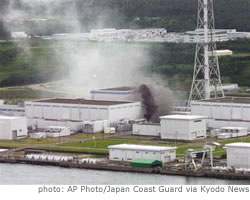
A 6.8-magnitude earthquake shook Japan on Monday. The quake caused a leak of radioactive water at the Kashiwazaki Kariwa nuclear power plant—and that should shake the rest of the world.
According to a report from the Associated Press (“Japan Quake Causes Nuke Plant Leak, Fire“), the power company that runs the nuclear plant initially announced that a fire in the plant had been put out with no damage to the reactor and no release of radioactive material. But later in the day, the company admitted that 315 gallons of water had spilled from a tank at one of the plant’s reactors and been flushed into the sea.
The leak of radioactive material—and especially the delay in reporting it—”fed fresh concerns about the safety of Japan’s 55 nuclear reactors, which supply 30 percent of the quake-prone country’s electricity and have suffered a long string of accidents and cover-ups,” according to the AP story. “The leak itself doesn’t sound significant as of yet, but the fact that it went unreported is a concern,” said Michael Mariotte, executive director of the U.S.-based Nuclear Information and Resource Service. “When a company begins by denying a problem, it makes you wonder if there’s another shoe to drop.”
The nuclear industry around the world has a long track record of denying problems, covering up accidents, and underplaying the dangers of nuclear power. If we fail to listen to the warnings in such small-scale accidents such as this week’s in Japan, we may very well be fated to learn by much more catastrophic means.
Jim Rice is editor of Sojourners magazine. See “ Is Nuclear Power the Answer?” in the current issue of Sojourners.


posted July 17, 2007 at 10:10 am
Yes, and whenever a company doesn’t get its story exactly right the very first time it is clear evidence of a sinister cover-up, not a result of confusion or miscommunication in the aftermath of an earthquake.
Get a grip man, the company figured out what happened and corrected its story within 24 hours. It’s one thing to demand honesty, it’s something entirely different to demand omniscience.
Before you contribute to panic, someone might want to give us some idea of how “radioactive” the released water actually was. Radioactivity is not a binary thing.
Oh, and NIRS is clearly an anti-nuclear energy group, which doesn’t make them bad, but it should at least be noted if you’re going to quote them as experts on the topic.
Wolverine
posted July 17, 2007 at 10:47 am
The nuclear industry should be subject to regulation, but I agree with Wolverine in that the early reports in any sort of natural or man-made disaster tend to be marked by confusion. I remember the hours after 9/11 when people thought that there were car bombs going off at the State Department and other planes had been hijacked. As the situation develops further and communications are restored, a firmer grasp of the situation will be revealed. Nuclear energy can be the cause of great destruction, but it can also be a great source of clean and efficient energy. One solution to the environmental and foreign-dependence problems that this nation has is to increase the amount of nuclear energy that we use. It is far cleaner than coal and oil when utilized correctly.
posted July 17, 2007 at 10:55 am
OK – Japan has / had a problem because of a 6.8 earthquake. But let us look at France and Sweden where the majority of their power is nuclear and they have been able to do it safe.
It is human nature to ‘cover-up’ ones mistakes or even lie under oath. Are you really surprised about that???? But your quoting the Nuclear Information and Resource Service, I am sure that they are very up-front and truthful in their reporting too. (I rather doubt it)
So – how long before someone comes up with the idea that this situation is the Bush Adms. fault – not long.
Do have a great day -
.
posted July 17, 2007 at 12:39 pm
I agree that he over-reacted and you are all probably right that there was no actual attempt to cover up any leakage.
However, the fact there was some damage certainly brings up some of the concerns about nuclear energy. In this country, we have shied away from nuclear since 3-Mile Island. If we ever go back in that direction, the Japan earthquake should help us to realize it isn’t a good idea to build reactors in earthquake prone regions of the country. So if California has plans for a nuclear reactor, I wouldn’t think that was a great idea. It’s interesting that Japan uses nuclear energy, considering their entire nation is earthquake prone. They don’t have much choice when it comes to their energy needs, however, since they don’t have much for natural resources. We do have the luxury of choice in the U.S.
posted July 17, 2007 at 1:42 pm
Cormac McCarthy has written a book called “The Road” which I found to be a potential reality for our world if we were to continue down the path of nuclear energy. He does not describe what the cause of the horrible conditions in his ficticious United States was, but it was an eye-opener. I know this is fiction but sometimes our authors of fiction have a firm grasp of the potential future better than policy makers.
Have a great day, all.
posted July 17, 2007 at 2:54 pm
The post doesn’t say there was a “sinister cover-up,” merely that the nuclear industry has a long history of underplaying the dangers of nuclear power (and particularly of nuclear accidents). In this case, no surprise, the story gets worse as the days go by: Now they’ve admitted that along with the 1,200 liters of radioactive water that escaped containment, “about 100 of the 22,000 drums containing nuclear waste at a warehouse had fallen over and ‘several’ lost their lids,” according to a power company official.
You may feel that nuclear power is worth the risk, but it would be foolish and shortsighted to underestimate the very real risks that are posed by nuclear power generation.
posted July 17, 2007 at 3:02 pm
“The post doesn’t say there was a “sinister cover-up,”"
It does say (or, rather, selectively quotes others as saying) that there was a troubling delay in reporting, and that the industry has a history of cover ups. It is not exactly a stretch to suggest that your are insinuating that there is a coverup in this instance.
You reinforce this by saying they have now “admitted” something, as though they were intentionally withholding information.
A discussion of the very real risks of nuclear power is worth undertaking, but entering the discussion with the attitude that nuclear power companies are the enemy is not a fruitful perspective, in my view.
posted July 17, 2007 at 3:28 pm
Jim Rice wrote:
The leak itself doesn’t sound significant as of yet, but the fact that it went unreported is a concern,” said Michael Mariotte, executive director of the U.S.-based Nuclear Information and Resource Service. “When a company begins by denying a problem, it makes you wonder if there’s another shoe to drop.
The nuclear industry around the world has a long track record of denying problems, covering up accidents, and underplaying the dangers of nuclear power.
While it’s true that Rice did not use the words “sinister cover-up”, I do think that was a fair inference based on what Rice did write.
I’m not sure why containers falling over is grounds for concern, nor can we assume that the containers that lost their lids represented any threat to the general public or even to plant workers. And even the drums that “lost their lids” do not necessarily represent a grave threat as long as any material that was spilled is contained and cleaned up properly.
This is not the old Soviet Union which controlled the Chernobyl reactor. This is Japan, a technically adept, reasonably open society with a government that is capable of regulating nuclear power plants, investigating accidents, and holding violators accountable for their violations or incompetence.
It’s possible that there is another “shoe” left to “drop”, but we should wait until more facts are in before drawing any conclusions or even hinting at bad faith. Until we have all the facts, I would argue that the biblical injunctions against gossip and rumour spreading apply; it is not our place to speculate about all the things that might have gone wrong, let alone the moral failures of people we haven’t met.
Wolverine
posted July 17, 2007 at 3:51 pm
Something all the anti-nuclear people forget is that while yes, there are other methods of generating electricity, the costs of those are not at all insignificant when compared to nuclear. And no, I don’t mean solely financial costs. For instance, coal-fired plants produce large quantities of carbon dioxide as part of the combustion process. In addition, coal mining isn’t exactly clean. Hydroelectric plants can only be built in certain regions, and significantly alter the environment. Nuclear plants have their problems, but also have their advantages of essentially zero emissions and the ability to operate on a large scale. Something we should realize when considering nuclear power is that while accidents are dramatic, a constant polluting stream usually is more damaging.
posted July 17, 2007 at 4:16 pm
“Nuclear plants have their problems, but also have their advantages of essentially zero emissions”
That’s not exactly true. Nuclear power plants emit heat as waste. Water used to cool the reactors is discharged into a receiving body – a nearby lake or river.
Then there is the issue of what to do with spent nuclear fuel.
I am not categorically opposed to nuclear power but, accidents aside, it is not a benign energy source.
Seek peace and pursue it.
posted July 17, 2007 at 4:45 pm
Nuclear power, like all things, has both its pros and cons. The issue I have the hardest time reconciling is the fact that while serious problems at nuke plants are rare, all it takes is one severe accident to kill tens of thousands of people –swifly and slowly– and render untold acres of land lethally poisonous for tens of thousands of years.
Remember, Uranium has a half-life of 25,000 years. It matters not whether we are talking about material released as a result of an accident or the growing piles of waste produced annually through normal and safe operations.
We should take the utmost care in persuing nuclear energy, in its current technological capacity, as one possible solution to our growing worldwide energy demands. Always should the greatest caution be used when attempting to control that which has such a capacity for long term harm lest we be guilty of delivering generational tyranny down upon countless people yet to be born.
God Bless ALL of the people of the world, not just the USA.
posted July 17, 2007 at 4:59 pm
You can quibble over whether it counts as a “cover up,” but even the prime minister of Japan is concerned about the official response, and even called for those involved to “repent their actions.”
This from an AP story a half hour ago (and the language “cover-up” is theirs, not mine):
KASHIWAZAKI, Japan — A long list of problems – including radiation leaks, burst pipes and fires – came to light Tuesday at the world’s largest nuclear power plant, a day after it was hit by a powerful earthquake.
The malfunctions and a delay in reporting them fueled concerns about the safety of Japan’s 55 nuclear reactors, which have suffered a string of accidents and cover-ups.
“They raised the alert too late. I have sent stern instructions that such alerts must be raised seriously and swiftly,” Prime Minister Shinzo Abe told reporters in Tokyo. “Those involved should repent their actions.”
posted July 17, 2007 at 5:01 pm
“Moderatelad” says:
let us look at France and Sweden where the majority of their power is nuclear and they have been able to do it safe.
Let me take the spin off that statement:
Yes, in France the majority of electricity generation is nuclear (propped up by substantial state subsidies and by an aggressive electricity export policy). They have had problems but have managed to close down reactors before things got too serious. I’m not convinced that a profit-driven fully free-market system would give them the margin to stay safe. (And they’ve had their fair share of leaks from their reprocessing facility too.)
In Sweden, the proportion of electricity generated from nuclear is 45% – i.e. not a majority – and the country is committed to eliminating it altogether (by not replacing reactors as they reach the end of their life) because they are aware of the risks inherent in the technology. The two reactor complexes in the German state of Schleswig-Holstein which had to be closed down recently are both managed by the Swedish company Vattenfall (which also operates a high proportion of the Swedish reactors).
Mark
posted July 17, 2007 at 5:13 pm
Mad Hatter said that nuclear power:
“can also be a great source of clean and efficient energy”
You’ve had too many nuclear industry executives at your tea parties. Yes, on the whole I would consider it preferable to coal or oil because of its lower climate change impact. But still nobody has figured out what to do longterm with the waste; and still it remains a weapons proliferation risk – why else are we all so concerned about Iran doing things which it is actually legally entitled to do?
It takes at least 15 years to get a nuclear power station from inital approval to fully operational. For a wind farm it can be less than 3 years. For biomass power stations there is no reason to take more than 5 years. Tidal stream and wave power technologies which are emerging into market-readiness can already claim similarly short lead times. All of these produce less greenhouse gases than nuclear, and no radioactive residue. They would also be able to compete more than adequately in a fair market, as is being seen through most of northern and western Europe.
No, Mr Hatter, you’re just repeating another piece of spin from the nuclear industry’s massive PR machine.
Mark
posted July 17, 2007 at 5:27 pm
Wolverine said:
“While it’s true that Rice did not use the words “sinister cover-up”, I do think that was a fair inference based on what Rice did write.”
Well I don’t. He merely pointed to the long and established track record of the industry.
Personally (based on a number of conversations with nuclear executives over the years) I don’t think they try particularly to cover up: it’s more that they believe their own propaganda so profoundly that they really expect every problem to be a minor one. Added to which, they (with good reason) don’t want to subject the public to false alarms.
But they do also have a massive budget for PR and are currently on a worldwide promotional offensive – as has been seen from the comments in this discussion which are virtually word-for-word repeats of nuclear industry promotional slogans.
Mark
posted July 17, 2007 at 5:39 pm
NeuroNurse points out (i.a.) that:
Nuclear power plants emit heat as waste. Water used to cool the reactors is discharged into a receiving body – a nearby lake or river.
While this is true, it is also true of any other thermal power station (coal, oil, gas, biomass), except where (as is the norm in large chunks of northern Europe) they are operated as combined heat and power stations. It is also only a local effect.
The nuclear industry does, however, contribute to climate change. The extent to which it does is disputed – studies from within the industry come up with very low figures, studies by nuclear experts who have left the industry come up with figures a little lower than natural gas. CO2 is generated as a result of the energy needs of the whole nuclear cycle, and especially of mining/refining and enrichment. As rich uranium ores are worked out, the industry will need to move to less rich ores, for which the energy requirement in mining and refining will be higher.
But to me the really serious problems with the nuclear industry are (i) radioactive waste, (ii) the intermeshing of the civil and military nuclear industries, making civil nuclear power a major route both to proliferation and to weapons of indiscriminate effect containing radiological poisons (notably depleted uranium shells, but also the much-publicised idea of the “dirty bomb”)
Mark
posted July 17, 2007 at 7:15 pm
A whole bunch of observations about this:
Jim Rice is moving on to more solid ground although I don’t see the evidence of a major cover-up here. There’s another explanation for the record here, which is that the power company wanted to assure the public that there was no immediate Chernobyl-scale radiation danger. Then as the plant was inspected more closely they found evidence of smaller radiation releases, which they made public.
Still, Japanese PM Abe is not satisfied and while it’s possible there’s some political posturing going on here, I’m not going to point fingers at him until I know more.
What we do not have, by all accounts, is a serious threat to public health in the area surrounding the plant. If there were, some organization, public, private, or educational, would have detected it and publicized it.
As cover-ups go, this one isn’t very serious nor is it going to last very long. The Japanese Government is on the scene and is likely to revise its regulations based on what it learns from this.
Mark wrote:
I’m not convinced that a profit-driven fully free-market system would give them the margin to stay safe.
You do realize that Chernobyl, by far the worst nuclear power accident, took place at a government-run facility in the old Soviet Union. If you don’t trust the market, you probably shouldn’t trust the government either.
BTW: I can’t speak for Mad Hatter, but aside from Montgomery Burns I don’t know a single nuclear power plant executive.
Summing up: there’s no such thing as completely safe: coal mines collapse, oil tankers rupture and spill, people have heart-attacks while riding their bikes. All technologies involve risk, and human nature is such that when something goes wrong there is likely to be some attempt to minimize and cover things up.
In Japan it looks like the system is working, the government is doing its job and the facts are being uncovered. I won’t say this is no big deal, but this ain’t even close to another Chernobyl.
Wolverine
posted July 17, 2007 at 9:37 pm
So, a huge earthquake hits Japan and the only power plant pollution is a small amount of water from a nuclear reactor….
I wonder if anyone can compare this to a similar quantity of pollution produced by coal or even natural gas plants for a similar amount of electricity.
A good question to ask when thinking about the environment and government programs is “compared to what?”
We tend to fear what we cannot see or what is difficult for us to understand more than obvious dangers or things we feel like we can control.
Think deeper.
Nathanael Snow
posted July 18, 2007 at 2:26 am
Wolverine sez:
“If you don’t trust the market, you probably shouldn’t trust the government either.”
I don’t.
My point is that government subsidy (which I consider to be unfair practice) is what enables the nuclear industry (i) to exist, and (ii) in France to put safety first.
Mark
posted July 18, 2007 at 6:56 am
What do we need electricity for, or oil, if we do not have CLEAN AIR to breathe and CLEAN WATER? Life is under threat by market forces whose prIority is not safety but PROFIT.
NUCLEAR POWER IS NOT CHEAPER ON THE LONGER TERM, because of the waste and the radioactive contamination of sea, rivers and air. It is only cheaper because regulators do not make producers pay the price for polluting and disposing of waste in safety.
A World Regulator is necessary, but if powerful countries do not even sign the Protocol of Kyoto (on environmental issues)the world’s population should demand a different attitude. BECAUSE THE INHERITANCE BEING LEFT TO OUR CHILDREN IS “PROBLEMS OUR PREDECESSORS WERE INCOMPETENT TO SOLVE”.
posted July 18, 2007 at 7:11 am
Some people seem under the misundertanding that the nuclear industry is not regulated. It is. The NRC in the US and the NII in the UK ensure very high standards are met and they copoerate with other regulators through the IAEA. A lot of work has gone on to improve nuclear safety in former Soviet states which goes unseen by the public unless they follow the IAEA reports.
As for nuclear waste; in the UK we have already produced 80% of the waste that will be generated by 2050. The fourth generation of nuclear reactors are set to increase safety and efficiency even further. And, as James Lovelock says, nuclear fission is all we realistically have until we get fusion to work on a commercial scale.
posted July 18, 2007 at 11:07 pm
If nuclear can be avoided, it should be. There are only short term gains in Nuclear energy. Nuclear energy is not safe for humans, good for the environment or safe to operate and use. Other forms of energy need to be harnessed, such as wind or water.
I am a Kiwi (New Zealander), and thus along with the stance my government has made for years, fundamentally disagree with using nuclear power. Where does the waste go? it will always linger.
If we work with things that were naturally created to work with us, we will minimise human and enviromental harm.
Very glad to read about regualtions in the nuclear industry.
posted July 19, 2007 at 4:16 am
AmieB is blessed to live in New Zealand with its natural resources for hydro electric and geothermal electricity generating schemes.
In the UK we are dependent on oil, coal and gas. Wind generation is starting to catch on but investment in tidal and sea current generation is slow as the national grid would need upgrading to get the electricity from the point of generation to the point of demand. This investment must happen sooner rather than later but in the mean time we are dependent on gas imports from Russia and nuclear power for most of our electricity.
I agree that we need to use what we have got and Iceland is a prime example. Blessed with masses of geothermal energy Iceland is well on the way to having a hydrogen based economy. Iceland has embarked on a staged programme introducing hydrogen fueled busses and once the infrastructure is established the plan is to introduce hydrogen powered cars to the public and eventually power the fishing fleet by hydrogen.
It is easy to say that nuclear must be stopped but we cannot afford to throw out the baby with the bath water. If we did our CO2 emissionions would go up. As for the waste it is well known how to deal with it but politicians dislike making decisions about where it is to be sited as it may be unpopular with some of the electorate. In Finland and America they are well on the way to having suitable deep repositories in geologically stable sites.
Obviuosly we would all like a fully sustainable means of generating energy but nuclear fission is essential to many developed and developing countries. By maintaining the skills base in this sector the ongoing research into fussion may one day provide us with a truely safe and sustainable energy source. Like it or not, but for the next generation or two nuclear fission will remain an essential part of the energy mix for many.
posted July 19, 2007 at 4:16 am
AmieB is blessed to live in New Zealand with its natural resources for hydro electric and geothermal electricity generating schemes.
In the UK we are dependent on oil, coal and gas. Wind generation is starting to catch on but investment in tidal and sea current generation is slow as the national grid would need upgrading to get the electricity from the point of generation to the point of demand. This investment must happen sooner rather than later but in the mean time we are dependent on gas imports from Russia and nuclear power for most of our electricity.
I agree that we need to use what we have got and Iceland is a prime example. Blessed with masses of geothermal energy Iceland is well on the way to having a hydrogen based economy. Iceland has embarked on a staged programme introducing hydrogen fueled busses and once the infrastructure is established the plan is to introduce hydrogen powered cars to the public and eventually power the fishing fleet by hydrogen.
It is easy to say that nuclear must be stopped but we cannot afford to throw out the baby with the bath water. If we did our CO2 emissionions would go up. As for the waste it is well known how to deal with it but politicians dislike making decisions about where it is to be sited as it may be unpopular with some of the electorate. In Finland and America they are well on the way to having suitable deep repositories in geologically stable sites.
Obviuosly we would all like a fully sustainable means of generating energy but nuclear fission is essential to many developed and developing countries. By maintaining the skills base in this sector the ongoing research into fussion may one day provide us with a truely safe and sustainable energy source. Like it or not, but for the next generation or two nuclear fission will remain an essential part of the energy mix for many.
posted July 19, 2007 at 10:19 am
Adrian:
“As for the waste it is well known how to deal with it”
Untrue for longterm storage.
In fact, given the length of time it needs to remain intact, I find it difficult to believe that it would even be possible to carry out tests that convincingly demonstrate that a method of storage would be safe.
Mark
posted July 20, 2007 at 3:35 am
I am not surprised by Mark’s concerns, it is the main thing that any right minded person would be worried about. However, the oldest known reactor on our planet is a couple of million years old and it occured naturally in Gabon, Africa. A deposit of uranium in a clay basin became submerged in water and went active producing heat from the sustained chain reaction. Reports suggest that the fission products from that reactor have not leeched out into the wider environment.
The US and Finland have chosen geologically stable sites for their deep repositories. The principle of restricting the movement of the fission products has been taken on board so high level radioactive waste is encapuslated in glass blocks sealed inside copper barrels and placed in a secure dry environment. Why copper, because the copper oxide that forms on the surface restricts further corrosion.
So God not only gave us the uranium to use, if we chose to through our own free will, but he also gave us pointers what to do with the waste if we did use it.
