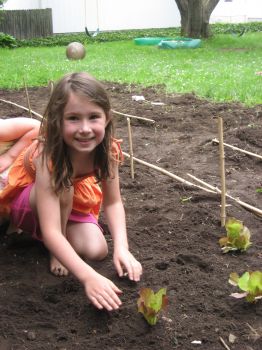
 This past week, our family planted a vegetable garden in our backyard. It was a day of dirty knees, even dirtier fingernails, and lots of shoveling. By the time bedtime rolled around, everyone was exhausted. But of course, not too exhausted for a story.
Coincidentally, we had just received a copy of The Brothers’ Promise, by Frances Harber, a folktale about a family of vegetable farmers. My daughters were delighted by the illustrations of the father teaching the sons to dig up the soil and plant seeds – “just like us, Mama!” They tried to identify all of the vegetables in the wheelbarrow (clearly they have not had sufficient exposure to cabbage in their short lives) and compared the brothers’ crops to our own. (Yes to carrots, but like the Obamas, no to beets.) As the story unfolds, the father makes a dying wish that the brothers continue his farm, and always care for one another. And when a poor harvest strikes the farm, the young men do just that – they sneak wheelbarrows full of food into one another’s cellar, each believing his brother’s needs to be greater than his own.
 I think there is an even deeper lesson about tzedakah in the act of gardening – one that goes beyond surplus crops. There’s a little bit of magic involved in growing vegetables. And although I struggle with how to define it for my children, for me, this magic is some of the strongest evidence I have of God’s presence. While we worked hard, surely we did not work alone. Some years, we are blessed with God’s gifts of sun and rain in all of the right proportions, and some years we are not. In gardens, as in life, when we are blessed, we should share. When we are not, we can only hope that others will share with us.
Indeed, Judaism teaches us that to farm is to share, in a biblical tradition that’s lost to most of us. The Torah mandates that we leave the corners of our fields unharvested, and that we should not pick up fallen fruits and sheaves of wheat. Instead, these are to be left for the poor and the stranger, who do not have their own land to till and tend. Technically, these laws, known as pe’ah and leket, only apply in the land of Israel, but I’ve tried to use our tiny agricultural plot, in a toy-filled backyard, on a busy street in a small New England city, to teach my daughters the values embedded in this tradition. Not only should we give our time and money to the local food bank, but we should invite others to take some of what we grow.
Last year, we posted an ad on the local Freecycle board inviting others to pick from our three apple trees. Granted, this was a painless kind of sharing – our trees dump way more apples than we could ever to use- and we put no effort whatsoever into the crop. But this year, I’d like to take it one step further and figure out a way to share what comes out of our garden not just with friends, but with those in need. Check the blog later in the summer, and I’ll post updates as to whether we’ve succeeded in growing tzedakah in our garden.
originally published in the PJ Library e-newsletter
 Read Previous Post