To permit non-essentials to shape our concerns, our relations, and our reputations is, to use the words of Jesus, to "strain gnats." Hamilton here speaks of Matthew 23:34: "You strain out a gnat but swallow a camel!" Whether we think of the Pope's statement about non-RC churches being defective, the American Episcopal leaders forcing their own way, the neo-Fundamentalists elevating women in ministry to a central idea, and the neo-Reformed contending that only the Reformed are truly faithful ... we could go on ... each of these somehow makes non-essentials the essential thing and each makes the non-essential what divides Christians from Christians.
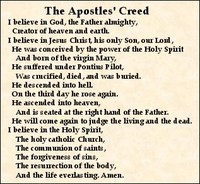
Question of the day: What would be your top <strike>give</strike> five "essential beliefs" of the Christian faith? Is the Apostles' Creed enough for you? What else might you want to add? Anything to subtract?
Adam Hamilton asks this question: "What if all 224 million Christians in America were actually working together to shape a nation that looks like Jesus' vision of the kingdom of God, where poverty does not exist, where people practice justice, where love of neighbor is universally practiced? But this will never happen. We are too busy 'straining gnats'."
Hamilton's plea is for humility, beginning with this: "the hope for the future of Christianity will be found, in part, in our willingness to accept that no one of us has all the truth" (13). What is needed, he explains, is humility -- humility about our own claims, about the legitimacy of the claims of others, and about it being God who has the truth.

Add to Newsvine
Add to StumbleUpon


Bryon,
The part about Pontius Pilate was to emphasize the historicity of Jesus. It makes Jesus a real human who was in Judea when Pilate, a real person was ruling. It is sort of like a date.
And I would argue that the Atonement is implicit in the Jesus being crucified, going down to hell, and rising again. As well as where it says that we too will rise. Keep in mind that a strict "penal substitutionary atonement," though present in the message of Jesus, and likely among his first followers, did not enter the mainstream mind of the Church until Anselm of Canterbury. Look up "Christus Victor" to get an idea of how the early church thought of the atonement. The true victory was not in the Cross (alone anyway) but in the Resurrection.
Tony
Tony,
I agree with the point about the resurrection. That is an area where contemporary preaching is incredibly weak. Yet, doesn't the fact that there are implicit arguments in the statement an argument for its weakness as a foundational piece? I still maintain that the creed as is is incomplete.
Also the statement that Jesus descended into hell is exegetically suspect.
Scott, thank you for discussing my book, Seeing Gray, in your Friday blog. Great question you've asked about essentials. It would have been interesting to ask Jesus what the essentials were. He never seemed to emphasize a credal formation - his emphasis was clearly focused on orthopraxy. The most comprehensive teaching we have of his, the Sermon on the Mount, was not a lecture in systematics but an invitation to a way of life. That's not to say that beliefs are not important - our beliefs shape our actions.
When we come to Paul we find the earliest creed: Jesus is Lord. Romans 10:9 is amazing for its sweeping simplicity - If you confess with your mouth that Jesus is Lord and believe in your heart that God raised him from the dead, you will be saved.
Again, it would be fascinating to have spoken to Paul in his day to ask, "What are the essentials - those doctrines that, if not believed, leaves one outside the Christian faith?
The Greek ICHTHUS might be taken to be a creed that pre-dates the Apostles' and Nicene Creeds. It, too, is quite simple.
Typically I fall back on the Nicene Creed as a statement of the "catholic" (i.e. universal) faith. All creedal denominations affirm it, and most non-creedal churches accept it. It was the first creed to be formally adopted by an ecumenical council representing bishops of both the east and the west. When I think of essentials I think of Nicea.
It is interesting to me that in most "statements of faith" of conservative churches and parachurch organizations the first, and presumably most important, statement of faith is not something that was included in any of the early creeds of the church, nor taught by Paul nor Jesus: biblical inerrancy.
As many have noted, even creeds like Nicea have their challenges. I'm never quite sure what to do with the "resurrection of the body." But in the end it is the most universally accepted of the creeds, it fleshes out the two natures of Christ, and it is the earliest creed that received the affirmation of the church across world.
Thanks for the great discussion, Scott!
Adam Hamilton,
Great to hear from the author. Thanks for your perspective. If I may, though, I feel that you are forcing both binary and anachronistic thinking onto the New Testament material you quoted.
For one, to use the word "orthopraxy" to describe what Jesus was "doing" seems historically naive. There is an implicit worldview and agenda Jesus is enacting when he does this "Sermon on the Mount" (leaving aside for the moment the collective redaction of the Evangelists). Jesus, in announcing the coming of YHWH's kingdom was saying that this and only this is the way to be Israel, reconstituted around himself. So Jesus wasn't emphasising "orthopraxy," he was emphasizing himself! Without the whole 1st century eschatological background, the sermon is nothing but a list of nice things. But, I recognize you did say that beliefs are important; I'm not trying to say that you split the two, merely pointing out that I feel you are parsing the details into 21st C models of thought where they do not always work so well.
It's the same with Paul. "Jesus is Lord," while certainly one of our earliest and most profound creeds, also has the eschatological background. That is to say, the theology must be correct, which holds up the creed.
I'm not trying to sound smart. Anything I say I ripped off of Scot and N.T. Wright. I simply feel that your way of arguing with Scripture isn't totally convincing (to me)
Thank you for contributing writing and thought to the Church,
Blessings
Adam,
It has been pointed out that my language, the use of words like "forced" and "naive" are pretty boastful and too harsh. Forgive me if I offend. I'm not the one writing books, you are!
Tony
Post a Comment
By submitting these comments, I agree to the beliefnet.com terms of service, rules of conduct and privacy policy (the "agreements"). I understand and agree that any content I post is licensed to beliefnet.com and may be used by beliefnet.com in accordance with the agreements.