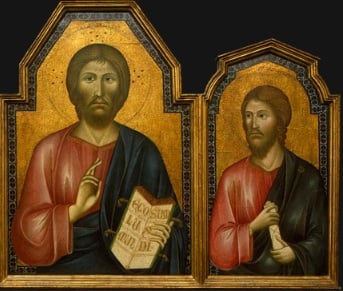
 We begin our series on James today and I suspect it will take us some time. As with previous Bible studies, we’ll do these Monday – Thursday. Our focus will be on how the brother of Jesus, James, offered wisdom to his day and offers wisdom for our day, too. James, we will observe over and over, “looks like” his brother both physically (according to this artist) and teaching-wise.
This study emerges from my commentary on James that I have now sent off to Eerdmans and will appear in about a year, but our focus here will be on the implications of James.
1 James, a servant of God and of the Lord Jesus Christ,
To the twelve tribes scattered among the nations:
Greetings.
James identifies his own credibility for writing such a letter in the term “servant.” The term suggests both a relationship to God and to the Lord Jesus Christ (no there is not anti-empire theology in James), and at the same time a connection to a great heritage: some of Israel’s greats called themselves and were called “servants,” including Moses. It is a good reminder for us to see ourselves as God’s servants and as Christ’s servants, and to let those kinds of “titles” shape our identity and what others think of us. The word “minister,” you may recall, has that sense too.
By connecting himself to the Lord Jesus Christ here James turns everything that follows into “Christian.” That is, James is a messianist and he writes for a messianic audience. This sort of thing matters because some still argue that James is “barely” Christian. Luther, as you know, struggled mightily with James because it didn’t teach his theology of justification and Calvin spends a lot of time wrestling James to the ground so he can get him on his theological side. But perhaps we’re missing something here: not all of earliest Christianity was Pauline or Johannine or Hebrews-ine or Petrine; some of it was Jamesian (better said as “Jakobite” since the Hebrew word behind our “James” is “Jacob”).
I’ve already indicated that James writes to messianic communities. To cut a long, long debate very, very short, I understand “to the twelve tribes scattered among the nations [diaspora]” to refer to (1) ethnic Jews, (2) who were messianic, and who (3) were now living outside the Land of Israel.
A Jewish audience; from a Jewish author; and that Jewish author happened to have been reared in the same home that reared Messiah Jesus.
 Read Previous Post