Jesus Creed

A Woman in the Footnotes

Sunday March 8, 2009

Categories: Women and Ministry
If you've got a Bible close at hand, open it up to Romans 16:7. Herein lies a tale I want to tell you. And I begin by quoting the NIV, then the NASB and then the NLT:

Greet Andronicus and Junias, my relatives who have been in prison with me. They are outstanding among the apostles, and they were in Christ before I was.

Greet Andronicus and Junias, my kinsmen and my fellow prisoners, who are outstanding among the apostles, who also were in Christ before me.

Then there are Andronicus and Junia, my relatives, who were in prison with me. They are respected among the apostles and became Christians before I did. Please give them my greetings.
There's a little trickiness in Greek here, but you'll have to take my word for it that the best scholarship -- and nearly all of it -- thinks Junias (male name) was originally Junia (female name), and the earliest Greek-reading commentator here was John Chrysostom and it was clear as a bell for him: Junia was a woman, and a woman who was called an apostle.
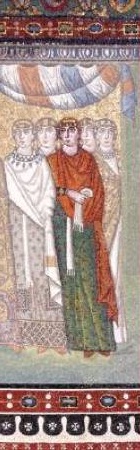
Junia.jpgBut there was a persistent (and at times pernicious) logic sometimes at work that went like this: women can't be apostles so, therefore, Junia (woman) was really Junias (man). This logic impacted what was printed in Greek New Testaments.

Here's the story you need to know: the Greek New Testaments -- the ones your pastor may well have studied in seminary and then studied from in his/her office -- of the 20th Century began with Junia and then shifted to Junias and have only of late recovered the original text as speaking of a woman. What I also want you to know is that most readers of the Greek New Testament rely on the decisions of the textual critics who determine what goes in the text (Junias or Junia?) and what goes in the footnotes (Junia or Junias?). It makes a difference. Correct that: It can make a huge difference. Here's what happened.

Early in the 20th Century some churches started ordaining women, and they had support in Romans 16:7 because it read "Junia" (female). The standard Greek NTs used then were the German-produced Nestle text (editions 1 through 12) and the English-produced British and Foreign Bible Society (from 1904-1958).

But, in 1927 Nestle's 13th edition changed from Junia (woman) to Junias (man). In Nestle 13 the footnote said some other Greek NTs had "Junia." So "Junias" was in the text and our female friend Junia in the footnote until 1979 when Junia disappeared even from the footnotes. That meant that pastors were trained from then on with a Greek text that didn't even let the reader decide if the reading was "Junias" or "Junia."

In 1958 the British and Foreign Bible Society Greek NT changed "Junia" to "Junias," following in line with Nestle. They put the woman in a footnote and most simply trusted the critics who said that apostle was a man, not a woman.

Now a third Greek NT becomes well-known, the United Bible Societies' text and from UBS 1 to UBS 3d edition Romans 16:7 read "Junias." Oddly enough, and blatantly wrong-headed, the UBS text rated "Junias" (a man) as a "certain reading." Only in 1993 did UBS admit that "Junia" might be a reading.

In 1998 Nestle's 27th edition lifted poor "Junia" from the footnotes into the text itself; in 1998 the UBS 4th edition did the same. Now the Nestle-Aland 27th edition doesn't even mention "Junias" in the footnotes.

This once gifted woman, Junia, because she was a woman -- and because women can't be apostles by definition (so it was assumed) -- was removed from the text and hidden in a footnote and then she disappeared altogether. But, thanks to folks like Eldon Epp and others, Junia has returned to the fold, Junias has returned to his own non-existence, and we've got once again a woman whom Paul considered an apostle.

This story is best studied in Eldon Epp's technical book Junias but if you'd like a short story, one on which I relied for this day, you can read two quick pages in R.R. Schulz, "Twentieth-Century Corruption of Scripture," in a journal called The Expository Times 119 (2008) 270-271 (the whole article is 270-274). Yes, there is some dispute; there were no accents in the original texts, but there is now a consensus that "Iounian" was a woman.
Advertisement
Comments
Joel Haas
March 10, 2009 6:40 PM
http://www.joelhaas.wordpress.com

Update.

“IOYNIAN (Rom 16:7) and the Hebrew Name Yehunni.” Forthcoming in The Journal of Biblical Literature.

Suzanne McCarthy
March 10, 2009 8:43 PM
http://powerscourt.blogspot.com

Here is Al Wolters concluding statement found in the footnotes, I believe,

"This conclusion still leaves open the question whether it is more likely that the IOTNIAN of Rom 16:7 reflects a Hebrew masculine name or a Latin feminine one. The answer to that question depends largely on how one assesses the likelihood that Paul would have considered a woman to be "prominent among the apostles" (see Metzger, Textual Commentary, 475).

To some, probability will still favor the quasi consensus of recent scholarship that IOTNIAN in Rom 16:7 refers to a woman. To others, the epigraphic and philological evidence for the existence of a Hebrew name Yëhunnï/Ίουνιας will tip the scales in favor of a male apostle. In my own opinion, a plausible (but not a decisive) case can be made for either position."

Jeremy Radford
March 12, 2009 3:08 PM

I am no where near a bible scholar, just a humble Catholic stubling on to this conversation on the gender of Junia, and her place among the apostles.

I, being thankful for the gift of faith, am confident that whatever the true identity and office of this character of Rom 16:7 doesn't change or raise doubt on the order or role/responsibilty of men and women in the church. If Junia was a woman, she was not a "priest" - impersona christi. She is no less important because of this distinction. Women hold a higher place in the Church than men in their natural role. These statments do not change that men and women are equal in diginty, but different in roles and possibilties.

Janet
June 6, 2009 11:07 PM
http://secret-womens-space.blogspot.com/

No disrespect intended (there are so many wonderful Catholic and Orthodox theologians) but I don't quite get the "priest as impersona christi" thing. On the very few occasions the New Testament scriptures connect Christians to the "priest" word (I've only found 4... see below) it is ALWAYS plural, implying all believers are "priests" (able to minister to both God and others). A special class of "priests" doesn't appear to exist in the New Testament... only the leadership of apostles, prophets, evangelists, pastors and teachers (Ephesians 4:11) plus elders and deacons and overseers... but the "priest" class did not appear to exist in the New Testament era.

Why and when did a "priestly" class evolve? Seems very Old Testament to me.

1 Peter 2:9
But you (plural) are a chosen people, a royal priesthood, a holy nation, a people belonging to God, that you may declare the praises of him who called you out of darkness into his wonderful light.

Revelation 1:6
To him who loves us and has freed us from our sins by his blood, and has made us to be a kingdom and priests to serve his God and Father—to him be glory and power for ever and ever! Amen.

Revelation 5:10
You have made them to be a kingdom and priests to serve our God, and they will reign on the earth."

Revelation 20:6

Blessed and holy are those who have part in the first resurrection. The second death has no power over them, but they will be priests of God and of Christ and will reign with him for a thousand years.

Janet
June 6, 2009 11:11 PM

Oh, and another thought... if the most conservative interpretation is right, and Junia has ONLY an outstanding reputation among the apostles (rather than recognised as an apostle) is that not still an absolutely remarkable commendation of the leadership of anyone?

It's hardly an argument for women sitting around doing the knitting... to be so prominent in the church of God that the apostles esteem her as "outstanding", and the Romans clap her in prison in an attempt to suppress her influence in the church.

Read All Comments

Post a Comment

By submitting these comments, I agree to the beliefnet.com terms of service, rules of conduct and privacy policy (the "agreements"). I understand and agree that any content I post is licensed to beliefnet.com and may be used by beliefnet.com in accordance with the agreements.


Please type the text you see in the box below to verify your post and help us prevent spam. You have a limited time to type - you may wish to compose your comment in a separate document and paste it here upon completion.

Type the characters you see in the picture above.

Advertisement

Search This Blog

About Jesus Creed

Scot McKnight is a widely-recognized authority on the New Testament, early Christianity, and the historical Jesus. He is the Karl A. Olsson Professor in Religious Studies at North Park University (Chicago, Illinois). A popular and witty speaker, Dr. McKnight has given interviews on radios across the nation, has appeared on television, and is regularly asked to speak in local churches and educational events. Dr. McKnight obtained his Ph.D. at the University of Nottingham (1986). Click to continue reading Scot McKnight's Bio...

View Scot's Speaking Schedule

Contact Scot at Facebook

feed icon Subscribe

RSS Feed

Receive updates from Jesus Creed

Calendar


Add to Technorati Favorites

Blogroll

Daily Prayers:

Emerging Movement:

Other sites I frequent:

Recommended Online Readings:

Scholarly Books I've written:

Scholarship Online:

Stuff online:

Advertisement

Advertisement


About Beliefnet

Our mission is to help people like you find, and walk, a spiritual path that will bring comfort, hope, clarity, strength, and happiness. More about Beliefnet.

Legal

Copyright © Beliefnet, Inc. and/or its licensors. All rights reserved. Use of this site is subject to Terms of Service and to our Privacy Policy. Constructed by Beliefnet.

Advertisement

Report as Inappropriate

You are reporting this content because it violates the Terms of Service.

All reported content is logged for investigation.