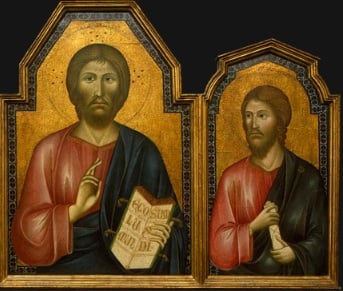
Attentive readings of this account reveal that Jesus had the same
solution and saw the same problems seen by Mary, Zechariah, and John
the Baptist: injustices everywhere. And he had the same solution:
repent and start living together as God’s beloved community. Listen to
his words from Luke 4:18-19 that Jesus quotes from Isaiah 61:1-2:
The Spirit of the Lord is on me,
because he has anointed me
to proclaim good news to the poor.
He has sent me to proclaim freedom for the prisoners
and recovery of sight for the blind,
to set the oppressed free,
to proclaim the year of the Lord’s favor.
In Luke’s telling of his story, we now have to ask our question: If
the kingdom is the solution, what was the problem according to Jesus’
first preaching event? Clearly, it was not what traditional
evangelicals very often hear – Jesus didn’t say a word here about
accepting him as personal Savior or of saying the sinner’s prayer.
Instead, by appealing to the language of Israel’s release from the
Babylonian Captivity, Jesus declared a solution to the following
problems: poverty, unjust imprisonment, blindness, and (quite likely)
the need for the Jubilee to be set in motion. The expressions “freedom”
and “the year of the Lord’s favor” are allusions to the Jubilee of
Leviticus 25
If this solution Luke tells us sounds strange to you, I ask you to read this passage again. It’s in your Bible and in mine. Mary’s and Zechariah’s and John’s stories differ from Jesus’ but only slightly. Jesus carries on their vision to announce that the kingdom he is setting in motion is a kingdom that will undo injustices, establish justices, and create a society where God’s will is done. The gospel is about church formation before it is about personal formation.
Jesus Blessing People
We need to jump ahead two chapters in Luke’s wiki-story to the Beatitudes (Luke 6:20-26). Once again we find both an important passage for Jesus and another glance at the problem the kingdom is resolving. First, let’s get something straight: these “blessings” (Latin, beatitudo) are not Jesus’ version of Paul’s fruits of the Spirit. In fact, the Beatitudes are not setting out a list of virtues at all as if you and I ought to work hard at being poor or hungry so we can be blessed. No, the Beatitudes are a list of the kind of people who are finding their way into Jesus’ kingdom by jumping out of the boat and chasing after him. They remind us of something important to what we have already seen: Jesus is gathering a community made up of all sorts and it is especially populated by those at the margins of society.
Blessed are you who are poor,
for yours is the kingdom of God.
Blessed are you who hunger now,
for you will be satisfied.
Blessed are you who weep now,
for you will laugh.
Blessed are you when people hate you,
when they exclude you and insult you
and reject your name as evil,
because of the Son of Man.
Jesus knows the poor, the hungry, those in mourning, and the oppressed are responding to the kingdom. Like his mother who pushed sharp barbs into the ribs of the oppressors, Jesus turns on another group for what they have done to the poor, hungry, mourning and oppressed.
But woe to you who are rich,
for you have already received your comfort.
Woe to you who are well fed now,
for you will go hungry.
Woe to you who laugh now,
for you will mourn and weep.
Woe to you when everyone speaks well of you,
for that is how their ancestors treated the false prophets.
Again, if the kingdom is the answer, what was the problem? A society marked by poverty, hunger, sadness, and oppression. Jesus came to form a community that would undo all that.
Jesus Answering John
Luke tells us that John is in prison for pointing his long finger at an empire builder, Herod Antipas. Antipas didn’t have the moral backbone to follow the Torah. John hears what Jesus is doing and sends two of his disciples to see if Jesus is “the one who is to come” or not. Jesus’ response in Luke 7:18-23 does nothing but confirm what we have already seen from Mary and Zechariah and John and Jesus’ words. Don’t tame these blue parakeet words. Let them say what they say.
So he replied to the messengers, “Go back and report to John what you have seen and heard:
The blind receive sight,
the lame walk,
those who have leprosy are cleansed,
the deaf hear,
the dead are raised,
and the good news is proclaimed to the poor.
Blessed is anyone who does not stumble on account of me.”
John’s question was not a theological test. What John wanted was for Jesus to hear what John was thinking: “If you are the One who is to come, then get me out of prison.” Jesus’ answer is this: “If you want to know what I am doing, this is it: I welcome back into society those who have been excluded. Especially the poor.” He adds a potent summons: “Don’t get tripped up because of who I am and what I do because I don’t do what most people think I’m supposed to do.” Once again: the problem is community injustice and the solution is community justice – for all. The last line of Jesus’ answer John says this: “Blessed is anyone who does not stumble on account of me.” This line puts Jesus at the center of the kingdom. The “me” of that line is about to announce a new paradigm for what kingdom means and any kind of commitment to the kingdom involves a commitment, a personal one, to Jesus. The Story, as it were, converges onto one person. In fact, the Story is a Person.
We now enter a new chapter in the Story with Jesus and this chapter turns everything upside down. Everything. Mary had to adjust everything to this change; had Zechariah or John been around, they too would have adjusted.
 Read Previous Post