Advertisement
Scot McKnight is a widely-recognized authority on the New Testament, early Christianity, and the historical Jesus. He is the Karl A. Olsson Professor in Religious Studies at North Park University (Chicago, Illinois). A popular and witty speaker, Dr. McKnight has given interviews on radios across the nation, has appeared on television, and is regularly asked to speak in local churches and educational events. Dr. McKnight obtained his Ph.D. at the University of Nottingham (1986). Click to continue reading Scot McKnight's Bio...
Daily Prayers:
Emerging Movement:
Other sites I frequent:
Recommended Online Readings:
Scholarly Books I've written:
Scholarship Online:
Stuff online:
# 1 Mick
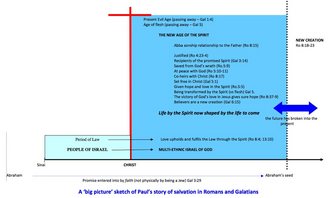
good idea on including the Gentiles, thanks - I was concentrating on God's unfolding promise to Abraham. I enjoyed trying to picture Paul's argument and it clarified for me the big picture eschatological framework of his argument and how the NPP has the right emphasis here. The other aspect is the absolutely crucial role of the Spirit - something that all too often has tended to be sidelined as some sort of abstract 'add on' to 'the gospel' within some strands of evangelicalism. This was the case in my experience - it was not that the Spirit was denied, it was just that there was just no coherent 'place' for him within a predominantly legal / individual understanding of the gospel.
Dru,
Great point about the parenthesis being around the law and not around the church - I would totally agree, and the diagram shows that quite well.
However, when you say the "law was the tutor" and "now we're re-newed..." who are you referring to? Surely the law was the tutor *for Israel* for that period? Paul tends to talk in Galatians about "we", "you", and "us" referring to Jews, Gentiles, and Christians (the new covenant people made up of both Jews and Gentiles).
Unlike Paul, I personally was never in bondage to the Torah, and neither were my ancestors. I come from Gentile stock who were in bondage to false gods. Paul's quite radical point here is that if I then place myself under Torah I just go into someone else's form of bondage - thus he explosively makes Torah observance somehow equivalent to pagan idolatry.
Mick, that's mostly how I see it too. My ancestors were running around the british isles naked and painted blue, worshipping trees, while Paul was writing this. I was using "we" a bit loosely, identifying myself with Israel, as I too am part of the grafted in wild branches on that old olive tree. I am Israelite by faith.
So I agree that's Paul's meaning. On a more personal significance level, I've watched lots of gentile Christians - including myself - recapitulate in a way Israel's and the Galatian's history. Starting with an exodus, freedom, and then living under the bondage of performance religion and legalism, until once again meeting the Seed and being set free.
And I'm hanging around with Messianic Christians who think being grafted into Israel leads one to love God and neighbor as the Jews were taught to: by Torah keeping. Thank you for the chart, it makes sense to me.
BTW, I finally posted my diagrams, FWIW.
Post a Comment
By submitting these comments, I agree to the beliefnet.com terms of service, rules of conduct and privacy policy (the "agreements"). I understand and agree that any content I post is licensed to beliefnet.com and may be used by beliefnet.com in accordance with the agreements.