Can These Bones Live? This is the question posed in Chapters 10 and 11 of Alister McGrath's book A Fine-Tuned Universe: The Quest for God in Science and Theology where he gives a brief overview of the chemical requirements for the origin of life.
There are two facets to this discussion.
The first is really a continuation of the general observation of fine-tuning in the universe. Life as we know it requires (1) the intrinsically flexible chemistry of Carbon, with Oxygen, Nitrogen, and Phosphorous also thrown into the mix and (2) the unique properties of liquid water (H2O). The presence of these elements and the presence of a water layer on earth arise from the fine-tuning of the primitive universe to produce the right chemical elements and the right environments.
But these building blocks - the chemical elements - are not the biggest
mystery. The more profound questions involve the emergence of life -
the origin of self-replicating molecules that lead to the formation of
humans capable of abstract reasoning, creative thought, and love. The second facet to McGrath's discussion of fine-tuning is the complex question of the development of life
from the primordial soup of chemical precursors. This is an enormous
puzzle and McGrath only sketches the tip of the iceberg.
Ah, ... but before we ponder this we must consider, with McGrath,
What is life? When can an ensemble of molecules, comprised of atoms, themselves composed of elementary particles, be said to be "alive"?
On the most elementary level life consists of an enclosed system capable of metabolism and reproduction - although the later needs some nuance. So a discussion of the origin of life must consider these elements.
McGrath suggests that "life could be defined as a "self-sustaining chemical system," able to transform resources into its own building blocks, that is "capable of undergoing Darwinian evolution."
Once a self-replicating cell is produced evolution by natural selection provides a mechanism to introduce variation and complexity, but
evolution provides no mechanism for formation of the first cells. There are several complex questions in the formation of life, more than I can list in a simple blog post. But we can consider three as examples of the kinds of questions faced.
1. The synthesis of the fundamental organic building blocks, the molecules of life. But cosmic organic chemistry is relatively common - spectroscopic measurements have identified many of organic molecules in space, meteorites and comets have provided more evidence. The evidence includes the formation of many simple compound, but also more complex and fundamental molecules, including amino acids - the building blocks of proteins.
The evidence of this comes from ... and the detailed chemical analysis of meteorites that have fallen to Earth, such as the famous Murchison meteorite of 1969. ... The Murchison meteorite, for example, was found to contain certain common amino acids such as alanine, glycine, and glutamic acid, in addition to more unusual ones such as isovaline and psuedoleucine. These could not be due to terrestrial contamination as a result of the impact of the meteorite. (pp. 134-135)
The Wikipedia article appears to give a balanced account of this meteorite. There is some evidence for terrestrial contamination but there also seems to be clear evidence for extraterrestrial formation of amino acids. The famous Miller-Urey experiment also demonstrated the formation of complex organic molecules under conditions potentially similar to those of the early earth. All these experiments or discoveries demonstrate is that organic chemistry is robust and that amino acids are stable and kinetically favored under a range of conditions.
2. The synthesis of an information carrying molecule. It is widely believed that RNA (ribonucleic acid) filled this function initially. RNA is capable of a multitude of functions - it can carry information, it can self-assemble and self-replicate, it can act as a catalyst - a ribozyme, it can synthesize proteins (which are even better catalysts - enzymes), and eventually it can modify to produce DNA (deoxyribonucleic acid). But there is no consensus on how the synthesis of nucleotides from prebiotic presursors came about - no known reactions appear capable of this synthesis. Research is ongoing.
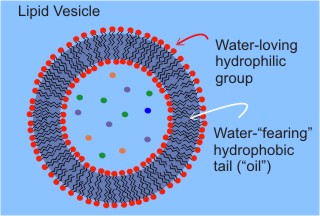
3. Develpment of contained organisms. The transition from "chemical soup" to life requires more than nucleic acids and amino acids however. It requires the formation of a protoorganism. "This "protoorganism" can be thought of as a single cooperative aggregate consisting of a protocontainer, a protometabolism, and protogenes." (p. 137) Here we really get into the importance of the unique properties of water as the biological solvent. Water enables complex acid-base equilibria, it dissolves polar molecules and excludes non-polar (think of the separation of oil and water). Lipids have nonpolar tails and polar headgroups combined in one molecule. In water these spontaneously form vesicles - rudimentary "cell membranes." Water supports complex chemistry and the formation of complex structures. It is speculated that a protoorganism could form from lipid vesicles in water encapsulating RNA and other simple molecules.
Can we see the hand of God in this process?
It must be admitted that we have no firm ground for speculating on the mechanism for the initial formation of life at the present time. Science continues to progress however, and perhaps we will have a viable explanation, sooner rather than later. On the other hand, a natural explanation doesn't negate the presence of fine-tuning in the universe, or eliminate the hand of God in the process. And here we (and McGrath) return to Augustine.
It will also be clear that Augustine's notion of rationales seminales plays an important heuristic role in engaging with the complex chemical phenomena that have briefly been described in this chapter. The emergence of chemical complexity precedes that of biological complexity and is generally ignored in accounts of biological evolution. Yet the importance of this point is clear: without an inherent capacity for chemical complexification, the foundations for biological development would not have been in place. These chemical properties must be regarded as emergent. Augustine's image of the dormant seed, awaiting the right conditions for germination, is a helpful analogue for understanding how certain chemical properties emerge under appropriate circumstances.
... On the basis of known biochemical systems, biological evolution remains dependent upon chemical properties which were ultimately determined in the primitive state of the universe. (p. 142)
What do you think - What constitutes life? What role do you think that God played in the formation of life? Did he embed a seed in the big bang or did he play a more personal role guiding and directing the process?
If you wish to contact me directly you may do so at rjs4mail [at] att.net.

Add to Newsvine
Add to StumbleUpon


Freelunch,
Do you honestly not understand what doperback is saying/asking? He's calling into question your conclusion that empiricism is the only measure of "reality".
You keep saying otherwise, but that is a FAITH CLAIM. You're welcome to it. But stop making it out to be anything other than what it is - an assumption.
Also, if you really don't understand the questions that doperback is asking you, then I'd suggest you are so far down the rabbit trail of one particular worldview that you're having difficulty even seeing it with some semblance of objectivity.
Darren King,
I understand what he is doing. I just don't think he is doing anything that shows a serious interest in discussion. If he objects to the idea that empiricism works, then it is up to him to tell me why and to offer an alternative that works better. As long as he fails to do either, he's no better than someone who plays games with epistemological nihilism.
Just equating every view of the world as a 'faith claim' ignores the proven difference in the effectiveness of the differing views. I see no reason to give any world view that refuses to test itself any sort credence. When you or dopderbeck want to start talking about a worldview that can be shown to be at least as reliable as empiricism, then there's something worth talking about, otherwise, you're just asking me to waste my time discussing utterly meaningless claims.
Thanks for your response RJS (#39). I am no expert on the ancient atmosphere, and when I looked just now, the answer seems complicated (as is typical!). I think the state of play is that the experiment assumed a reducing atmosphere, and then people starting thinking it was actually mostly the opposite. Now people are arguing that volcanic activity, etc. could have provided conditions more like the experiment and so offered an avenue of production of some amino acids.
Either way, I agree with your conclusion that the (much) bigger question is how do you get from chemicals to life. I also think that there is a significant question (or at least additional explanation needed) for how you get from simple organic molecules to complicated ones, and for how those complicated ones get coded with what can only be described as information.
Darren, FK and Dopderbeck,
I don't know if anybody else is, but I am fascinated by the discussion, and as a religious perosn I am very interested in FL's point.
I think his point is being missed, if I understand it correctly. I do not belive that it it fair to characterize a general way of looking at the physcial world as a a "faith position." That charcaterization adds little to the discussion.
I think that you are instead suggesting that FL is pre-committed to a paricular world view and it is that pre-committment that is a "faith position." I do not hear FL asserting any such pre-committment.
Instead he is simply saying that, by trial and error over human experience, we have come to expect things to operate in certain ways under normal circumstances. As a pragmatic matter it is fairly safe to plan your life around the assumption that such things will continue to follow observed patterns.
For example, FL assumes that gravity normally works. Therefore he expects to go down if he steps off of cliffs. I suppose there are other ways of knowing, such that you can have an expectation that maybe angels will hold you up. (Acts1:1-11) Pragmatically, however, the expectation that gravity works as we have observed from multiple human experiences is a good way to plan your life.
If things have changed, or the observations no longer hold true, then pragmatism allows an indivdual to change their mind about the validity of the patterns we have prevously observed. Pragmatism is not particualry wedded to any worldview or even religion.
FL pragmatically disregards phenomena that cannot be observed to effect his life. Those phenomena may well exist. I think he used the unicorn example. Unicorns may exist in some part of the world or even on some other planet or may exist in the same sense as fairies, pixies and lepreechauns, but FL and the rest of us live our lives pragmatically as if unicorns have no effect on our lives. Those who live as if unicorns have no effect on their lives seldom suffer ill effects as a result of that assumption. I suspect almost all of us posting here act as pragmatically as FL with respect to unicorns. I do not characterize my thoughts on unicorn existence as "faith-based."
There is nothing faith based about any of this. There is no "faith" that pragmatism always works. Our pragmatic reliances may one day prove fatal. However, pragmatic reliance on the laws of physics operating in this world is not a bad way to respond and interact with the world. It has a track record of success--nothing more. Your mileage may vary and past results are no guarantee of future performance.
FL is apparently atheist.
As I understand him, he acts exactly the same with respect to the existence of God as he does to the existence of unicorns. To him this si still not a question of faith. God may exist but simply not manifest Himself in any way to FL or God may not exist.
It seems unproductive to claim that such a view is "faith based." It gets you nowhere and reduces "faith to a meaningless concept.
Instead, the question to be answered is, "How does God manifest Himeslf in this world? What has happened in this world so that we should assume that God makes a differnce to us and how we plan our lives?"
The fine tuning argument attempts to answer that question by suggesting that the universe itself could not come into existence without Divine action.
Any other examples to offer FL?
Freelunch (#55) and UC (#57) -- the problem is that the thread as wandered. Early on in this thread, Freelunch claimed that his approach involved very few unverifiable assumptions. I challenged that claim -- I think quite successfully. As far as I can tell, Freelunch hasn't responded to any of my challenges, except to ask me for something better.
The point is this -- all of us unavoidably base lots of what we known on "faith." The empiricist is in no better position here than anyone else. When Freelunch or the new atheists suggest that their view is the only responsible one because it is based firmly on "science" or empirical observation, while other views are based on "faith," that is hogwash. All knowledge claims rely heavily on faith, even empirical ones. Logical positivism died decades ago.
As to Freelunch's question about why empricism doesn't "work" -- I've answered that a couple of times already as well.
Empirical methods work reasonably well for certain kinds of things that we can observe. Even here, empirical methods can't produce real certainty. Human capabilities are limited. There could be enormously important things in the physical universe that we can't observe, and that could fundamentally change how we think.
Indeed, this is exactly what happens every time new technology enables us to observe what was previously unobservable (think the telescope and the microscope). The notion that human capabilities of observation are as extensive as the universe itself is just hubris. Yes, we can have and have had progressively better knowledge of the physical universe -- sometimes with astonishing speed -- but this very idea of "progress" demonstrates that we never grasp all of it.
Moreover, empirical methods ultimately can't comment one way or the other on whether a thing that is by definition un-observable -- e.g., God or a "spiritual" aspect of reality. This is where Freelunch's (and the new atheist's) approach really falls apart. If God exists, He is the most important thing in reality to know about. Yet, Frelunch's empirical method excludes, by definition, the possibility of knowledge of God. So how could anyone consider adequate a method that automatically excludes knowledge of the thing that, if it exsists, would be the most important thing to know about? Again, this seems to me the utmost in hubris: "I can't see it, so therefore it must not exist, or at least it must not be very important."
Post a Comment
By submitting these comments, I agree to the beliefnet.com terms of service, rules of conduct and privacy policy (the "agreements"). I understand and agree that any content I post is licensed to beliefnet.com and may be used by beliefnet.com in accordance with the agreements.