Jesus Creed

Tell us what you think: from John LaGrou

Friday July 17, 2009

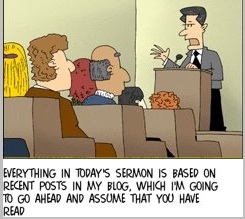
Sermon.jpgJohn LaGrou is avant garde when it comes to the power and value of technology. In this post, he questions the long term value and survival of the Sunday sermon. What do you think?

Antoine at MMM asks, "How Do Faith-Based Organizations Respond to Increasingly Mobile-Connected Members and Communities?" This isn't just a good question. I think it echoes a central dynamic shaping not just religion, but all social organization going forward.

How do faith-based organizations respond to virtuality? The hardest part may be convincing the community that there's a good reason to sit and stare at a stage, listening to a religious lecture. The virtually-connected church now has on-line access to the finest teaching and preaching imaginable, accessible at their convenience, 7 x 24 x 365. Of what value is physically proximate information (e.g., stage-centric pastor) when the average person can now access the best sermons, preaching, teaching, and cross-referenced commentary on-line?

Finding better information elsewhere, the virtually-connected community will restructure their physical gatherings to really connect and be present with each other - like they do on-line all week long. When this happens, pastors can step off the stage and be released to really pastor. Gifted teachers (who may or may not have pastoral gifts) can teach in smaller groups where true interactivity can take place. Intimate, organic F2F gathering becomes the central focus, not a mid-week breakout session.


I listen to the world's finest theological discourses via my Blackberry while I workout at the gym or on my morning walk or driving in my truck. Why would I spend my time sitting in an audience every Sunday to hear a comparatively mediocre religious talk? In the last few weeks, I have absorbed hours of profound spiritual monologues and conversations with people like Tozer, Yancey, Peterson, and Fr. Rohr.

We all have something to contribute, together. A virtuality-connected community (which is everyone in my son's generation) will increasingly mimic their on-line engagement in F2F gatherings, signaling the end of the monologue church era. "Church" is redefined, in part, from a place of one-way information transfer to a distributed gathering which fosters authentic collaboration - in many ways mirroring the multi-way virtual experience.

Is it the end of the Sunday Sermon? No. Not in my lifetime, nor in my son's lifetime, nor perhaps anytime. And certainly there is a place for the stage. But generational changes in networking assure that a profound shift is coming. And this gives me great hope for a virtual reformation in the way we live as a glocal spiritual community.

Advertisement
Comments
Karl Dahlfred
July 17, 2009 11:35 PM
http://www.dahlfred.com/blogs/gleanings-from-the-field

Online interaction will never replace face-to-face interaction. Also, more fundamentally, a good pastor will have relationships with his congregation and they with him such that his sermons will be suited to the understanding and needs of the congregation. The truth of Scripture may be the same but the application needs to be local - i.e. suited to the people and their situation in life. A pastor who knows his people can speak to where they are. Most people do not have the time or ability to search for a sermon online that is precisely suited to them. A sermon is not one size fits all and to think that online church or sermons will replace the fellowship of the saints is to be too individualistic and consumer oriented. The church is the body of Christ that fellowships together and bears one another's burdens, not merely all showing up in a physical location for a religious lecture.

Richard W. Wilson
July 18, 2009 2:09 AM

Fascinating reflections on the part of all. I just last week experienced my first recorded video sermon by Darin Patrick at The Journey here in St. Louis; I think the other three "campuses" have been getting video feed of live sermons from the central campus where we have been worshiping for some time. There really isn't any intimate or extensive fellowship or interaction of the congregants, particularly with the pastor/preacher/teacher, on Sunday mornings anyway, but there is participation, spiritually with God and the community on various levels.

I "get" the sense of not needing to be there to engage with the pastor/preacher's input as I've been maintaining a sort of involvement with another congregation (from which my wife and I are mostly estranged) through listening to the sermons of the pastor with whom we don't "relate." (I still meet with a mens' group from that church too).

I also "get" the sense of being able to access superior preaching/teaching 24/7/365--this DOES change things. I'd guess that we can't now begin to see how things will "emerge" among the churches in coming years. We will grow, change, adapt, and by the grace of God be transformed more and more into His image despite our natural tendencies to desperately hang on to old modes of church and humanness.
For Christ and His Kingdom,
Richard W. Wilson

John L
July 18, 2009 11:14 AM

Thanks, all, for the excellent comments. I purposefully exaggerated my point (a bit) to elicit a response - to get people thinking about our Western religious-consumeristic status quo – to take a fresh look at things we often take for granted. I do think future generations are going to change the nature of religious gathering – perhaps radically - and virtuality will be a central catalyst driving many of these changes.

Karl, I'm not inferring that on-line activity should replace F2F interaction. Not at all. I'm considering the ways in which virtuality might enhance our expectations of F2F experience, just as printed books radically changed our glocal culture, including religious culture.

"a good pastor will have relationships with his congregation and they with him such that his sermons will be suited to the understanding and needs of the congregation."

Let's not overly romanticize. Unless there are specific issues common to a single community (which at times there are, of course), the "needs" of any particular community are fairly universal. Speaking from personal experience (25+ years of sitting and listening to local sermons), it's rare to hear anything deeply tailored for locality, save for the occasional rhetorical use of some shared local experience (local news event, a road everyone drives, etc.)

Someone shared privately “…but I really like the live sermon. It is part of my heritage.” I can’t argue with that. But I do think, for those interested in such things, we can find a far more organic balance to our gatherings. Moving away from the stage, towards a common floor we all share, might be a positive beginning.

We can now encounter the greatest religious monologues anywhere, anytime. So let’s use our rare F2F gathering time to really connect as community, rather than as individual spectators. As givers rather than consumers.


Cindy N
July 20, 2009 10:47 PM

Of course, one interesting effect of sermons no longer being preached is that there would no longer be a weekly setting for all those stunningly articulate preachers to preach so they could be recorded, thus killing the goose that laid the golden egg....

joanne
July 21, 2009 10:35 AM

I think the message will no longer be controlled or shaped by those in power. That is good news. I think that any who are savey enough to look things up will and a variety of view points will abound. I think dialogue will be an imperative as folks come to the community and want to talk about what they have learned in virtual community.

Read All Comments

Post a Comment

By submitting these comments, I agree to the beliefnet.com terms of service, rules of conduct and privacy policy (the "agreements"). I understand and agree that any content I post is licensed to beliefnet.com and may be used by beliefnet.com in accordance with the agreements.


Please type the text you see in the box below to verify your post and help us prevent spam. You have a limited time to type - you may wish to compose your comment in a separate document and paste it here upon completion.

Type the characters you see in the picture above.

Advertisement

Search This Blog

About Jesus Creed

Scot McKnight is a widely-recognized authority on the New Testament, early Christianity, and the historical Jesus. He is the Karl A. Olsson Professor in Religious Studies at North Park University (Chicago, Illinois). A popular and witty speaker, Dr. McKnight has given interviews on radios across the nation, has appeared on television, and is regularly asked to speak in local churches and educational events. Dr. McKnight obtained his Ph.D. at the University of Nottingham (1986). Click to continue reading Scot McKnight's Bio...

View Scot's Speaking Schedule

Contact Scot at Facebook

feed icon Subscribe

RSS Feed

Receive updates from Jesus Creed

Calendar


Add to Technorati Favorites

Blogroll

Daily Prayers:

Emerging Movement:

Other sites I frequent:

Recommended Online Readings:

Scholarly Books I've written:

Scholarship Online:

Stuff online:

Advertisement

Advertisement


About Beliefnet

Our mission is to help people like you find, and walk, a spiritual path that will bring comfort, hope, clarity, strength, and happiness. More about Beliefnet.

Legal

Copyright © Beliefnet, Inc. and/or its licensors. All rights reserved. Use of this site is subject to Terms of Service and to our Privacy Policy. Constructed by Beliefnet.

Advertisement

Report as Inappropriate

You are reporting this content because it violates the Terms of Service.

All reported content is logged for investigation.