Daily Prayers:
- A. Book of Common Prayer
- A. Book of Common Prayer 2
- A. Divine Hours
- A. Evening Prayer (Anglican)
- A. Morning Prayer (Anglican)
- Celtic Prayer
- Creeds of Christendom
- Eastern Orthodox Prayers
- Lectionary
- Liturgy of the Hours
- Missio Dei
Emerging Movement:
- Andrew Jones
- Andrew Perriman
- Anthony Stiff
- Art Boulet
- Bob Robinson
- Br. Maynard
- Dan Kimball
- David Fitch
- Dogwood Abbey
- Ecclesia Network
- Emerging Women
- Eugene Cho
- Henrik Holmgaard
- Jamie Arpin-Ricci
- Jazz Theologian
- John Frye
- John Lagrou
- Jonny Baker
- JR Briggs
- Leonard Hjamarlson
- LeRon Shults
- Lukas McKnight
- Peggy Brown
- Sivin Kit
- Stephen Shields
- Steve McCoy
- Steve Taylor
- Tamara Buchan
- The Practicing Church
- Tim Miekley
- Todd Hiestand
- Tom Smith (RSA)
- Tony Jones
Other sites I frequent:
- Allan Bevere
- Andy Rowell
- Attie Nel
- Barna
- Brad Boydston
- Chris Ridgeway
- CC Blogs
- Don Johnson
- Ed Gilbreath
- Erika Haub (Carney)
- Faith Blogging
- Falsani
- Fr. Rob
- Hummers
- iMonk
- James McGrath
- Jim Martin
- John Stackhouse
- JR Woodward
- Karen Spears Zacharias
- Laura Barringer
- LaVonne Neff
- LeaderFOCUS
- LL Barkat
- Luke/Annika
- Mark Galli
- Mark Roberts
- Michael Kruse
- Nexus
- Owen Youngman
- Ted Gossard
- Tom Wright
Recommended Online Readings:
Scholarly Books I’ve written:
- Dictionary of Jesus and the Gospels
- Hist Jesus Anthology
- Interpreting the Synoptic Gospels
- Introducing NT Interpretation
- Jesus and His Death
- Jesus in Memory (ed.)
- New Vision for Israel
- Synoptics: Biblio
- The Face of New Testament Studies
- Who Do They Say I Am?
Scholarship Online:
- Apollos
- Books & Culture
- ChristianityToday
- CS Lewis
- EAC
- Early Xian Writings
- Euaggelion
- Gospels
- Jesus and His Death Blog
- Karl Barth Online
- Mark Goodacre’s Weblog
- Online Journals Access
- Online Pseudepigraph
- Pete Enns
- Prime Time Jesus
- Theopedia
- ThinkTank
Stuff online:
- 5 Streams
- Big Muddy
- Catalyst Scripture
- Catching the Wave
- DaVinci Code
- Forgiveness
- Future or Fad?
- Gospel of Judas
- High Calling
- Interview on Emerging
- Interview with LL Barkat
- IVCF Eikons
- IVCF Gospel
- John Bunyan
- Keys of the Kingdom
- Lake Emerging
- Mary in CT
- Missional in Seattle
- Missional Matrix
- Nativity Story
- Never Alone
- New Perspective
- Pepperdine Interview
- Professor as Scholar
- Recl Mind Mary 1
- Robust Gospel
- Social Justice
- Trojan Horse 2
- WiredParish Mary Interview
- Word/World NPP


posted August 21, 2009 at 12:52 am
I am conflicted. Scripture certainly allows for such acts of judgment by God. And should expect judgment to come upon God’s own house first. Yet my first reaction to Piper was heavy skepticism and even distaste for such a statement. And I’m still asking myself why.
One of the primary reasons I hesitate to draw his conclusion is that is sounds too similar to Pat Robertson?s views of Hurricane Katrina as judgment on East Coast and Jerry Falwell?s statement that 9/11 was God?s judgment on gays, feminists, abortionists and other sinners. I abhor such statements and think their incredible out of line. Is this the same thing?
There is a significance difference: I believe God?s judgment is more severe and warranted upon those who are called leaders of his church, shepherds of his flock and guardians of His sacred Word. ?What business is it of mine to judge those outside the church? Are you not to judge those inside? God will judge those outside? (1 Cor 5:11-13). So, for this reason, Piper?s call to repentance is more palatable than those self-righteous Christians who constantly like to condemn the behavior of those outside the church.
I am still uncomfortable with Piper’s conclusion. But I’m more uncomfortable with those whose theology doesn’t even allow for such an act of God if He so chose. This side of God makes me squirm – and maybe that’s appropriate. Anyone find their theology conflicted by this story?
My full reflections are posted at http://www.JeremyBerg.org.
posted August 21, 2009 at 12:54 am
I am always cautious of statements made in haste without time taken for prayerful discernment.
It reminds me a great deal of this quote by Jerry Fallwell from September 13, 2001:
“I really believe that the pagans, and the abortionists, and the feminists, and the gays and the lesbians who are actively trying to make that an alternative lifestyle, the ACLU, People For the American Way, all of them who have tried to secularize America. I point the finger in their face and say ‘you helped this happen.’”
posted August 21, 2009 at 1:02 am
For Piper to be saying this strikes me as phenomenally stupid, for a whole lot of reasons, but to remain within the context of this discussion, I think it suffices to say that Piper’s epistemology is baffling at best. There’s no way one can draw solid conclusions about God’s intentions or otherwise when an event like this occurs.
posted August 21, 2009 at 1:21 am
On one hand, attributing bad weather to an angry God seems a ridiculous thing to do – something that is better left for eras when meteorological analysis was next to zero and people clamored for some semblance of understanding amidst seemingly random weather events.
On the other hand, I think Piper actually does those of us who oppose such thinking a favor by being so outspoken about it. Because, once one is forced to really think through where you draw the line on this kind of thinking, it clearly emerges as an untenable theology.
posted August 21, 2009 at 1:27 am
Wow. It’s not surprising though. I remember his remarks a couple of years ago about the bridge collapse were along similar lines. It’s tough to know without a prophet. It works under the assumption that every natural disaster happens because of some sort of horrid sin. I would just like to ask, really? The hundreds of thousands who died as a result of the tsunami died because that was God’s judgment on their sin? So that means none of them were righteous believers? Are Christians exempt from this or something? Was hurricane Katrina a result of our acceptance of homosexuality too? I’m so glad you know God’s thoughts and can do us such a great service by helping us see what we clearly could not have were we left to ourselves and didn’t have you, Mr. Piper.
I hate it when Christians speak like this (think Jerry Falwell). It makes us look like fools because there are too many things we sweep under the rug when we make such statements. When you stress God’s sovereignty so much that you essentially ignore many of his other attributes, I guess that’s what happens though. Like I said, no surprise.
posted August 21, 2009 at 1:32 am
The Church’s statement is a little bit iffy, hardly worthy of a hurricane / tornado thing.
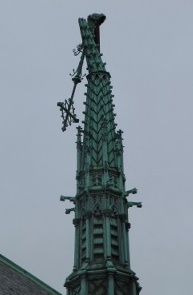
Maybe the Lord just didn’t like the steeple?
Churches all over the world have done and said a lot of crazy stuff with very little effect on the weather around them; interpreting the weather like that (in my opinion) is a bit like trying to decipher the entrails of a goat – not an exact science.
On the other hand: Considering the amount of hot air that flows freely at church gatherings, especially Synods / Conferences etc I’m not surprised that there might have been some sort of a meteorological consequence.
Thanks for the blog Scot!
posted August 21, 2009 at 1:35 am
We have witnessed how many wonderful inroads with the culture these kinds of comments have made when spoken or written by the likes of Pat Robertson and Jerry Falwell over the years! It disappoints me that John Piper would join their ranks so publicly. It’s one thing to have a private opinion about whether God could be behind a natural disaster. It’s quite another to further alienate the homosexual community that so many Christ-followers are trying to love into the faith by making such a callous, subjective and un-provable statement.
Like Piper, I am a theologically conservative Evangelical pastor. Although I frequently disagree with Piper, I have admired him in many ways over the years for his speaking out against such movements as the so-called “Prosperity Gospel”, etc. it is his inflexible and dogmatic commitment to 5-point Calvinist determinism that often taints his ability to use discretion. To his credit, he has publicly apologized in the past for speaking wrongly – and I hope he will humble himself and do the same in this case.
For Piper (as with many determinist theologians who wrongly believe that anything other than their point of view borders on Open Theism) he can “know these things” – from his perspective – because he views God as someone who delights in the destruction of evil-doers. His theological system forces him to believe that because God literally “loves Jacob” and “hates Esau” He is angry with sinners themselves rather than their sin (despite the clear teachings of Jesus and the Apostles). As such (according to Piper) God can darn-well impose such wrath upon the lost if He chooses!
Technically, of course, God can do anything He wants to do – except violate His own Word. Jesus affirms repeatedly that He did not come to condemn the world – but that the world through Him might be rescued or saved (John 3:16-18). Paul repeatedly affirms that we now live in an age of grace since God’s wrath has been satisfied through Christ’s vicarious death and resurrection for those who believe – and that His wrath is suspended until judgment day even for those who don’t believe. It is extremely unfortunate and unproductive to the cause of evangelism interdenominationally when a high-profile Christian leader publishes statements like this.
If you are a practicing homosexual reading this, I ask you to look past the mistake of my brother John Piper. He (like myself) is often prone to say dumb things – which is one of the reasons we both need Jesus so badly. Don’t allow sinful people like us to prevent you from coming to faith in Jesus. He loves you just as you are and not as you “should be”. And if you enter into relationship with Him – seek Him through His Word (the Bible) and seek to be open-minded to the Spirit of God, He will begin to change in you whatever he sees fit to change.
posted August 21, 2009 at 1:56 am
Outrageous, uncharitable and illogical to boot. The god portrayed in Piper’s post is a vindictive tyrant who has to teach people a lesson. I guess since no tornadoes have touched down on the buildings belonging to companies that reaped obscene profits from junk mortgages, etc. etc., that must mean the greedy and swindlers in our midst don’t have to repent just yet…(ref. the quote from 1Corinthians). Give. me. a. break.
Behind this are some truly problematic issues:
1. American Protestants don’t know what to do with suffering and apparently senseless evil.
2. A seriously flawed biblical hermeneutic, esp. WRT the Old Testament.
3. Thinking that the sovereignty of God can be reduced to a statement like “God is in control.”
a. Making God the author of evil.
b. Believing that God overrides the choices human beings make. How in the world can we love and do good unless we can choose to do so??? God is not the master puppeteer of the universe. It was for freedom that we were set free. God is *greater* for being able to accomplish his purposes without having to be “in control”.
c. Asserting that God is bound by some aspect of his character, or some other necessity, making said aspect/necessity into something that is “higher” than God. Think about it.
God’s glory was shown supremely in condescension: in the humility of the Incarnation, in the Galilean carpenter who grew up and labored in obscurity for 30 years, then rode a donkey into Jerusalem, sobbing, at the beginning of one week and was lifted onto the cross at the end of it. That’s where God’s power is. It is the *kindness* of God that leads to repentance.
I’ve never identified with Piper and his theology; I’m not even an evangelical anymore. I wouldn’t care so much about this drivel except that it reflects incredibly badly on all Christians, and, even worse, it endangers people’s faith. May God help us all.
Dana
posted August 21, 2009 at 2:02 am
I in no way support the decisions/direction of the ELCA, but I have never seen/read/heard of a tornado hitting Westboro Baptist Church or The Episcopal Church
posted August 21, 2009 at 2:06 am
for the sake of accuracy that is not the whole article in the post but a portion of the article.
The whole article is available at the desiring God link
posted August 21, 2009 at 2:07 am
1. Piper is a Calvinist so he can’t help what he says: it’s already been determined;
2. If “disasters” of any kind indicate God’s wrath, then He must be really, really mad at trailer parks and busloads of Baptist kids;
3. If he wore brightly colored clothes, he would be the Pied Piper;
4. The town of Oakfield, WI was destroyed by a tornado on July 18, 1996. Since it is a staunchly conservative Wisconsin Synod community, the only valid conclusion is that God just hates Lutherans, liberal or conservative.
posted August 21, 2009 at 2:25 am
If we follow Piper’s logic regarding God’s wrath and natural disasters, then shouldn’t have Los Angeles recently been hit by a powerful earthquake while TEC met there and made similar deliberations. Since it didn’t happen should we come to the conclusion that God is alright with homosexuality for the Episcopal Church, but not the Lutheran Church.
posted August 21, 2009 at 2:25 am
Posts 8, 9 and 11 are each great in their own way. To Dana, I think you points are well-taken. I’m saddened that you have left Evangelicalism altogether – although I can probably empathize with why.
Related to your point number 3 (post #8), I struggle also as to why some Christians believe that to God’s sovereignty is equivalent to his puppeteering of every leaf that blows off the branch of a tree. Certain He knows all things in advance, and certainly He can choose to intervene at any time. But like you, I believe that God’s creation of free moral agency within humanity displays an even greater picture of His sovereignty – that He is able to direct this universe to it’s appointed eschatological destiny while allowing freedom of choice. Personally, I like the term “in charge” rather than “in control” – because as you noted, “in control” implies that God causes or even delights in the starvation of children, genocidal wars and mothers orphaning children by dying of AIDS.
I live near San Francisco, CA. We’re not exactly known as a bastion of friendliness toward Christianity – and yet, our last calamity was the ’86 earthquake. Lucky for us, it seems God has been too busy judging Southeast Asia, New Orleans and now Liberal Lutherans in Minneapolis to remember us out here on the left coast. I’d better shut up before I tick Him off….
posted August 21, 2009 at 3:58 am
If God is responsible for the weather’s actions,
who is responsible for our action or inaction?
To stand by and look at one’s misfortune through weather damage and cite it as God’s judgment is a highly suspect and immoral venture.
I have personally visited Piper’s Bethlehem Baptist Church and the
weather-damaged Central Lutheran Church. They have more in common than not. Can’t Bethlehem offer the Lutherans help in repairing their damaged cross? Can’t they have a pancake breakfast together to raise money for repairs?
I hope that the good congregants of Bethlehem Baptist can prove themselves more wise and charitable than their pastor and go apologize, have a chat over Minnesota casserole, and get to work fixing that roof-top cross.
posted August 21, 2009 at 5:10 am
A similar incident occurred in Britain in the late 80s when Durham Cathedral was struck by lightning around the time of the enthronement of a new liberal bishop who apparently denied the physical resurrection of Christ. Plenty of conservative Christians attributed this to divine displeasure. (Incidentally, the Cathedral hasn’t been struck during Tom Wright’s time as bishop – what would John Piper say if it were?)
This way of thinking about providential retribution used to be far more common than it is now. British abolitionists saw hurricanes in the Carribbean as outbreaks of divine wrath against the owners of slave plantations. And there were loads of sensationalist early modern tracts describing the horrible demise of Sabbath breakers. The births of deformed children were also interpreted as divine punishments (e.g. John Winthrop sees the birth of a deformed child to a New England antinomian woman in this light). I’m glad we no longer think like this about stillbirths or disabled babies!
What this points out is the need to develop a thoughtful theology of providence – one that helps us avoid rash pronoucements without denying any place for God’s judgments within history.
posted August 21, 2009 at 6:16 am
And this is a classic example of why so many of the unchurched see no reason to take the church seriously. I believe the book, “Unchristian” and Barna’s research bear this out. It’s one thing for Christians and churches take stances on various issues which is appropriate, and quite another to use the scare tactic of a tornado to make their point.
posted August 21, 2009 at 6:28 am
There is a lot of bad psychology in blaming the victim for whatever misfortune occurs.
No less an authority than Jesus Himself discussed this in the Tower of Siloam (Luke 13:1-9)incident. From what I read there, He seems to be saying that disasters occur, the people killed or injured by them are no more sinners than any other. All humans are in need of repentance, equally.
Seems like a pretty good answer to me for the Minnesota tornado, and it seems a better one that John Piper’s. At least to me.
posted August 21, 2009 at 7:01 am
I too am a bit confounded by his epistemology. How can the reason God saves us be so confounding and mysterious but we can know concretely that God sent this exact tornado, for this exact purpose, at this exact point in time?
posted August 21, 2009 at 7:18 am
A few thoughts from a piece I wrote yesterday http://tinyurl.com/nhmfqc
:
- Were there any people whose homes were damaged who may have been conservative Christians like Piper? If God micromanages the universe down to this level, one might expect better aim.
- How do we know the tornado wasn?t a warning to those who were going to vote against the inclusion of gays and lesbians?
- If God uses tornados for this sort of thing, why wasn?t there one at a similar meeting the Episcopal Church had last month? For that matter, why do tornados seem occur in areas of the country where people are more likely to be Evangelical Christians? We rarely see them in “liberal strongholds” like NY, California, or Europe.
- If God is in the business of sending tornados to influence voting, why wasn?t one sent to warn the Supreme Court in the Dred Scott case, or German voters in the presidential election of 1932? I think we would all agree the outcome of those votes led to an evils far worse than the claimed evil of gay clergy – at least, I hope we do.
- If the vote was such an offense to God, why not just show up and tell us so?
posted August 21, 2009 at 7:24 am
Well, now Piper has a bigger problem – today they (ELC) will vote on the gay clergy issue. The question is, will God send a tornado to hit the meeting place in time to stop the vote?
posted August 21, 2009 at 7:48 am
Isn’t Pastor Piper the same pastor who believed that the Minneapolis bridge disaster from a couple of years ago was also a judgment from God on the city and its sinners? Pastor Piper’s God is a totally different God than I know. If I lived in Minneapolis, I might consider asking Pastor Piper to kindly move away.
posted August 21, 2009 at 7:53 am
I just posted on another blog spot this same comment, so for those that visit both, please forgive the redundancy: the tower of Siloam as well as the history of Job’s counselors misinterpreting Job’s suffering should teach us. While in Sumatra after the Boxer Day Tsunami of 2004 I discussed with Muslims their interpretation that this was God’s punishment for being bad Muslims; when I returned to the States I heard “Christian” interpretations that it was God’s punishment just for being Muslims in the first place. I would consider the most biblical interpretation to be the one that is also the most materialistic (sorry – unsure of the reference): “A tectonic plate’s gotta do what a tectonic plate’s gotta do.” Our interpretation of these events requires only one response: go serve the victims/survivors with love, seek justice and do it all humbly. The rest is “from the Evil One.”
posted August 21, 2009 at 7:58 am
is that you really don’t know which side the tornado is on. Isn’t either “side” “justified” (by the *exact same* epistemology) in claiming the tornado as God’s condemnation of the other?
posted August 21, 2009 at 8:05 am
The “flesh” in me wants to see the “unrighteous” receive their “just desserts,” The grace of Jesus says, NO!
posted August 21, 2009 at 8:28 am
ouch … American Christianity just gets curiouser and curiouser …. I’m going become a Jesus-loving Buddhist … or something.
posted August 21, 2009 at 8:34 am
It could be.
I find it interesting that Piper wants to speak like a prophet, and then goes on to making his point like a logician. Premise one, premise two, and then the conclusion.
The whole bunch of us – secular, religious, Christian, spiritual but not religious – are those that God’s voice is trying to reach.
posted August 21, 2009 at 8:51 am
Just a couple of questions to possibly provoke some thought from an otherwise very one-directional discussion.
Do we want to go so far as to say that God is NOT in control of the weather? Do we want to say that He is NOT sovereign over things like tornadoes, Katrina, etc.? And if so, what kind of a God does that leave us with? Flipping it around, if God IS in control of the weather, is it possible that He might use it for judgment or for blessing (as He frequently did in the Old Testament)? I’m not even getting at the question of whether He did in this particular case or not – just in general, is that something He can do, that is consistent with His revealed character?
posted August 21, 2009 at 8:59 am
Inconsistently applied, poor logic. Comment 11 illustrates well.
One question: Does Piper use this logic on every disease that strikes us since Jesus clearly also has power over disease and not just weather?
All tragedies are a warning in a sense–to us all–that we are all mortal, and about how fragile our lives in this world are. There really is more wisdom at a funeral than at a party, generally speaking. But this reasoning—from the scriptures!—so selectively applied, is disappointing, and does nothing for his reputation as a person who wants to handle the scriptures well.
posted August 21, 2009 at 8:59 am
Chris Kycho-
You may be right, but the problem comes in claiming a direct connection. Does the person proclaiming this have some special divine insight on this matter? I would say no, but do not want to limit God either.
I think this whole weather event in Minn. may have something to do with the Vikings signing Favre this week ;^) (sorry- I could not resist).
posted August 21, 2009 at 9:00 am
Do we want to go so far as to say that God is NOT in control of the weather?
I guess I would go that far and say that. It makes God very arbitrary. God givng you sunshine for your picnic means the farmer down the street doesn’t get water for his crops to sell and feed his family. Is that the business God is in? I can’t subscribe to that.
posted August 21, 2009 at 9:06 am
Maybe Piper is wrong… way wrong. And yes, how does he know? Got it. I’m in. ~ I am left wondering: do we no longer believe God judges sin – & yes, especially mine? Are we really only incredulous about Piper or is there an underlying disbelief that – as in the Siloam Tower story – unless we repent, we too shall perish? Are we in fact bothered that God is still the righteous judge of all the earth – yes even me? Dare I ask: what would Aninias & Sapphira’s family say about God’s severe irritation of those who muck up Christ’s Bride?
posted August 21, 2009 at 9:15 am
Also, I could be wrong, but isn’t this very close to the ANE view of the “gods”? Arbitrary beings that needed to be appeased? If they were appeased, good things happened; if they weren’t, bad things?
posted August 21, 2009 at 9:16 am
I’ve been asked to join the conversation. As you know, it is better for the blog conversation for me to ask questions and enter into the conversation for clarification etc instead of giving my view up front.
Here goes in brief: the claim of Piper is nonfalsifiable. I could go on, but you can fill in the lines easily enough.
posted August 21, 2009 at 9:36 am
I’ve never been a big fan of Piper’s theology, but I always thought him to be a reasonable, thoughtful man. This is disappointing and troubling to say the least.
What’s especially worrisome to me is watching Piper fans support the statement…when I suspect that they would normally distance themselves, had just about anyone else said it. It’s a reminder for all of us not to get so enamored with one theologian or pastor or teacher that our wisdom and discernment fails us. (Not even Scot McKnight!)
I think the most effective way to deal with the situation is to:
1) ask Piper some good questions
2) challenge his position from Scripture.
Tried to that in a post on my blog today entitled “Six Questions for John Piper.” – Yeah. I shamelessly plug now and then.
posted August 21, 2009 at 9:42 am
Though Dr. Piper’s prophetic call is welcome, and generally needed, using acts of providence in this way is notoriously problematic. If you study the history of this interpretive paradigm in the American pulpit you will be more sanguine about its effectiveness since people use it on both sides of moral debates to show what God was doing. Abraham Lincoln was right when he said the real issue is not whose side God is on but rather whose side are we on. Seems to me that we best preach/write the good news and leave the mystery of providence where it belongs: a true mystery to us. AS an old hymn says: “God is his own interpreter and he (alone) will make it plain!”
posted August 21, 2009 at 9:45 am
Thought your post was great Rachel!
What’s especially worrisome to me is watching Piper fans support the statement…when I suspect that they would normally distance themselves, had just about anyone else said it.
I know he doesn’t speak for all of conservative evangelicalism, but this type of arrogance, and undiscerning support of such arrogance, represents enough of it for me to have left the “evangelical” camp a while ago. Haven’t looked back since.
posted August 21, 2009 at 9:46 am
It’s a terrible burden to put on people.
posted August 21, 2009 at 10:03 am
I’ve thought Piper’s theology seriously messed up for ca. 30 years now and he’s done nothing to change that impression.
The serious problem isn’t his theology though. I am sure that mine is also wrong in ways I’m blind to. The problem is his certainty and the fact that his certainty and errors hurt real people – often.
posted August 21, 2009 at 10:14 am
One can be certain about the question before the ELCA convention without resorting to reading providential tea leaves. Did God send the tornado as a warning to the gathered delegates? I don’t know. But I can be quite certain that he has warned them already with the clear words of the Scriptures on this subject.
posted August 21, 2009 at 10:15 am
I agree with others who say that interpreting natural occurrences like weather, etc., as an expression of God’s opinion about this or that is a terrible idea. A few years ago, the number and severity of hurricanes hitting the gulf coast was considered a clear sign of God’s disapproval of (fill in the blank) in America. Where are they now? Does the fact that this years hurricane season is mild to say the least a sign that God approves of the turn America has taken with the last election?
posted August 21, 2009 at 10:22 am
What strikes me as odd is that he can in one breath destroy the prosperity gospel (for which I applaud him) and then turn around to use the exact same logic for calamity. The Deuteronomistic Editor would be proud, but that doesn’t make it consistent. The natural and logical opposite of a prosperity doctrine is a doctrine that says, “If you disobey God, bad things will happen.”
Inconsistent, Mr. Piper and I’m sad that you said it.
posted August 21, 2009 at 10:23 am
I wonder how one interprets such events when it happens to Christians who are NOT acting in ways contrary to God. For instance, how does Piper explain the shootings at the various churches we have seen over the last few years? It seems like an uneven way to interpret tragedy. Either all acts are judgment or we selectively choose those that fit our personal taste. One could argue, of course, that shootings are carried out by sinful people against innocent individuals. But how do we explain, then, that Christians, along with ?heathens?, were killed by the hurricane tragedy in New Orleans and Mississippi?
posted August 21, 2009 at 10:50 am
Some brief thoughts.
How does he know?
Statements like this make me want to take my ESV Bible and…
He makes me ashamed of evangelicals and pushes me away even though I know all of us are not the same.
John Armstrong gets it right in his comment.
posted August 21, 2009 at 11:01 am
I guess I just don’t understand why we refuse to wake up. We are all sinners, there is no one who does good, no one who seeks God. Thank God for Jesus Christ who saves sinners like us. Why won’t we believe God would send a message before imminent judgement? Don’t we see in the Old Testament that God was always sending many signs and prophets to turn the nation of Israel from her wicked ways? Don’t you believe judgement begins with the house of God (also with those who purport to be in the house of God)? In most situations we look at the facts and we make assessments. In this case I believe it would be illogical to conclude that Pastor Piper is wrong since all of the facts point in the direction of his assessment. Maybe we don’t like to believe he could be right because it scares us to believe that God is that serious about sin. What about my sin? What about yours? This I do know- The Lord takes the greatness of His name very seriously and the holiness of His church is so serious to Him that He sent His Son to die for it.
posted August 21, 2009 at 11:03 am
Does anybody know if Piper had anything to say (pro or con) when Pat Robertson said similar things a while back? If he spoke out against Robertson’s attribution of natural disasters to God’s wrath regarding some social issue, then it seems like he has some ‘splainin to do for inconsistency. If he agreed with Robertson, then this shouldn’t be a surprise.
posted August 21, 2009 at 11:04 am
My wife was going to be a professional concert pianist, her hands gave out and she can now play for no longer than an hour. The question is not whether God uses circumstances and yes disasters, famines, floods, fire, wind (read the Old testament) to get our attention — the question is whether or not we are paying attention and willing to respond the way He desires. Repentance means “changing one’s mind”. It is us who need to be transformed into His image, not God into ours. The people in this blog post consider themselves “reformed” in terms of theology, am I correct? Then why not let God reform your thinking to align with His. Homosexuality IS wrong in the eyes of God and therefore it is WRONG period. But if you’ll remember that was not the point of Piper’s comment. Piper did not call it judgment or blame the tornado on homosexuality; he never said that. He was pointing out that this might be a way that God is “gently” trying to get our attention, ie. point out the huge error in making church decisions that are in direct opposition to his revealed Word. You bloggers who are so adamant in your posts say that it’s not right that anyone suppose that he or she speaks for God and what He’s doing, yet you are very quick to give logical and theological arguments and some of you quote HIS WORD. Do you read the bible? completely? in context? Here’s the big question, do you allow His Word to transform you? change your mind? from what the world says, to what He says.
posted August 21, 2009 at 11:11 am
Doesn’t the book of Job have something to say about those who try to interpret natural events in this way?
posted August 21, 2009 at 11:52 am
Piper’s comments are not a surprise to anyone familiar with the reformed culture. They are pretty consistent given their hermeneutics and culture.
posted August 21, 2009 at 11:54 am
Any validity in his theology will regretably fall on deaf ears in the tornado of theological sound bites. It wasn’t so much God using this tornado to get the conventions attetion, it was Piper boldly attempting to use the tornado to bring attenion to his rebuke – valid or not.
Pastors and faith communities need to continue to talk about sexuality and how God has guided the discussion through the ages. At the convention this was true – whether we agree with conclusions or not. Yet for Piper and now in blogosphere it’s about a pastor giving in to the age old temptation of proclaiming to the world that they’re the true voice for God. Reminding all of us to repent of our God complex.
posted August 21, 2009 at 12:01 pm
I feel conflicted about this. Piper’s comments are consistent with his tradition, I think — the Puritans, probably Piper’s closest theological heirs, often understood natural and other events as providential signs. But I agree with Scot that the claim is non-falsifiable, and with others who wonder what degree of certainty even a modern Puritan-providentialist can have about the significance of any given set of coincidences.
I feel even more conflicted because of what the ELCA is doing. A church such as the ELCA seems to me in a great position to provide an example of a “third way” in action. It stands in a rich theological tradition with deep rooted confessional statements and ecclesial practices, yet its theology hasn’t been ossified by fundamentalism. But now they seem to be verifying the slippery slope logic of the fundamentalists. This raises hard questions for me about how precarious a balance a “third way” can be.
posted August 21, 2009 at 12:13 pm
@DC Cramer – yes!
posted August 21, 2009 at 12:17 pm
#50 dopderbeck
What third way are you referring to? The ELCA social statement on human sexuality addressed far more that same gendered relatinships and it expressly recognizes that not all are in agreement on this issue and so call for us to walk together in our disagreement. Can Christians do this? I hope and pray that we can.
posted August 21, 2009 at 12:35 pm
It would be more convincing if Piper had predicted the tornado. Otherwise, it just sounds convenient. One is left to wonder what caused tornadoes before there were Lutherans.
posted August 21, 2009 at 12:42 pm
To those who wonder if God judges sin:
Yes, he did. On the cross in the flesh of Jesus.
We do need to “get with the program” – to receive the forgiveness of the cross and the life of the resurrection as we are baptized into Christ, and head ourselves back toward how God meant for us to live as human beings were created to live, trusting God and in self-giving love toward others. (The Jesus Creed.) Yes, living “morally” is an important component of that- and we do so out of gratitude and in the freedom of love, not from a place of fear.
Two of my favorite authors:
“In the biblical tradition, judgment is emphatically *good* news, not bad. It means that the creator God has promised to make the world right at last, to sort it out, to sift it and straighten it and heal its ancient wounds and wrongs.” – N.T. Wright (emphasis in original)
“God as judge should not be seen as part of a larger legal metaphor, but rather as an analogy. In Israel, a judge was someone who set things right – put things in their proper place and restored relationships to their proper order. In that sense, we all need to be judged, and that right soon indeed!” Fr. Stephen Freeman (Orthodox)
Dana
posted August 21, 2009 at 12:51 pm
MJ@46: are you using “reformed” as in the Calvinistic sense or in the sense that we are mainly reformed sinners? If the former, I personally am not. I think many here are Remonstrants while I’m a Visigoth.
Scot@33: JPiper’s comments are pretty much non-falsifiable within the context of a specialty that is at the core, non-falsifiable. It’s my understanding that theology begins with the doctrine that God exists (non-falsifiable) and then proceeds from there to use scientific reasoning to reach certain conclusions. Piper’s error falls within the second process.
posted August 21, 2009 at 12:57 pm
NancyS(#50) — we’ve talked here from time to time about a “third way” between “liberalism” and “fundamentalism”. IMHO, this entails, among other things, retaining a robust Biblical / Christian account of sexuality and sexual ethics, without the literalism and such of fundamentalism. And IMHO, while there are important things to be said about ministering to be of homosexual orientation, this means there’s no room for officially validating same-gender sexual relationships.
I understand what you’re saying about the broad ELCA Statement, which recognizes disagreement on my last proposition. I disagree, however, that this is the same sort of question as the “meat sacrificed to idols” paradigm St. Paul offered for disputed ethical issues. IMHO, this is a more fundamental question about what it means to be a rightly ordered community. The difficult thing, of course, is how to discern what in fact comprises such a fundamental question. Without the certainties of fundamentalism, I’m not sure exactly how to answer that, which is my real point. This dispute in the ELCA highlights for me the precarious balance between freedom / diversity and submission / unity. I personally think the ELCA is getting the balance wrong in this important instance (though I suppose my opinion really is meaningless to anyone in the ELCA since I have no connection to it other than as an observer).
posted August 21, 2009 at 12:59 pm
I meant, “ministering to those who happen to be of homosexual orientation…”
posted August 21, 2009 at 1:02 pm
Incidentally, along a similar theological line of thinking, I’ve heard seemingly well-meaning, sincere, conservative Christians claim that global warming couldn’t possibly be human-caused – because God controls all weather – including temperature.
Of course, on one hand, as others have said, this IS consistent with this hyper-Calvinistic view of God and the world.
And that’s EXACTLY why we must reject it.
The claims, as Scot said, may be unfalsifiable. But the entire worldview can be shown to be decidedly unfruitful – even destructive; especially when finite, limited, biased human beings attribute bad weather to an angry God when – and ONLY when – it suits their theological perspective.
I’m seriously amazed, flabbergasted even – that people don’t see just how untenable this position is.
People, weather is NOT random – as if sent by some divine agency to send a message. Rather, it is predictable based on our understanding of the interacting factors of the environment. So, that being the case, we MUST conclude that either those biblical accounts are metaphorical – or just misguided.
I understand this may apply tension to your biblical-based theology. But to conclude otherwise is to end up in Piper’s camp. And, is that better? Is that more justifiable? Is that EVEN tenable?
I think not.
Seriously, if we are to have any impact on the world – any impact other than frequently pronouncing its judgment that is, then we must move beyond; we must move on.
posted August 21, 2009 at 1:42 pm
#56 dopderbeck
Thank you for that explaination about the third way. I think that even this way will lead to disagreement, but I am an advocate that we disagree while continuing the dialogue and that we disagree while trying to walk together.
I am a pastor in the ELCA and I hesitated to move to this denomination from the LCMS (does not recognize women as pastors) because I was not really interested in entering the fray over issues of sexuality. But I did enter after much prayer and believing that God has called me to this place at this time.
I saddens me greatly that regardless of the decisions made in MN this week the ELCA is in danger of splintering. This is because the divide is so great and it is impossible to reach true consensus.
For me personally I am glad to not have been a delegate because I am torn. Why? Because for me the ultimate call is God’s grace and if I am to error theologically then I will err on the side of grace and inclusion. I know that many will not agree with this. But hopefully, within the ELCA we will be able to continue talking and loving one another as sisters and brothers in Christ.
After the resolution passed today regarding recognition of committed monagamous same gender relations by congregations that want to do so I was moved to tears… not only by the decision but by the heartfelt prayer of our bishop over this momentous decision. Many will disagree and many will say we are not longer Christians… But then I have been accused of being a heretic by following God’s call to be a pastor. The tears were also for those who feel validated and for those who hearts were broken because they cannot understand how a church body can take this stance.
This is a day and a time when prayer and grace are needed more than rejoicing and when prayer and grace are needed more than condemnation.
Maybe I have rambled a bit without saying to much… sorry.
In Christ,
Nancy
posted August 21, 2009 at 1:49 pm
Piper’s line of thinking may be true, but it may not as well, and to say it with definitiveness as he seems to be doing (or is being portrayed) may well set him up to join Job’s miserable comforters.
I wrote my Master’s thesis on pain and suffering, and my analysis of Scripture led me to various conclusions, one of which was the fact that we live in a fallen, broken, chaotic, and powerful world, and some pain and suffering happens simply because the world is how it is, an indirect consequence of the Fall, not a direct consequence of specific sin. Some suffering is a direct consequence, but I think much, particularly natural disasters, some disease, and societal ills, isn’t. It’s an unfortunate reality of living in a fallen world that, like us, is waiting for redemption.
Forgive me if this has already been said, but I only have a moment before I have to run.
posted August 21, 2009 at 2:05 pm
We must be very careful when we call something an act of God’s wrath or Judgment. If this act was one that should be considered God’s “Judgment” then we must suppose that there are no believers at that church because God does not sweep away the righteous with the wicked. Perhaps it was an act of God’s “Discipline,” If that is the case, then maybe God was disciplining his children who have gone theologically astray. Considering that God is completely sovereign, and that no one died, maybe this was just a light warning to both believers and unbelievers that life is fragile and that we must be careful to follow the Lord’s precepts. Either way, when God allows things to happen in our lives it is definitely for a purpose, in trying to discern that purpose we must be very careful indeed!
posted August 21, 2009 at 2:16 pm
This is all very ignorant. It is clear from scripture that God hates the wearing of mixed fibres (Lev19:19; Deut22:11)This tornado was quite obviously a warning to an apostate ELCA for their persistent and unrepentant use of polyester cotton. The Episcopal Church was spared as their vestements are woven of pure cotton.
posted August 21, 2009 at 3:25 pm
If I follow Piper’s logic, then because ‘God is a consuming fire’ (Deut 4.24) the house fire I went to the other day must have been God’s judgement too, as there was clearly no parapet around the roof (Deut 22.8).
posted August 21, 2009 at 3:33 pm
Dear Kate, I’m afraid your argument is a favourite old chestnut of liberals who can’t stomache the moral demands of Scripture. It conveniently neglects to mention that in the NT, the law of Christ which is binding on all Christians, homosexuality is condemned.
Sure, the wearing of mixed fabrics and homosexuality were condemned under the OT law in the same passage. Yet now that Christ is the end of the law, we have to interpret these passages through him. The argument you posed is reductionistic and ignores the progress of redemptive history. It ignores the fact that the moral demands of the OT, far from being abrogated or dismissed as a collection of quaint Israelite idiosyncrasies, have been ratcheted up in the NT.
Now while I disagree with Piper’s attempt to intepret providence, I must ask at the same time: is it so unimaginable that God may judge his people for condoning what he roundly condemns? What about a passage in Romans 1 where the apostle describes homosexual practice as an outworking of God’s wrath in human society? What about Jesus’ threats to judge sexually bankrupt churches in the book of Revelation? What about Scriptural warnings that judgement begins at the house of God?
posted August 21, 2009 at 3:37 pm
Nick,
The argument you posed is reductionistic and ignores the progress of redemptive history. It ignores the fact that the moral demands of the OT, far from being abrogated or dismissed as a collection of quaint Israelite idiosyncrasies, have been ratcheted up in the NT.
Perhaps you are doing the same thing to the NT that you accuse Kate of doing to the OT? Could it be that the Bible marks out a trajectory and that it is up to us to determine what that trajectory is where we are now from the basis points given to us in the Bible, both Old and New Testaments?
posted August 21, 2009 at 3:53 pm
You got it wrong, Scot. Your confusion is excusable because Piper’s intended meaning was a little subtle, and the number of wacky people out there who line up to blame every natural disaster on the sinfulness of specific individuals is indeed large. But Piper is not among them.
Please reread a bit of what he wrote, especially his 5th point:
5. When asked about a seemingly random calamity near Jerusalem where 18 people were killed, Jesus answered in general terms?an answer that would cover calamities in Minneapolis, Taiwan, or Baghdad. God?s message is repent, because none of us will otherwise escape God?s judgment.
Jesus: ?Those eighteen on whom the tower in Siloam fell and killed them: do you think that they were worse offenders than all the others who lived in Jerusalem? No, I tell you; but unless you repent, you will all likewise perish.? (Luke 13:4-5)
Piper is not claiming special insight or discernment that is not available to any other bible-reader. He is giving the same answer that Jesus gave regarding the tower in Soloam.
In effect: Don’t concern yourself with the specifics. Use this as an occasion for reflection on your own sinfulness and God’s judgment.
That’s a far cry from what you seem to be trying to tar him with when you ask: “Have you ever seen a calamity or a disaster and truly believed you knew why that event happened or why God made that event occur? How did you know that sort of thing?”
posted August 21, 2009 at 4:23 pm
As I mentioned previously, I disagree with the idea of God using meteorological events as warnings.
However, what I hear some of you saying is that God does use things like storms etc. as warnings but that Piper was wrong to be specific about this incident. Or that storms and the like are acts of Divine Providence but it’s wrong to try to interpret specific storms as such. Doesn’t such a view make the notion of Providence almost meaningless? It’s like saying, “Oh there definitely is this thing but I can’t give you any specific examples, but I’m sure they’re out there.”
I don’t mean this an insult. I’m asking it as a genuine question. How is Providence a meaningful concept if it can’t be discerned?
posted August 21, 2009 at 4:25 pm
Don, isn’t that the question asked in the opening post?
posted August 21, 2009 at 4:25 pm
Dear Nick, could you please tell Andy off as well because he mentioned parapets which is probably a reductionistic argument too.
PS do we know that the people at Siloam weren’t wearing mixed fibres?
posted August 21, 2009 at 4:30 pm
NancyS (#59) — thanks for that thoughtful comment. I do understand the preference for inclusion. It just seems to me that there is a real and important difference between inviting a person to walk alongside you in the pilgrimage of faith, even if you disagree sharply about a moral issue, and specifically approving of the conduct with a sacramental ceremony and/or a pastoral investiture. I’m glad I’m not in the ELCA (or the ECUSA) because I think I would have to be among those who would separate on this particular issue, and I’m sure that would be a painful choice (it is difficult for me to see even just as an observer). I guess my prayer is that, as this issue winds its way through the mainline churches, it will somehow produce a new unity among moderate groups that nevertheless feel they have to separate — as maybe will happen with the new North American Anglican group.
posted August 21, 2009 at 4:47 pm
Scot,
Yes it is somewhat the same question. I just wanted to hear more from those who feel some sense of resolution in the idea of un-discernible Providence, but still believe God can act or send warnings through the weather.
posted August 21, 2009 at 5:41 pm
It could have been God’s judgment, but I think that’s for individuals to decide for themselves in the face of such disaster: “Is God trying to get a message to ME” vs. deciding that God is judging your neighbor. If John Stott Piper is right, what has he gained from making this pronouncement? So what? Now what? Maybe Mr. Stott Piper should be asking HIMSELF is what does God have in this calamity for HIM.
posted August 21, 2009 at 6:50 pm
Kate, to patronise Piper’s (and other conservatives like him) stance on sexual ethics by reducing it to being built upon a tenuous piece of exegesis from Leviticus is breathtaking. Have you really bothered to engage conservative arguments related to NT exegesis, or do you just prefer your ignorant stereotype?
posted August 21, 2009 at 8:00 pm
Just in case people see Pat #72 comment out of context, the venerable moderately conservative British evangelical John STOTT has nothing to do with this discussion.
This is John PIPER, a very different animal (who I guess might consider Stott a dangerous liberal).
posted August 21, 2009 at 8:50 pm
Adam #66,
I don’t know what I find more disturbing here – Piper’s theology of such events, which I believe to be thoroughly unbiblical in general, or his misuse of scripture to make his point.
The statement that Jesus controls the winds from Mark 4:41 – all the passage says is that the winds obey him, he commanded calm. But any parent or leader knows that there is a huge leap from obey to control. Not that God couldn’t control – but that his interaction with the world is not “control” in this sense. I think that the theological leap to “control” is unwarranted. God is powerful – and sovereign, but he does not generally extend his power and sovereignty to control. It is interesting that the passage never assigns control of the storm to God. Could God use to wind – even a tornado? Yes – but this passage is totally irrelevant to that point.
It seems to me that Piper’s point about the tower of Siloam is also a misuse of the intent of the passage. Wasn’t the point not that they died from the judgment of God (or the Galileans in the preceding verses)- but that all should be concerned to repent? I will go a step further – wasn’t Jesus telling his listeners that unless they repent and follow his way (God’s way) of bringing about the kingdom of God that they too would die by the violence they advocated? I don’t see how this has anything at all to do with the judgment of God through disaster on people.
posted August 22, 2009 at 12:32 am
As a member of an ELCA congregation, I can tell you that the members of our congregation to whom I have spoken are not seeing the occurrence of the tornado tearing down the cross as a coincidence, but as a warning. Can there be accidents with a sovereign God? The older I get, the more I have my doubts.
posted August 22, 2009 at 2:15 am
From Greg Boyd’s blog in which he responded to John Piper, I give you the following regarding God and the control of nature:
John justifies his interpretation by claiming ?Jesus Christ controls the wind, including all tornados.? He supports this claim by quoting Mark 4:41 in which Jesus? disciples ask; ?Who then is this, that even the wind and the sea obey him?? What?s interesting to me is that the disciples make this remark in response to Jesus having just rebuked a threatening storm. If Jesus was already controlling all storms, as John claims, why on earth would he need to rebuke this one?
Even more interesting, Jesus ?rebukes? the storm by commanding it to be ?quiet.? The Greek term used here literally means ?to muzzle? or ?strangle,? and its the same word he sometimes used when confronting demons. The implication is that, far from suggesting that Jesus controls all storms, the passage actually suggests that at least some life-threatening storms have a demonic power behind them that resists God?s good purposes (for a fuller discussion on this, see Boyd, God at War [IVP, 1997]).
http://www.gregboyd.org/blog/did-god-send-a-tornado-to-warn-the-elca/
posted August 22, 2009 at 2:56 am
I think Chuck DeGroat has articulated what a lot of us are thinking about Piper… respect in many ways, but bafflement at such a ridiculous thing to say….
http://drchuckdegroat.wordpress.com/2009/08/21/on-john-piper-and-tornadoes-sent-by-god/
posted August 22, 2009 at 6:46 am
Nick, I can’t tell whether you’re joking or whether you honestly thought that I was “patronis[ing] Piper’s (and other conservatives like him) stance on sexual ethics” or making an “ignorant stereotype”
I do not rule out the posiblity of God using a tornado to make a point, but have to join others above in wondering why the ELCA and not the Episcopal church? My childish joke was an attempt to point out that these kind of pronouncements always seem a bit arbitrary, ie one church gets zapped, others more “sinful” seem to get off scot-free.
It seems to me that Jesus answered the “does God do that?” question when talking with his disciples the people killed by the tower at Siloam. I had no intent to make any point about sexual ethics, and am sorry if you really thought I was doing so.
posted August 22, 2009 at 6:48 am
Sorry, “talking with his disciples ABOUT the people killed at Siloam”
posted August 22, 2009 at 11:22 am
Anthony #77 Is Greg Boyd actually saying Jesus calmed a storm but couldn’t control it? Greg Boyd does not believe in the sovereignty of God, John Piper does. Who do you agree with? Think about your answer carefully: What kind of God would He be if He could create the whole world and everything there is but not be sovereign over it. In my opinion He would not be God at all. Would He be a puny God of man’s creation who sits in the heavens and taps His fingers or wrings His hands as the world goes it’s own way? No. The God we see in the Old and New Testaments is a God of ABSOLUTE authority and power. He is altogether not like us nor is He anything like what we want to imagine Him to be. He allows, causes, and uses every situation to fit His perfect plan for all eternity. Now that is good news to those that know and love Him through Jesus Christ but for those that do not that is very scary indeed. And we know that ALL things work together for good for those who love God and are called according to His purpose. Romans 8:28. Will we be afraid of His sovereignty over all the universe or will we cover our mouths and stand in awe of the One who holds all eternity in His hands. I look at the Lord’s warnings as divine mercy and grace-He doesn’t have to warn us. He like so many human parents could send a disciplinary slap before a word of warning ever goes out. His love and patient forbearing are behind these warnings to mankind.
posted August 22, 2009 at 1:09 pm
RJS, #75
I’ll think about what you wrote about Jesus controlling the winds.
Regarding your second point about the tower at Siloam… Yes! I agree 100%! That’s what I’m saying. Scot and many others have wrongly accused Piper of claiming special knowledge about God’s specific intentions. Pipers point is jesus’ point and also your point (more or less). Calamities shouldn’t lead us to ask, “what did the victims do wrong?” Instead, they warn all sinners in general to consider their sinfulness, God’s impending judgment, and then to repent.
posted August 22, 2009 at 1:31 pm
Adam, you seem more intent to defend Piper than anything else. The text points us away from the specific sins of some persons or some group and to the fact that we are all sinners. Piper points to the specific sins of the ELCA and only then generalizes. Don’t you see the tension of these two approaches?
posted August 22, 2009 at 1:35 pm
Adam #82 wrote:
“Pipers point is jesus’ point and also your point (more or less). Calamities shouldn’t lead us to ask, “what did the victims do wrong?” Instead, they warn all sinners in general to consider their sinfulness, God’s impending judgment, and then to repent.”
I think this is exactly right. I just think that the way he presented his blog post was not the best, it seemed that it had numerous not so subtle hints that maybe the tornado was judgment from God.
posted August 22, 2009 at 3:52 pm
Scot,
I am interested in defending Piper against what I believe are incorrect and even in some cases malicious interpretations of what he wrote. I think your criticism in #83 is valid, however.
posted August 22, 2009 at 4:27 pm
Back to Dana @8…
We’re no longer evangelical either, and I’m sad to say that I’m relieved at not having to explain/defend/understand these types of comments anymore.
Ironically enough, we’re now part of an ELCA congregation… we didn’t set out to join that denomination, or any specific denomination. We came across a church with heartfelt worship and a strong sense of mission and community. And we joined it.
posted August 23, 2009 at 3:52 am
Aleta – I am not sure that I must fall for the dichotomy of choosing between Boyd or Piper. First, you should know that my quoting from someone doesn’t constitute an endorsement on my part of the totality of that person’s thinking. Rather, one of my general presuppositions is that no one is going to correctly understand all things regarding the nature of God and his work in the world. For this reason, I can be quite fluid in connecting with, being inspired by, and borrowing from people from different traditions, and theological orientations.
Regarding this conversation, I saw something insightful from Boyd about the issue of Jesus relationship to the weather. Regarding God’s sovereignty, I don’t think it is accurate to say that Greg Boyd denies this quality, but rather he and John Piper understand and define it differently. I realize that this assertion might be offensive to those who think it is possible to construct a theological blue print, but my conviction is that this is epistemologically impossible in the relationship between finite creatures and an eternal God. This is not to say we are not accountable to God’s revelation, neither do I deny that there are limits to the possibilities of how we understand or interpret this revelation. Rather, I think that theological language is analogical, and thus there is always going to be something that doesn’t quite fit the constraints of our understanding regarding concepts like God’s sovereignty and human responsibility and the relationship between them.
posted August 23, 2009 at 10:42 am
Balaam could have used your logic or powers of equivocation, Scot.
Whether our normally docile donkey starts resisting us or our church’s steeple gets bent, with the cross pointing downwards, it is always a good time to pause and ask, “is it possible that God is trying to get my attention? Is there anything in me that is resisting Him that He is graciously warning me about?”
posted August 23, 2009 at 1:19 pm
I heard a good sermon on the radio by Jack Hayford some years ago in response to an earthquake in California. Some people felt that this was God’s judgment on porn studios in that area while others openly mocked the idea. Hayford said that one the one hand, it was reckless to pretend to know the mind of God. God allows many things that don’t seem to add up and we are often confused. Yet, those who mocked and ruled out the possibility that God might have at least in part been trying to get their attention through the natural disaster put themselves in a dangerous position of pride before God. Important to be willing to consider ones heart and be open to God, allow him to convict and change. Be humble and ready to repent. But it is also important not to pretend that we know more than we do about the mind of God.
Some said that 9-11 was God’s response to gays in America (although that was not a natural disaster), I was told that perhaps Katrina hit Louisiana because there were a lot of abortions performed there. When I pointed out that abortions are performed all over, so the storm should have hit the entire US if this were the case, the person gave a “you can’t handle the truth” cold shoulder. I don’t recall hearing any such logic about the tsunami that hit Sri Lanka. This starts to sound like the old covenant system where we obey God and he blesses our crops and opens wombs, etc. But even under that covenant there were questions. Job’s friends, as has been mentioned, were sure they could read God’s mind concerning disasters. Psalm 73 deals with questions resulting from the wicked prospering and the righteous suffering, so there were difficult questions even then, such that one could not even then pretend to read God’s mind.
It is important that those in the ELCA be humble, ready for God to convict and change them, even allow God to convict them of sin if he chooses to do so. It is important that we do not over-reach and explain more about God’s motives than we can possibly know. Maybe the visual of the downed steeple could be a side-effect that God would choose to use, regardless of whether he specifically sent the storm.
posted August 23, 2009 at 1:23 pm
MatthewS, a wise comment and I thank you for your chastened humility about what we can know, what we can’t know, and how we can approach disasters.
posted August 23, 2009 at 2:58 pm
Adam (#66 and 85),
Thanks. I agree with your perspective. I think Scot asks a great question and has raised a valid point… I’m weary of the springboard effect this has on those who want to misread Piper and bash reformed theology generally (e.g. Dan #48).
posted August 23, 2009 at 5:31 pm
Aleta (#81) – You say: “Greg Boyd does not believe in the sovereignty of God, John Piper does.” Piper does not hold the only viable view of God’s Sovereignty. Greg Boyd certainly has a different view of divine sovereignty. One might even say a “higher” view than Piper’s. Consider:
R.C. Sproul: “If there is one single molecule in the universe running around loose,…then we have no guarantee that a single promise of God will ever be fulfilled. Perhaps that one maverick molecule will lay to waste all the grand and glorious plans that God has made and promised to us” (Not a Chance, p. 3).
Boyd’s response: “There is, I submit, no conceivably weaker view of divine sovereignty than one that is threatened by a single maverick molecule” (Four Views on Divine Foreknowledge, p. 43).
Something to ponder.
posted August 26, 2009 at 12:10 pm
Anthony- You may not have to choose between Greg Boyd and John Piper but I believe that we all must choose what we will believe about God and His sovereignty. I understand that all men are fallible and subject to error which is why I am so thankful that God is totally true, just and holy. I’m no theologian but it is right and good to test all things which is what the Word of God tells us to do. In that case I would like to go back to the original point of this discussion and submit to you Job:37 9-14. I believe it does come whether for correction, or for His land, or for mercy. Whichever it is He sends it and He commands it. We should all “Stand still and consider the wonderous works of God.”
Jeremy-I do not agree with the quote from RC Sproul although I am not aware of the context of his statement. I think the point of believing in the absolute sovereignty of God is that there cannot be any “maverick” molecule in the universe which is out of God’s sovereign power to control, and nothing could ever thwart the sovereign plans of God. Needless to say, I believe behind all of this type of thinking is a very low view of God certainly not a higher one. What we believe about God is foundational to our whole belief system. If we begin with wrong thinking about who God is we will have wrong thinking about everything else. I have heard Greg Boyd say that abortion is right in some situations, such as when a woman’s health or life is at stake. I’m not sure what you think about that, but the Word of God says murder is wrong. Again it seems when the foundation of belief about God is off kilter everything else goes awry.
posted August 27, 2009 at 5:59 pm
If the tornado was meant to warn members of the ELCA about the dangers of letting homosexual men and women be members of the clergy, why did the tornado continue its path of destruction into south Minneapolis? Are the hundreds of people whose homes were damaged by high winds and downed trees and left without power for days also supporting homosexual clergy? Or did God take advantage of a perfectly good tornado to just warn humanity of his power.
Maybe the tornado just took a random path. We will never know.
Pingback: Who Will Call Out John Piper? - The New Christians