

A “spam storm”: of a hundred comments an hour or more requires the catcha back on for a time. Bear with us and join the conversation. (Copy a long comment before posting, so you won’t lose the thought if the system times out or you type the captcha wrong.)
This is the fourth in a series of posts looking at the implications of the fact that we are fully embodied beings created in the image of God. We have body and soul – but these are not separable entities. (The third, on Science and Christian Virtue, contains links to the first two on Science and Sin.)
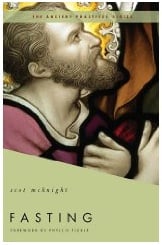
I will get back to NT Wright and his development of the idea of Christian Virtue, but today I would like to focus on Scot’s book Fasting: The Ancient Practices. I don’t want to review the book (which is excellent) here, but use it as a focus point for what it means to think of humans as “organic unities” (a term I picked up from Scot’s book).
Here is how Scot introduces the idea in connection with fasting:
The thesis of this work is simple: a unified perception of body, soul, spirit, and mind creates a spirituality that includes the body. For this kind of body image, fasting is natural. Fasting is the body talking what the Spirit yearns, what the soul longs for, and what the mind knows to be true. It is body talk – not the body simply talking for the spirit, for the mind, or for the soul in some symbolic way, but for the person, the whole person, to express herself or himself completely. Fasting is one way you and I bring our entire selves into complete expression. The Bible, because it advocates clearly that the person – heart, soul, mind, spirit, body – is embodied as a unity, assumes that fasting as body talk is inevitable. (p. 11)
The core idea here – that a unified perception of body, soul, spirit, and mind creates a spirituality that includes the body – has profound implications for worship, for spirituality (including fasting), and for discipleship. For one thing, discipleship should lead us concern for the bodily well being of others. The command to love God is not an issue for intellectual assent, but a command for whole life transformation; loving others is not cerebral empathy – but a matter requiring concrete action.
This leads to the question I would like to ponder today.
What are the key ways that a unified perception of body, soul, spirit, and mind impact worship, spirituality, and discipleship?
Or – to put it another way (thanks Scot):
Where are you seeing dualism in Christian worship, in spirituality and in discipleship? What does dualism look like?
As I read Scot’s book on fasting I was struck by the way the themes that he developed meshed with things I was thinking about in connection with the science of the human mind and the ideas of Christian virtue.
Scot’s approach to the ancient practice of fasting is quite simple – fasting is not a spiritual discipline as much as a natural, inevitable response to a grievous sacred moment in life, moments that are so serious, so severe, that the only appropriate response is a whole body response. It is the natural response of a human as an organic unity.
Humans are made as God’s Eikons. A variety of terms can be used to describe humans in their various facets, terms like soul and spirit and body and heart. But no matter which term we use, you and I are organic unities, and we cannot lose sight of that unity.
There is, however, a reason that dualism develops. Each person, however you divide up the terms in the previous chapter, is both an outer physical person and an inner spiritual person. The Bible does not say the body contains a spirit, like a beaker into which we pour a liquid, but that each person is a spirit and is a body. In other words, the Christian traditions teaches that there is a duality about humans, but there is not a dualism. We are one person with an inner and outer dimension, but we are not comprised of two parts. – an inner and an outer part. Neither is is right to think that one is good (the inner) and the other bad (the outer). (p. 17)
The remainder of the book develops the theme of fasting as a natural, even essential, part of whole body spirituality. It is turning and plea and grief and discipline and calendar and poverty and contact and hope. Fasting is not a way to get something from God – nor is it a means to battle the (worldly) body.
Many examples of fasting throughout church history are really examples of body destruction from the depths of dualism – not body discipline. Science shows that extreme fasting will change body chemistry and curb bodily desires. But extreme fasting does not lead to the discipline of body, soul, spirit, and mind that transforms one’s entire life to follow Christ. It does not lead to Christian virtue.
Carrying on with the theme of humans as organic unities. A unified perception of body, soul, spirit, and mind impacts other areas of Christian life as well. I have a few thoughts on this – but perhaps others will add to the list.
Because we are organic unities worship should be a polyphonic whole body experience – praise and awe, repentance and submission. There is a time to stand with hands raised and a time to kneel before the Lord. In music we should use the entire dynamic range (not just “loud”) and variety of forms – from rock band to organ to a cappella to hand bells. In the name of cultural relevance we accept monotonic worship – and are poorer for the sacrifice. We need liturgy, spontaneity, tradition and innovation. Most of all we need sacrament as a body and in the body of the church.
Recognizing ourselves as organic unities requires that we view others in the same way. It is not possible to have a healthy concern for another’s soul without an accompanying healthy concern for their physical and emotional well being, a concern for justice.
Dualism allows one to concentrate on saving souls without concern for feeding bodies, caring for widows and orphans in their distress, or pursuit of justice.
On the other hand, only a rejection of the Biblical duality – body and soul – allows one to concentrate solely on feeding bodies and pursuit of justice without concern for the soul
What do you think? Where should the recognition of humans as organic unities change the way we approach spirituality, the church, or the world?
If you wish to contact me directly you may do so at rjs4mail [at] att.net
 Read Previous Post
