Jesus Creed

Jesus Creed

Help for the Doubting

posted by Scot McKnight | 5:50am Monday November 16, 2009

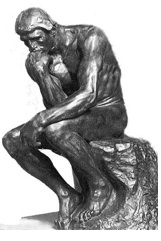
Thinker.jpgTwo of my students, in the last month, have sat in my office in tears — their problem, though from two different angles, was doubt. Everything was changing, they were confused, they were having trouble finding their way … 

Robert Wennberg, emeritus professor of philosophy at Westmont College, has given us all a gift: a book about doubting that is brief, thoughtful, careful, encouraging, but deadly honest and realistic. I suspect anyone plagued by doubts will find immense help from this pilgrim who knows the road and one who has lived in both the summer and the winter of faith. So, I recommend Faith at the Edge: A Primer for Doubters
.
OK doubters, what has been your story? Your discoveries? Your helps? What is the one thing that has helped you the most with doubt? Another question: What is doubt? What are words that get connected to “doubt” that you think are mistaken connections? What is the opposite of doubt? (Think about that one.)
What I liked most about this book is the topics: the distinctions between doubters, skeptics and seekers; relativism won’t help; that the first bout with doubt is the hardest; the importance of a theology of God’s absence; stuff on CS Lewis and Mother Teresa and St John of the Cross; hope as sustenance during doubt; the Christian community as the best location for doubters; that Christians aren’t always as good as non-Christians; and this one is so good: why God chooses not to make his presence more obvious. And that God is both adversary and ally.


Previous Posts

This blog is no longer active
This blog is no longer being actively updated. Please feel free to browse the archives or: Read our most popular inspiration blog See our most popular inspirational video Take our most popular quiz

posted 3:10:39pm Aug. 31, 2010 | read full post »

Our Common Prayerbook 30 - 3
Psalm 30 thanks God (vv. 1-3, 11-12) and exhorts others to thank God (vv. 4-5). Both emerge from the concrete reality of David's own experience. Here is what that experience looks like:Step one: David was set on high and was flourishing at the hand of God's bounty (v. 7a).Step two: David became too

posted 12:15:30pm Aug. 31, 2010 | read full post »

Theology After Darwin 1 (RJS)
One of the more important and more difficult pieces of the puzzle as we feel our way forward at the interface of science and faith is the theological implications of discoveries in modern science. A comment on my post Evolution in the Key of D: Deity or Deism noted: ...this reminds me of why I get a

posted 6:01:52am Aug. 31, 2010 | read full post »

Almost Christian 4
Who does well when it comes to passing on the faith to the youth? Studies show two groups do really well: conservative Protestants and Mormons; two groups that don't do well are mainline Protestants and Roman Catholics. Kenda Dean's new book is called Almost Christian: What the Faith of Ou

posted 12:01:53am Aug. 31, 2010 | read full post »

Let's Get Neanderthal!
The Cave Man Diet, or Paleo Diet, is getting attention. (Nothing is said about Culver's at all.) The big omission, I have to admit, is that those folks were hunters -- using spears or smacking some rabbit upside the conk or grabbing a fish or two with their hands ... but that's what makes this diet

posted 2:05:48pm Aug. 30, 2010 | read full post »

Advertisement
Comments read comments(37)
post a comment
tim e

posted November 16, 2009 at 12:50 am


looks interesting, but the final comment, “why God chooses not to make his presence more obvious.” I am convinced that God’s reality is exceedingly obvious to those who want to find him. One of my favorite quotes is by Pascal, God has given more than sufficient evidence of himself to those who want to find him, yet he “hides” in the shadows for those not seeking him. When we consider that God himself showed up as a human on this planet, did amazing things and recorded these as scripture – - and yet many still chose not to believe – well i honestly don’t think there is much more God can do or should do.


report abuse
 

rebeccat

posted November 16, 2009 at 1:41 am


Ah, tim e, just walk with God a bit longer. He will disappear on you. At least if you’re doing the walk right, He will. Of course, He doesn’t really disappear, but as the writers of Psalms were wont to put it He will “hide His face” and as often as not “be silent”. For someone who is faithful in their walk, it’s usually a way to move us from milk to meat and from without to within. And just like all growing up, it’s hard and painful.
At any rate, I’ve had my fair share of times of doubt when God has just disappeared and I’m tempted to write off my previous experiences and thinking as foolishness and delusion. Reading John of the Cross and other writers on the theology of God’s absence has been helpful. But probably most helpful was something John Eldredge wrote somewhere. He was bemoaning our tendency towards forgetfulness and shared that he has a sign next to his bed that says “God exists”. He says he needs to see it each morning when he wakes up because he can forget this truth during the night. In the middle of my own doubts, I have remembered that sign many times. It reminds me that I am not the only one who forgets or can’t find God. My doubts, while common, no more represent reality than the idea that God could cease to exist because we forget His existence in our sleep. The thought of that sign also reassures me that just like forgetfulness can be countered with reminders, so to can other doubts. And the thought of that sign reminds me of the reality that God does exist.


report abuse
 

Jon

posted November 16, 2009 at 1:54 am


Best help in times of doubt is a friend who’s been there who’s willing to listen and acknowledge the significance of the issues you’re struggling with. Trying to answer every issue directly out the “apologetics handbook” can do more damage than good. @ tim e (#1) your response will most likely cause the doubter to immediately write off your answer as trite and you as naive. Just being honest.
Books that have helped me would be Yancey’s Reaching for the Invisible God and Daniel Taylor’s The Myth of Certainty.
As far as misconceptions about doubt the biggest one is that it’s the enemy of faith. In many ways my times of doubt have shaped and solidified my faith during the more “stable” times.
Great post Scot!


report abuse
 

Brittany Stringfellow Otey

posted November 16, 2009 at 3:15 am


I had Bob Wennberg for several courses while I was at Westmont. I can remember sitting in his office, my mind filled with all sorts of questions and doubts in response to my first doctrine class. He seemed like a reasonable, faith filled person, so I begged him just to tell me what he believed….hoping I could just adopt it and find peace. Thankfully, he refused, but graciously offered to act as a sounding board for me any time I needed it. The most striking thing about our conversations was that he was far less concerned about my doubts than I was…which gave me freedom to explore. His kindness, and his assertion that God could shoulder any question I came up with, deeply impacted my journey.
Thanks for the heads up on his book!


report abuse
 

Jes Kast-Keat

posted November 16, 2009 at 8:02 am


I am a part-time pastor and full-time seminary student and in this world I live in I am constantly saying “doubt is not the opposite of faith, but it is a part of faith and we should embrace it”. My thoughts were first altered when I watched the movie Doubt (a good movie on multiple levels!). This movie awakened, or maybe gave me permission, to awaken the doubts that I have and just start naming them. Naming them for the sake of acknowledging their presence in the room — NOT to fix them. In fact, I think doubt can be a gift for us but modernity has been so concerned with the answer that there isn’t room for it in many church bodies. I am a believer, but I am a deep doubter as well. My mind is on a relentless pursuit for truth and I believe this is a never-ending journey. I also believe this is good – “love the Lord your God with all your mind” — my mind asks questions and doubts sometimes. I believe this God is right there in the midst of my doubt sustaining my by grace. I rest in that.


report abuse
 

dopderbeck

posted November 16, 2009 at 8:06 am


I’ll have to add this one to my list. The question that has bugged me is, “what is ‘doubt’ and what is ‘questioning’ that leads to different views?” My views on many theological points have changed over the years, because I “doubted” the truth of my prior views. But, looking back, I think often that the “doubt” I experienced wasn’t “improper” doubt — it was because the views I had held were wrong or distorted in some way.


report abuse
 

Steven McDade

posted November 16, 2009 at 8:44 am


I’m doubting my own future right now. My family is part of those who are in major debt because we were doing everything that we could to make sure we have food, clothing and shelter.
I drive a school bus but have doubts that we will be driving soon due to the hints of a strike by the local transit union.
I have no doubt that God loves me and everyone. But I doubt that humans have come to understand that we MUST love, even when we don’t want to.


report abuse
 

T

posted November 16, 2009 at 9:01 am


My most serious doubts were about my own salvation and along the Calvinist-Arminian fault lines. There was never a doubt about whether God was real, just whether I was “in” or “out” with him. Growing up in evangelical/fundamentalist churches and schools, that was THE question, and it remained the question for me for years even after I finally gave in to Jesus in a serious way. I knew I was “saved by faith alone” so what happened if I doubted my salvation? It was like having doubt in a faith-healing except the healing was my justification. It was a downward spiral of doubt and depression. Those passages in Hebrews about never entering God’s rest because of unbelief and others couldn’t have been more intense.
No amount of theologizing helped or could have helped. As a lawyer in training, I saw holes in every would-be propositional solution. Here’s what helped, in no particular order: I found solace in the Psalms, where people were “officially” praying what I was feeling and fearing. And I made the decision that even if I was damned/not elect and such a decision “does not depend on [my] desire or effort”, I still had to follow Jesus as best I could, mainly for my wife’s sake (my thought was for helping her and treating her as she should be treated). So basically, I eventually just accepted that I couldn’t do anything about it and gave the issue of my justification over to Jesus (the judge) while I read the Psalms and went to church (thankfully not an argumentative one). I accepted that I may be damned unless he said otherwise, which I may not know about in this life if at all. Over time, my thinking changed and the locus of my “faith” and hope slowly shifted from the salvation formula (which seemed to hinge on my faith) to Jesus as a person and on his love (a theme from the Psalms). Things got better. Much, much better.


report abuse
 

Scot McKnight

posted November 16, 2009 at 9:05 am


T, awesome story.. not unlike my own experience in my college years and early seminary years. Shifting from “am I in?” and “do I have that saving faith or is my faith a self-deceptive fraud?” to “Look to Christ” led me out of that morass and spiral, during which time I learned deeply in theology, into a second naivete.


report abuse
 

dopderbeck

posted November 16, 2009 at 9:08 am


T (#8) — I can totally, totally relate to your story. Isn’t it interesting that the end result of the kind of struggle you describe often is a kind of resignation: “it is all in Christ’s hands and there is nothing more I can do about it.” We realize then that this ultimately is “faith,” and all the formulas and formulations often are ways in which we try to control things ourselves.


report abuse
 

AHH

posted November 16, 2009 at 10:05 am


One helpful thing that finally got through to me was the insight that some people are more “wired” to see things in black-and-white and have unwavering certainty (people who write apologetics and evangelism books tend to be in this category), while others (like me) are more inclined to see contrary points and to have doubts. And trying to make myself into this other type of person would be trying to reject something God has given me, something that can have value to the Kingdom.
Somebody already mentioned Taylor’s “The Myth of Certainty” which has been helpful to me in this regard.
Another helpful distinction is to differentiate between doubting God, and doubting (questioning) man-made doctrines about God. Not that I haven’t done my share of the former also, but sometimes church cultures make us feel like the latter (such as questioning a doctrine of Scripture) is equivalent to doubting God.


report abuse
 

T

posted November 16, 2009 at 10:08 am


Scot, dopderbeck, thank you both. You both highlight such important parts. I’m pleasantly surprised to be in such good company!
You know, if this is so common, we should talk about this more often at church (I say this as a life-long church-person). I don’t think I heard anything about, for example, “the dark night of the soul” or any frank and thoughtful discussions of similar experience. It led me to suspect strongly that anyone with my experience was now outside of church altogether; that I was on a lonely one-way street heading out of town. I went to at least 4 or 5 pastors about this at the time, but no one made me think that this was a common path for many in the church. I think they all wanted to talk theological propositions. Don’t get me wrong, some did this with compassion, but not commonality, at least not that they were willing to admit or elaborate upon.
Anyway, thanks for sharing this post and this book. I hope more pastors who don’t have such an experience get the book and have more conversations about it.


report abuse
 

Patty

posted November 16, 2009 at 10:25 am


Where in the Bible does it say what Jesus looked like?Only the disciples and people of that time really knew.Alot of have “pictures”
of a man with long hair and a beard.I’ve never seen anywhere in the
bible that says that is what he looked like.All I’ve read is that
he was “the light”…


report abuse
 

EricG

posted November 16, 2009 at 10:39 am


As a doubter, my advice for doubters is: Don’t let anyone make you feel like your doubt is a defect, or that there is something wrong with you that needs to be fixed. And don’t spend a lot of time with people who have pat answers (the majority of Christians in my experience, unfortunately), because it will drive you nuts. But also don’t go the other direction and view yourself as superior to those whose faith is more simple. Find someone who is a good listener to talk to, rather than someone who preaches at you.
I’ve gone through a few stages of doubt in my life, and am in the middle of a significant one right now. I don’t doubt that God (or an Initial Cause) exists. My doubt relates to what sort of God he is — the loving God of Christianity who is active in his creation, which he plans to redeem, for example, or one who is not so loving or “good” (as we perceive the term), and is much more distant. On any given day I am often more inclined to believe the latter. But I want to believe the former, and I have a glimmer of hope that it is true. And I live my life as if the Christian hope is true. I suspect that if the Christian God is the true God, the reason he insists on faith is not because he is desperate to be believed (that doesn’t sounds God-like to me). Instead, he wants people with enough faith to be his active agents here today.
I appreciate the book suggestions Scot and AHH, and plan to buy them today.


report abuse
 

Your Name

posted November 16, 2009 at 10:43 am


I have been challenged by this passage from Is. 50:10-11. I like to try and light my own fires, but still find I have no light or at least not the light I thought I might have so often I walk in the dark but still try to rely on my God. Not an easy task.
Who among you fears the Lord
and obeys the word of his servant?
Let him who walks in the dark,
who has no light,
trust in the name of the Lord
and rely on his God.
But now, all you who light fires
and provide yourselves with flaming torches,
go, walk in the light of your fires
and of the torches you have set ablaze.
This is what you shall receive from my hand:
You will lie down in torment.


report abuse
 

RJS

posted November 16, 2009 at 10:58 am


The stories here should quell any conception that this is unusual on many levels. I’ve commented on this in the past and certainly have had my share of doubts. Unlike some above I would have to say it has never been an “in or out” issue for me. Rather worldview and truth are the big ones. In this regard I expect that the posts on “8 little foxes” may hit some useful directions as we move along.
The rational materialist approach is so deeply ingrained, that it is hard to break the mold. This is the path I’ve been walking for quite awhile – and working through. Pat answers, simplistic propositions, and “just faith” won’t do it. Defying reason and logic isn’t the right approach. But I also think that much of a “nothing-but materialism” worldview arises from cultural blinders of our day and age.
Anyway, I’m rambling – but this is great set of comments.


report abuse
 

b

posted November 16, 2009 at 11:13 am


I went through periods of doubt early in college. First, it was a doubt about God’s existence. Once I had somewhat worked through that, it was a doubt about the reliability of Scripture. After that, it was doubt about my own salvation: was my faith even real at all. In other words, working through logical answers to my doubts didn’t really help all that much.
My wife, however, has never been one to doubt. Until a few weeks ago, she said that she had never had any doubts at all.
Well, back in September, we found out that we were pregnant with our first child. What was incredible about this is that she was diagnosed with premature ovarian failure when she was a teenager. In other words, no eggs, no follicles, non-working ovaries. Well, we spent about 8 weeks being the happiest that we’ve ever been in our lives. God had truly done a miracle.
Then there were some complications. Honestly, I have never heard my wife pray with as much earnestness and passion as she did during that time. We really felt like God had done a miracle and that he wouldn’t let anything happen to this baby.
Well, she had a miscarriage about two weeks ago.
Honestly, it felt like God did a miracle and then reneged on it.
My wife and I have both been struggling with doubt since then. About the existence of God. About his goodness. About our own faith. About whether or not he really cares about us.


report abuse
 

Scot McKnight

posted November 16, 2009 at 11:22 am


B, I have no words that can soothe your pain and there are no answers that will scatter the darkness. But many have traveled this path and are traveling this path with you. Hang on and learn how God’s presence is found in his difficult absence.


report abuse
 

Kevin Sweeney

posted November 16, 2009 at 11:35 am


Times of profound doubt carry sacred potential…when we find ourselves in a place where we do not know what to hold, we are able to experience being held in ways previously unknown.


report abuse
 

Jeff Cook

posted November 16, 2009 at 11:37 am


?God being thus hidden, any religion that does not say that God is hidden is not true, and any religion which does not explain why does not instruct.? -Blaise Pascal
In my mind, the problem of God’s seeming absence is far more difficult to wrestle with than the problem of evil, for we acknowledge that God loves us, desire us to have a real encounter with him, and yet some seem to experience extended times when God is seemingly indifferent.
I got a graduate degree from Colorado University in Philosophy, and did my masters work on (what is called in those circles) the problem of divine hiddenness. In my own journey those were very dry years. When talking about God in class, you can only be torn down so me times by a guy with a PhD from Oxford before your beliefs becomes a little shaky. Two line (mentioned in your original post) appeal to my mind, and were very helpful to me during that season.
The first is the importance of Christian community. One could argue that God “hides” in order to restrict encounters with himself to soul transforming communities alone. Knowledge of God, even an encounter with God, may be useless if it does not lead to participation in the Kingdom–and therefore God may choose to minimize his own self-discloser to those spheres. (This is primarily an argument for why God does not reveal himself more boldly to those not-yet Christians).
On the other side, it seems meditating on the many, many God-lovers who say they experienced God’s seeming hiddenness is very valuable. It’s not just Mother Teresa, CS Lewis, Anselm, Pascal, and some of the Psalm writers — but Jesus himself.
One final passage worth wrestling with. Jesus himself addressed the divine hiddenness problem (kinda):
?Then Judas [not Iscariot] said, ?But Lord, why do you intend to show yourself to us and not to the world?? Jesus replied, ?If anyone loves me, he will obey my teaching. My Father will love him, and we will come to him and make our homes with him.? – John 14:22-23
At the end of the day, it is our need to see that God has been with us all along that is so difficult. But that is the place where faith and hope hold hands, and God takes us there because in that sphere we are actually made more like Him.


report abuse
 

Jeff Cook

posted November 16, 2009 at 11:43 am


Much Love to you and your family b.
In this time of healing, may all good things be yours.


report abuse
 

T

posted November 16, 2009 at 11:56 am


Given the pain of all these kinds of experiences, I’ll add that the book of Job became a friend to me during this time for me. It may do the opposite for others, but it helped me. Maybe it was the total absence of control Job experienced, I don’t know. I don’t even know exactly what Job was hanging onto (I don’t know if he knew) but his story still helps me, and the ending gave me hope.
And Jeremiah’s story, too. Some translation of Lamentations renders one of the sections as saying “Everything that I had hoped for from the Lord is lost.” I thought about that line for hours. Then he follows with the statement that he still “dares” to hope when he thinks of God’s character, his love. I remember getting flickers of hope myself in that prayer, and some empathy when I thought about all that was lost by the writer as Jerusalem fell.


report abuse
 

Terry

posted November 16, 2009 at 12:35 pm


T, from another T (you’re the only other one I’ve ever ‘met’), thanks for your comment. It too is my story, and in some ways I suppose continues to be my story as I move forward.
When things came crashing in on me several years ago, it did so in the midst of serving as a senior pastor in an apologetic and propositionally driven environment (and pastoring for about 20 years.) To make a long story quite short, I too knew what you knew: I still had to follow Jesus as best I could. That single thought has kept my course true more than any other single thing. There were months/years I would have rather done anything than preach multiple times weekly about all that I doubted. I have often felt the hypocrite and been in great despair. But I have also come to know that my faith is not in my faith, but my faith is in God. So, I press forward, following Jesus the best I can.
This is a common path in the church, but as has been mentioned it is often shuttered, cornered and closeted. Not for me. I recently completed teaching through Job, and am a third of the way now through the Psalms. It is just what the Father ordered, for me, and for those I am blessed enough to be able to minister to.
This is an important topic Scot, thank you so much for posting.


report abuse
 

Billy Usery

posted November 16, 2009 at 12:43 pm


Great post! I remember one of my NT Profs at SWBTS saying that at times we would have a chapel speaker who would declare, “I have never had a doubt!” Dr. McGorman said, “I always wanted to ask,’have you ever had a thought?’” As a 71 year old retired pastor I can say that I have move “questions” (or “doubts” as in an above post) than I had when younger. Could it be that I now know better which “questions” to ask? Doubt comes not only from our own esperiences but from the experiences of others as well and there is a lot going on within our family and our family of friends. It does cause one to pause and reflect, question or to use the “d” word, doubt!


report abuse
 

mick

posted November 16, 2009 at 1:00 pm


T, thanks for sharing your story as it resonates well with mine. I’d say I’m still learning to live it the light that is Jesus but that I still revisit these shadow lands seasonally. Immersing myself daily in the gospels, and especially in John’s Jesus has been most helpful for me – and Jesus revelation of who/what the Father is like through his stories and thru his own relationship with the Father.
B, I am saddened by your loss. Life (and God) must feel very cruel right now in the midst of such pain and disappointment. I don’t know what to say other than I will pray for you and your wife.


report abuse
 

Edward T. Babinski

posted November 16, 2009 at 1:09 pm


Intervarsity Press has a “Questioning Faith” blog. See some of the past questions and answers.


report abuse
 

Edward T. Babinski

posted November 16, 2009 at 1:10 pm


Oops, here’s the URL to the Intervarsity Press blog, “Questioning Faith”


report abuse
 

rebeccat

posted November 16, 2009 at 1:21 pm


I also wanted to share a quote from Gregory of Nyssa that I came across during my most recent round of rather intense doubts that I found comforting:
“Moses’ vision of God began with light; afterwards God spoke to him in a cloud. But when Moses climbed higher and became more perfected, he saw God in the darkness.”
It’s from a book Gregory wrote about Moses and the book of Exodus. It helped me to think that when I find myself lost or stuck in darkness, it could be that I have become more perfected and closer to seeing God than I was when my faith was more like a burning bush. So often, we assume (or perhaps are told) that our faith walk should involve moving into ever greater clarity, light and revelation. Yet, this is not what we see in scriptures and it has not been the experience of so many brothers and sisters in Christ who have come before us. It is amazing that this sort of doubting and searching has been going on for as long as there have been people of faith, and yet it is so rarely accepted and spoken about in our modern churches.


report abuse
 

rebeccat

posted November 16, 2009 at 1:24 pm


b,
please accept my condolences for your horrible loss. I wish so much that there was something I or anyone else could say that would offer you and your wife real comfort during this time. But words often don’t help much on journeys such as these. Please know that prayers are being said for you and your wife as you walk through these dark days.


report abuse
 

Marc Holalnd

posted November 16, 2009 at 2:00 pm


I’ve started a church in downtown Sacramento with a strong emphasis on exploring your doubts (and being willing to doubt them). I love this thread. In January I’m doing a 2 month series on Core Doubts, so I’m talking to people (e.g. http://tinyurl.com/ykbw295) who don’t go to church to assess the central subjects to preach on. Thanks for this blog Scot! Love your books & recommendations. http://www.sacramentocitylife.com


report abuse
 

Gary Carlson

posted November 16, 2009 at 6:37 pm


The number of comments show you’ve hit a nerve on this one. We all have doubts to some extent. For me, coming to Japan as a short term missionary after spending the first 20 years of my existence in a mostly Christian environment brought on my first bout of doubt. It was a struggle, to be sure, to live among a population 99% not Christian, for whom religion was pick and choose among Shinto, Buddhist and sometimes even Christian rituals. What I kept coming back to, and what ultimately helped, was the cross. I couldn’t find anything like the cross of Jesus in anything else. And that has been my anchor in times of doubt ever since.


report abuse
 

John Sobert Sylvest

posted November 16, 2009 at 7:43 pm


Thanks, everyone, for the great generosity and depth of your personal sharing and for your safe & welcoming presence in this holy forum.
Doubt, in the evidential, rational, presuppositional, propositional sense, or however one would call it, has plagued me throughout my life. Decades ago, now, I somehow came to believe that doubt is not the opposite of faith. Instead, I accepted that faith and doubt are indispensable aspects of a single polar reality and that indifference was the opposite of this faith-doubt continuum. And it continues to give me great consolation to know that, whatever else is going on with me, I am deeply and passionately and ultimately concerned and have never been and will never be indifferent.
I resonate, then, with Thomas Merton’s prayer of abandonment:
“My Lord God, I have no idea where I am going. I do not see the road ahead of me. I cannot know for certain where it will end. Nor do I really know myself, and the fact that I think I am following your will does not mean that I am actually doing so. But I believe that the desire to please you does in fact please you and I hope that I have that desire in all that I am doing. And I know that if I do this, you will lead me by the right road although I may know nothing about it. Therefore will I trust you always though I may seem to be lost and in the shadow of death, I will not fear, for you are ever with me and you will never leave me to face my perils alone.”
Yesterday, I wrote on my blog: “For life?s most important questions and most pressing concerns, don?t expect easy problem resolutions and dissolutions. One best learn to nurture creative tensions and to live with absurdity. All of the great wisdom traditions are in agreement about this reality; in Christianity, it?s called the Cross. In the end, our trust in this process must go beyond our rational problem-solving and apologetics to be grounded in a relationship, which believes and hopes for the sake of love, alone, and loves for the sake of love, itself; in Christianity, this relationship is grounded in Jesus.”
From the standpoint of theodicy, I have often wondered why God doesn’t make his presence more obvious. Sometimes, I truly suspect that, if reality was any less ambiguous for us and any less ambivalent toward us (in other words, more friendly and transparent), it would possibly diminish our freedom thereby decreasing our capacity to love (in other words, God’s presence would then be coercive). I anonymously published part of my faith struggles on a friend’s website years ago and he died a few months ago, but I’ll acknowledge this publicly for the first time, here:
A Journeyer. Maybe this will help just one person or console someone just enough to press on. God richly bless you brothers and sisters and grant healing and consolation in the way He intends especially for you.


report abuse
 

Your Name

posted November 16, 2009 at 8:54 pm


B, I was sorry to read about the death of your baby. I had a son born 17 weeks early – just short of “legal viability”, doctors would not intervene and I had no choice but to hold him and love him for 20 precious minutes until he died. That experience shook my faith down to its foundations. I crouched in the dust and ashes of my belief in God and wept a hundred thousand tears. I learned – slowly – to base my faith on daily decisions rather than emotions. In my search for understanding I went back to school and got a Bachelor in Theology. It fed my mind but did not reinstate my joy, because I no longer TRUSTED God. I didn’t feel supported by my church community either, who couldn’t seem to grasp the pain I was in – this made me a “nominal Christian” in their eyes, I suppose.
Let me share what DID help: 1)I spent many years supporting and helping other families who had experienced similar tragedies. Spending time reaching out to others and being surrounded by a community of people who truly understood my struggles helped restore my faith in what it means to be human;
2)When God was “absent” I looked for him in the face of every loving Christian who reached out a hand to me in the darkness. I searched their expressions of concern and tenderness for hints of God and I found him THERE. That’s where he is hiding, dear B.
It’s been 9 years since my son died and I find myself unexpectedly pregnant at 40. There goes my Masters in Biblical Theology! Like your wife, this wasn’t supposed to happen. I’m 16 weeks along and already I’ve had surgery to try and stop this little one from arriving too soon. Doctors aren’t too optimistic. Will I have to go through the horror again? Or will it all work out this time? UGH! I just don’t know. I’m crawling through it, moment by moment. God may not deliver me from more tragedy, but he is WITH me through all of this. That’s all I know. I won’t ever get over my pain, and I’ll tell you the truth: neither will you. But you WILL get THROUGH it. God has not left you; he will not leave you; his Son is the guarantee of his everlasting love for you both. May you be comforted by that.
Yours in understanding and prayer, Rachel


report abuse
 

Your Name

posted November 17, 2009 at 12:46 am


perhaps rebeccat misunderstood what i intended to say. i was referring to the statement of God making himself more visible from an “apologetics” perspective, not necessarily from that feeling believers experience from time to time..ie. not feeling God is close to them, or on their side, or doubting perhaps his goodness.
By far here is one of my favorite stories that i have shared many times. Corrie ten Boom tells us of a story that happened to her near the end of her life. She was retired from ministry and some friends from her church pooled resources and bought a home that she could retire in as she lived out her final years on this planet. she reflects on how folk commented, “Isn`t God good, isn`t He kind to provide for you at this time.“ As i recall the story, Corrie said, “yes, God is good and yes He is kind in this amazing provision, but God was also just as good and just as kind when my sister Betsy died in my arms in that concentration camp.“ for my money, that woman`s faith and capacity for trust endured through one of the darkest valleys any of us could traverse.


report abuse
 

Adam Back

posted November 17, 2009 at 6:53 pm


I wonder if anyone has read James K. Smith’s new book of collected essays – The Devil Reads Derrida:And Other Essays on the University, the Church, Politics, and the Arts. Great read on the whole, but one essay has garnered hope for me the last few months entitled “The Secret Lives of Saints: Reflections on Doubt.” He writes about his own experience and about Thomas’s experience of being the last of the original twelve to see Jesus resurrected. He sites what Kierkegaard pointed out, that a week passed before Jesus appeared to Thomas. A week! He makes a clear distinction between saying, “I won’t believe,” and, “I can’t believe.” He also lays out pretty clearly the differences of faith and conviction. Smith’s essay has been very encouraging lately. Just a recommendation to pass on.


report abuse
 

John Sobert Sylvest

posted November 18, 2009 at 3:14 pm


Adam (#35) Jamie Smith is totally on the ball! D’accord!


report abuse
 

Marc Holland

posted December 10, 2009 at 4:57 pm


check out my new conversation on belief net: 111 Words of Doubt, hoping to get lots of posts regarding what makes faith difficult for people. -marc


report abuse
 

Post a Comment

By submitting these comments, I agree to the beliefnet.com terms of service, rules of conduct and privacy policy (the "agreements"). I understand and agree that any content I post is licensed to beliefnet.com and may be used by beliefnet.com in accordance with the agreements.

Share this story


About Beliefnet

Our mission is to help people like you find, and walk, a spiritual path that will bring comfort, hope, clarity, strength, and happiness. More about Beliefnet.

Help

Media Kit

Subscribe

Legal

Copyright © Beliefnet, Inc. and/or its licensors. All rights reserved. Use of this site is subject to Terms of Service and to our Privacy Policy. Constructed by Beliefnet.

Advertisement

Report as Inappropriate

You are reporting this content because it violates the Terms of Service.

All reported content is logged for investigation.