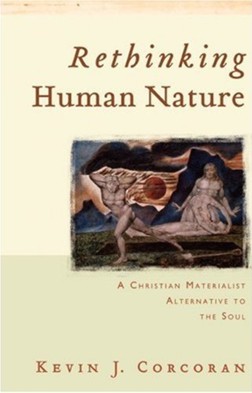
Over the next couple of weeks or so I would like to look at two books, not new but fairly recent, that think through some ideas on body and soul. The first is by Kevin Corcoran, Rethinking Human Nature: A Christian Materialist Alternative to the Soul where he develops a constitution view of human persons. Professor Corcoran is a philosopher teaching at Calvin College specializing in philosophy of mind, metaphysics, and philosophy of religion - a philosopher who tries to connect philosophy with bible, theology, faith, and science.
The second book is by Joel Green, now a professor of New Testament interpretation at Fuller Theological Seminary. His book Body, Soul, and Human Life: The Nature of Humanity in the Bible looks at a biblical view of human nature and argues that a dualistic view of the human person as material body and immaterial soul is inconsistent with both science and Scripture. Green is a biblical scholar who works to connect bible, theology, and faith with philosophy and science.
I, on the other hand, am a scientist who would like to connect science with philosophy, bible, theology, and faith. Join us it should be interesting.
To get this going let's start simple, with a little question.
What kind of things are we?
Corcoran poses the problem like this (pp. 11-13):
A common Christian view through the centuries has held that we are immaterial souls - contingently and tightly joined to bodies on earth but capable of existing without them. The essence of our being is this immaterial soul and this is what is preserved after death and in the age to come.
But this is decidedly not the common view in our modern (or postmodern) western culture. As Corcoran puts it:
... today the dominant view among philosophers, ethicists, neurobiologists, psychologists, and cognitive scientists is a "nothing but" view of materialism, the view that creatures like us are "nothing but" complicated neural networks or mere biological beasts. (p. 12)
The question of human nature has profound ramifications and impacts christian views of such topics as cloning, abortion, stem cell research, and even organ transplants. The question of human nature also touches on the afterlife and the meaning of creation "in the image of God."
We ran a short series awhile ago looking at the science of sin (Part One and Part Two). This series explored the idea that what
we are and how we behave is intimately related to the make up of our
physical bodies. Not only that but how we choose to behave and to
think has an impact on the make up of our physical being. Virtue, like
vice, can change the structure of the human brain. This information also impacts the way we think about human nature - and how we view ourselves.
Corcoran presents a version of materialism - not nothing-but materialism, which is a view inconsistent with Christian faith - but a version of materialism which keeps essential insights from the dualist view of of human nature while presenting a view of humans as what I would call embodied unities. This is, according to Corcoran, a Christian materialism. He doesn't claim definitive answers, but opens his ideas for discussion.
This brings us back to the little question above as a way to begin this discussion - a question we can express in several ways, take your pick...
What kind of things are we?
Are we, in our essence, immaterial things or material things - or both?
If both, what kind of compound beings are we?
Is a materialist view of human persons and human nature consistent with the Christian faith?
If you wish to contact me, you may do so at rjs4mail[at]att.net

Add to Newsvine
Add to StumbleUpon


One more (for now)quick comment. One of the things that drives me crazy in this debate is when theists give the following argument in support of their reductive or even non-reductive materialism: The interaction problem shows that material substances and souls could not interact with one another (or at least it lowers the probablity of such interaction significantly). So, we should abandon our belief in souls. Well if you are a theist this should not be a problem at all. God is a spirit and He apparently interacts with matter quite a bit. So given theism the probability of interaction between non-material stuff and material stuff is quite high. Indeed given theism and the existence of matter, the probablity that non-matter and matter interacts is near one.
An aside: I recommend J.P. Moreland's recent book on the argument from consciousness for the existence of God. It's very relevant to the discussion here (I hope to have a review of it done very soon for Review of Metaphysics).
David,
I am not a philosopher but a scientist (a professor and researcher) so some of your terms seem to assume a knowledge of definitions I don't have. It would be helpful to give a little more than a term (reductive materialism, nonreductive materialism, or idealism - even "interaction problem") the first time a term is used - at least it would help me in the conversation.
Given theism - the probability of interaction would seem to be one unless there is a technicality of definition of which I am not aware.
On Moreland - are you referring to his book "The God Question"?
Hi RJS,
I apologize for not providing definitions to the terms I used. As you know definitions themselves can be contentious so I'll to be as brief as possible and yet informative.
Reductive materialism: All mental events/things are identical with material events/things
Non-reductive materialism: Not all mental events/things are identical with material events/things but all mental events/things have a material base (or are constituted by material events/things).
Idealism: All events/things are mental events/things
Interaction Problem: How can non-material things/events cause/be caused by material things/events?
The probability of interaction between material and non-material things/events given theism is not one because the probability of there being anything material at all is not one.
The reason I hesitated on saying that the probability of interaction between material and non-material things/events is one is because some (most?) believe that only necessary truths have a probablity of one.
Thanks David.
I will put up another post on Corcoran's book on Tuesday which will continue the discussion I am sure.
This is probably a philosophical detail - and reflects a difference in starting point but I would say that the probability of there being anything material at all is exactly one.
The probability of a nonmaterial reality is not one.
But as a theist - given both material and non material - interaction is also a given.
Regarding reductionistic approaches, in general, we can also ask what specific aspects of reality one aspires to describe. 1) One might employ a reductionistic interpretation to such concepts as mind or soul, restricting one's description to philosophy of mind concerns. 2) One might employ a reductionistic interpretation to other, but not all, aspects of created reality, beyond the mind. 3) One might employ a reductionistic interpretation to all of created reality. 4) Finally, one might employ a reductionistic interpretation to Reality writ large (primal and local).
Different attempts to describe the nature of the soul in the various philosophy of mind approaches, which David discussed, don't pose any problems for Christianity, in my view. I also agree with David that the interaction problem is a pseudo-problem (assuming that one's concepts have been properly disambiguated, suitably predicated and sufficiently nuanced).
Eliminative materialism pertains to a philosophy of mind approach and need not suggest, necessarily, the progressively broader materialist stances. Different in/compatability issues will emerge for different Christians whenever materialism gets invoked to explain more and more of reality, "eliminating" nonmaterial categories. One could ask, beyond the nature of the soul: What's essential to Christianity from progressively broader materialist/physicalist perspectives vis a vis, for example, putative supernatural created realities (angels and demons, miracles and so on)? Those questions might be beyond the scope of our present consideration, though not unrelated.
When one "does" metaphysics, one chooses a "root metaphor" for one's ontology (description of reality) such as substance, process, experience, field, matrix or even consciousness. In so choosing, one is adding a category to the "givens" of reality, such as its primitives (e.g. space, time, mass, energy), forces (e.g. strong, weak, electromagnetic & gravity) and axioms (e.g. laws of thermodynamics, relativity, quantum mechanics). The speculative grammar of metaphysics has historically used a "modal" ontology that employs the modes possible, actual and necessary. This third category, necessary, has been replaced by the "probable."
I'm all for metaphysics and feel that a thousand metaphysical blossoms should bloom. At the same time, it is a highly speculative enterprise and it is not easy to cash out the practical value of most metaphysical concepts in our daily lives. I'm not saying that folks cannot and do not inhabit elaborate tautologies articulated in all types of metaphysical concepts but I am saying that many find it very difficult to jump outside these systems [JOTS] in order to enjoy alternative takes on reality. They not only have problems with JOTS; they also have problems recognizing that these systems are inescapably probabilistic, as metaphors will eventually collapse and are not otherwise "necessary" truths.
The practical upshot of what I am describing is that, when we reason from how things are (our descriptive ontology) to how things should be (our normative de-ontology), we must be mindful of the very highly speculative nature of our ontology and recognize that, derivatively, our deontology might best be considered very highly tentative. Because we live in an increasingly pluralistic society, we need to understand that, to the extent that our metaphysical concepts and categories are not understood, recognized or accepted by others, they will have little or no normative impetus, which is to suggest that they won't likely find their ways into a given society's codes and laws because they have no meaning in that society's social, economic, cultural, political or, even, religious discourse. Such concepts must first be translated and then negotiated.
This is not just an issue for interideological and interreligious discourse. It is an issue within Christendom, itself, between and even within denominations. In my view, the essence of Christianity is a LOT less propositional (though it certainly has propositional elements) and much more practical in nature, theologically speaking. Metaphysically speaking, it is WAY less propositional, addressing only the most essential God-concepts and their proper predication. Beyond that, the metaphysical nature of created reality is wholly up for grabs and any theological discourse regarding God's relationship to created reality, in general, and human nature, in particular, does not require robustly descriptive metaphysical conceptions, only our vague phenomenological understandings and participatory imaginations (which means "hometown" knowledge: we know HOW to get from home to school even if we cannot easily put it into words or engage in conceptual map-making about our experience of our reality).
Post a Comment
By submitting these comments, I agree to the beliefnet.com terms of service, rules of conduct and privacy policy (the "agreements"). I understand and agree that any content I post is licensed to beliefnet.com and may be used by beliefnet.com in accordance with the agreements.