We are moving from an age of belief to an age of the Spirit. We are open to the Spirit and pray for the work and power of the Spirit.
An Age of the Spirit doesn’t mean laissez faire anything goes spirituality. Nor does it mean Charismatic Christianity with speaking in tongues, prayer languages, prophecy, and ecstatic worship (although it may include all of these – and will include these for some). But it does mean a step away from modern rationalist materialism and proposition centered faith. Even more importantly, it means breaking free of our view that body and soul, flesh and spirit are separate and separable entities – we need a fully embodied Christianity focused on God and on His work, His presence, and His mission; isn’t this, after all, what true religion and for that matter biblical Christianity is?
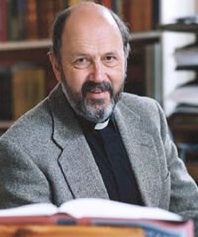
Today I would like to put up an excerpt from Tom Wright – from a lecture that he gave at Calvin College in January of 2007 – on Space, Time, and Sacraments. (You can download both lectures and the q&a sessions from the link, his homily on Luke 24 is also well worth listening to.) The excerpt I would like to consider is 45 minutes into the second lecture, Sacraments and New Creation and runs about 4 minutes.
As you read (or listen to) the excerpt I would like to focus on the following question:
What is the significance of sacrament, particularly the Lord’s Supper, in our worship and our faith? Do we need the sacramental life of the church as part of our mission to follow God and participate in His mission?
Sacraments and New Creation N. T. Wright, Jan 6, 2007 45 minutes into the lecture (from ca. 45 minutes to ca. 49 minutes).
And with that we get, through this Eucharistic theology of new creation, a rejection of the false antithesis between spirituality and action for God’s kingdom in the world. Again and again, our categories as Christians naturally fall into those two, because that’s the way we were brought up, it’s the way our churches have lived.
I suspect that those of you in the reformed tradition have long since worked out good and sophisticated ways of bridging that gap. And are saying no, this is all part of the same thing because we are about declaring God’s kingdom in and for the world, which is anticipating in the present the new creation which will result in the future.
This theology of the Eucharist, which I am offering to you today, or sketching out with you today, therefore is extremely closely conjoined with a holistic view of mission. Of the mission of God in the world, which is of course all about the challenge to you and you and you and you to repent, to believe, to accept Jesus, to know him for yourself, to rejoice in His salvation, in and through your whole being. But also simultaneously and for the same reasons, the challenge for you to become agents of new creation, where there is hunger, where there is poverty, where there is injustice, where there is danger anywhere in the world.
And, as I said before, this is because God’s work in the world is never merely pragmatic. It isn’t just we can organize a program to go and do this. If you think you can do God’s work like that read the lives of people like Wilberforce and think again. You can’t. You need prayer, you need the sacraments, you need that patient faithfulness, because we are not wrestling against flesh and blood, but against principalities and powers and the world rulers of this present darkness.
Read some of the great Christian biographies and see how they did it. Read about Desmond Tutu. Who would have thought forty years ago that at the start of the 21st century there would be a black archbishop of Cape Town chairing a commission for truth and reconciliation listening to white thugs and black thugs confess their sin? Who would have thought that? But God had other ideas, because that black archbishop used to spend three or four hours on his knees every morning, day after day and week after week, and get other to do the same, and was living the life of the sacramental life of the church and claiming the victory of Jesus over the principalities and powers.
You can’t do it by just a little bit more politicizing, social techniques. You can only do it through being energized in the sacramental and prayerful life of the church, whatever the “it” is that you have to do.
I posted a few weeks ago on Scot’s book on Fasting. The focus of that post, and Scot’s book (Fasting), is the importance of a fully embodied faith. Fasting, then, is a natural response to life’s grievous sacred moments. We simply cannot separate body and soul. Wright’s point in this excerpt is along the same lines. A spiritual battle demands bodily response and preparation, on our knees before God. Fasting, prayer, and participation in the sacramental and ritual life of the church are integral components to the mix. We will not change the world through a pragmatic search for justice. God can use us, through the power of the Spirit, to change the world in small and cumulative ways, but only if we are on our knees and involved in His mission in a fully embodied fashion. I don’t think that it will happen without fellowship, worship, prayer, repentance, sacrament, church.
What do you think of Wright’s sketch of the importance of the sacramental life of the church? Do you agree that Spirit-led faith, justice, and mission are conjoined with an embodied faith and the sacramental life of the church?
If you wish to contact me directly you may do so at rjs4mail [at] att.net
posted November 17, 2009 at 8:02 am
“Read about Desmond Tutu. Who would have thought forty years ago that at the start of the 21st century there would be a black archbishop of Cape Town chairing a commission for truth and reconciliation listening to white thugs and black thugs confess their sin? Who would have thought that? But God had other ideas, because that black archbishop used to spend three or four hours on his knees every morning, day after day and week after week, and get other to do the same, and was living the life of the sacramental life of the church and claiming the victory of Jesus over the principalities and powers.”
RJS,
You write with a great deal of passion and I find that compelling. I agree with your quote above and that attention and passion for the sacramental life are key to bringing to miracle (God’s Kingdom) to fruit in our world and that politics and plans alone won’t do it.
However–and I recognize this puts me on a fringe–the sacramental life you describe in Tutu is a life of prayer, not a life of taking ritualized communion. I believe–I KNOW–you can have a sacramental life without the eucharist as the Church commonly understands it:You don’t need a bit of bread and grape juice/wine to become part of the body of Christ and the communion of saints. In fact, I think the church would do far more to embody mission or to conjoin spirit and mission if we ate the Lord’s Supper, so to speak, as Jesus did–as an actual sacred (and I want to emphasize sacred) full meal to which all were invited. That would put us in communion with the poor–the living poor of today–the faces of Christ–the blessed–and would also, if fully implemented, work to end hunger while demonstrating the power of the Gospel. When you conjoin the Last Supper and the miracle of the loaves and the fishes, you are beginning to have the Kingdom of God on earth. Beside that, the argument I have heard repeatedly–we are tied through space and time to other believers who enacted an identical ritual (what Wright says in his clip)–pales. I don’t need a relationship with ghosts to have a living relationship with Jesus. But I do need to be embodying his love among the living.
posted November 17, 2009 at 8:07 am
Diane, I see your point. Tom’s eucharistic theology, as I read him, illustrates an embodiment of the gospel in flesh and blood — and his terms like holistic make me think Tom is using eucharistic here in way that focus on embodiment.
No?
posted November 17, 2009 at 8:44 am
Diane,
The example of Desmond Tutu is Wright’s and one I’ve heard him use several times. Sure, sacrament isn’t magic and isn’t enough. But my point is that we are embodied and sacrament is an important part of the whole. It isn’t optional or merely ritual or merely symbol.
posted November 17, 2009 at 8:51 am
I suggest that it will only be by the Spirit that we overcome the prevailing gnostic stranglehold on popular spirituality. That participation in the Eucharist has anything whatsoever to do with making things right in Jesus’ Name in the world in not on the radar screen of popular spirituality. The Eucharist is an in-house, “us” thing with nary a thought about it as an powerful impetus to engage the crackedness of the world. If I were to ask friends, “Does the Lord’s Table have anything to do with the church’s missions ministry?” I think I would get a glazed eye silence. Come, Spirit, come. Amen.
posted November 17, 2009 at 9:34 am
Unlike most congregations in our denomination, the one we have recently joined celebrates the Lord’s Supper every week. First, something here IS DIFFERENT. Whether it is because the service is tied to a different liturgy or not. However, once we have come to this point, I believe Diane’s point is one we must consider.
Our congregation offers a church and community dinner each month (it was 2x per month during the summer months). We are working on how to get people in the door when we meet inside, which is a task in itself. But between the Lord’s Supper and our community supper, I believe we need to create a space for celebrating the kind of full-orbed dinner for all that Diane suggests.
Now if we could just tear down these walls…
peace,
Randy Gabrielse
posted November 17, 2009 at 9:39 am
Scot,
Yes, I agree that there is something embodied in the eucharist and that such embodiment is a good thing, but I can’t shake the conviction that in the eucharist we’ve replaced the best with the good.
RJS,
I imagine we have to agree to disagree: I do think the eucharist is, of itself, mere ritual, and I do think “bread and juice/wine” communion is unnecessary. The Quakers replaced that eucharistic ritual with communion as the gathered body of believers together experiencing the power and light of Christ and were able at times to transform the world: For example, they abolished slavery amongst themselves in 1772 and before that, established Pennsylvania on Christian principles. They did pray fervently and frequently, lived seeking God’s will and entered into ecstatic relationship with Jesus.
posted November 17, 2009 at 9:44 am
Scot, I like the emphasis of the unity of body and soul/spirit over a false duality. I’m for the most part glad that we are “breaking free of our view that body and soul, flesh and spirit are separate and separable entities.”
But how does that statement square with what happens to Scot McKnight after he dies but before the new Kingdom is inaugurated? N.T. Wright likes to talk about “life AFTER life after death” which he believes – and I agree – is an embodied existence in the new and restored Kingdom. But what about in between now and then? What about the “life after death” that isn’t the end, but that is an intermediate state where the body is in the ground (or cremated, or decayed) and *some* essence of Scot McKnight is still in existence somehow, somewhere. How does this idea that body, soul, flesh and spirit are inseparable deal with that?
posted November 17, 2009 at 10:12 am
That being said, I’m a supporter of the bread and wine eucharist. I simply don’t think it’s necessary, which I know is a fringe view.
posted November 17, 2009 at 10:23 am
Although I don’t subscribe to the theory of “The Age of the Spirit”, this topic is too close to my interests to not respond. How do we embody our own theology? Having been rescued by grace, do others find grace in us? Having been recipients of the mercy and kindness of God, do others see mercy and kindness in us? Believing that every human being is an imprint in some sense of the very form of Deity, do we treat people of all types and beliefs with respect and compassion? Could the pre and post reformation types all do a better job than we have of embodying our theology?
As an example of one who definitely embraced an “Age of the Spirit”, may I say mystical theology(please don’t take a shallow definition);and one who exemplified an embodied faith; I think we should mention Frank Laubach. You read him, or google him, but the results of his theology speak for themselves. Just for one example, his respect among Muslims, and Muslim extremists, is unparalleled.
Now I would make a distinction between Laubach, and other “mystics”, and the church type that is the so-
called “spirit type”. I would call it the sect type, but that terminology has so much baggage, like the word mystic, that it is hard use today. The “spirit type” church has lived and had a hard time dying throughout Christian history. It was in reponse to it’s form of embodied theology that the sacramental systems came into being in the first place. Of course one can relive history, but we all don’t have to. The “spirit type” has traditionally believed they are the cutting edge, when in fact they are reactionary.
We are groping toward what we believe- the communion of the saints. Contrary to what some believe, that doesn’t have to wait until the marriage supper. Sacramental people know you leave communion changed.
posted November 17, 2009 at 11:16 am
Diane,
Nothing is necessary. All is a gift.
posted November 17, 2009 at 11:32 am
All our practices (whether eucharist or common meal, ecstatic or liturgical) ought to have this in common: the prayer that God’s will be done–fully lived with all of our heart, soul, mind and strength–on the earth as in heaven. Is Wright “right” that a more full-bodied appreciation and practice of the eucharist would be helpful toward that end? Absolutely. And Diane is right to point out that despite our never-ending preference (and sometimes idolatry) for some sacraments over others (whether eucharist, or singing praise songs, or preaching, etc.) there is no silver bullet sacrament, because God refuses to allow his work and presence to be so constrained. If we keep the mission as the focus, the loving work of God in and for the earth as revealed by Jesus, then the sacraments all come into their proper place and practice for receiving and entering that work.
posted November 17, 2009 at 2:02 pm
It seems we have learned from anthropology that we are story-tellers and that our intellectual, affective, moral and social growth comes not only from propositional cognition but also from our participatory imagination, our active participation in various narratives.
One could say we are liturgical animals, Homo liturgicus. And this is true whether one practices an explicit faith, implicit faith or no faith at all. And this is true for better and for worse, as our desires are formed, shaped and reinforced by the liturgies of the mall, sports stadia and the marketplace as well as by our worship and fellowship. So, an approach that best articulates our faith (including propositions), best celebrates our hopes and best reinforces our love will, in my view, help us move more swiftly and with less hindrance along our ongoing journeys of transformation, enjoying a life of superabundance. So, I’m thinking there will be some type of sacramental economy in play for all, again, for better or worse, which helps order our orthodoxy, orthopathy and orthopraxy. What that should be, precisely, is another consideration but there certainly will be norms in play.
Even people of implicit faith and no “formal” sacramental access will be realizing life’s most important values of truth, beauty, goodness and unity, iow, a life of love and abundance (as various semiotic signs and symbols bring into reality what they bring to mind). I don’t view these value-realizations in terms of all or nothing but more so in terms of degrees of fullness of realization of the God-encounter (as well as frustration of). It is said that the God-encounter is a full body-blow (head & heart, body, soul & spirit) and that seems an apt anthropological description.
As for the nature of the soul, however dual or nondual or in-between (hylomorphic), I think it suffices to recognize that our temporal experience is radically integral, which is to recognize that our experience is wholly embodied & wholly ensouled. What happens transtemporally in an eternal realm is nothing God can’t handle inasmuch as He’s not constrained by our speculative metaphysical constructions.
posted November 17, 2009 at 2:29 pm
BTW, one of the most interesting parts of that talk by Wright was where he talked about practicing the eucharist as matter of a healthy epistemology. (It was after the quote above.) We “know” not only by propositions by also by taste, touch and so on. To me, the more we realize this, the more all of the traditional sacraments and more besides can be helpful to our mission and toward forming a real humanity in the church.
posted November 17, 2009 at 4:21 pm
I found this point intersting:
But it does mean a step away from modern rationalist materialism and proposition centered faith. Even more importantly, it means breaking free of our view that body and soul, flesh and spirit are separate and separable entities – we need a fully embodied Christianity focused on God and on His work, His presence, and His mission; isn’t this, after all, what true religion and for that matter biblical Christianity is?
When you say modern–are you referring to the Enlightenment, because the critique you call for has been going on for quite some time in science. Have you read Damasio for instance?
Folks seem to throw around these concepts like modernity, etc but seem unaware of the critique and advances in science regarding this so called world view. Read Lakoff, Damasio, Dennett, Gardner, etc.
posted November 17, 2009 at 6:14 pm
Diane,
Why do you think that the Quakers are a good example here? If you interpret either Wright or me as claiming that only through participation in the sacrament can an individual or a group do good – you misinterpret.
My point is a bit different than this – the separation of body and soul, material and immaterial, is a false dichotomy. But because we are embodied souls ritual and sacrament are important components to a full-bodied faith and mission. Sacrament in this context means baptism and eucharist. I don’t hold with “real presence” or a “magical” transformation, but I do think that there is no substitute for actually physically doing this in remembrance of him, or for doing it to proclaim the Lord’s death until he comes again.
Isn’t failure to do so – like failure to baptize – really failure to take scripture or the physical, historical basis for our faith seriously?
posted November 17, 2009 at 6:23 pm
Mich,
I haven’t read these authors – but this is, in a Christian fashion, the issue I want to think about for a few weeks. I know that it is not new. Many will claim (Dennett for example) that this embodiment eliminates faith in general and Christianity in particular as a viable view of reality. I tend to think that it tweaks our understanding of the faith and of human nature, but does not undermine the faith itself.
posted November 17, 2009 at 7:59 pm
RJS,
I thought that you were equating “sacramental life” with the Eucharist because of the focus of the Wright clip. Since I read JC first thing in the morning, I may have missed a larger picture. But my understanding, as a former Lutheran, is that the Protestant sacraments are baptism, confirmation and communion and as there was no mention–that I recall– of the first two, I commented on the eucharist. If by “sacramental life” we mean some sort of embodied, incarnate worship that falls between the ethereal and the missional, yes I agree that’s important. Some way of embodying the faith matters–I believe we lose to the Wiccans and Pagans when we don’t have an imagistic, textured, corporeal worship. However, and of course blogs are not the place for these kinds of extended discussions, I don’t believe it HAS to be “bread and wine” communion as practiced by most of the church.
I chose the Quakers as I happen to be one and because I believe, in their earlier days, the Quakers rejected communion as an empty ritual that people (Anglicans) used to feel that they were Christians while not doing the work of feeding the hungry and clothing the naked, of whom there were many in the 17th century. The Quakers replaced bread and wine communion with an idea of the embodied presence of Christ binding and gathering a group of believers into a communion of saints–and this reinterpretation seems to have borne fruit. So for me, this is empirical evidence that you don’t need communion (as traditionally practiced). Of course, that’s not to say traditional communion is a bad thing (I actually like it) but that it’s simply not necessary.
Why do you think there’s no substitute for it? And what about those for him it is an empty ritual that convinces them they are Christian while they are doing nothing to help those in need? When the embodiment of communion becomes a substitute for embodying Christ missionally? Sometimes I think for some people it becomes a “feel good” moment equivalent to waving the cigarette lighters at the end of the Queen concert and perhaps that’s not so good.
posted November 17, 2009 at 8:13 pm
RJS,
These become very emotionally laden issues and nobody’s mind will be changed, but can’t baptism–or water sprinkling as the Quakers call it (and I had all my children water sprinkled before I saw the light) –and sipping a bit of wine and swallowing a bit of bread actually represent the failure to take our historical, physical faith seriously? When Christianity gets reduced to “you’re in, no Hell for you if you’re baptized and take communion” (which is what I was taught) doesn’t that re-nail Christ to the cross? I get concerned that such pointers toward embodying Christ on earth become ends in and of themselves. And I recognize I am swimming against 1,000 years or more of church tradition–put so am I in wanting to ordain women.
posted November 17, 2009 at 8:30 pm
Diane, those Quakers have a point… but let me emphasize something about what I think RJS and Wright and others are getting at. They are arguing against total spirituality and a lack of embodiment, and the historic (unQuaker) sacraments are part of a picture that many sketch of embodiment — that God wanted to make things physical.
Genuine sacramental life leads to holistic embodied faith. Reducing the faith to a sip and a nibble, of course, disparages the whole faith and not just the sacrament.
posted November 17, 2009 at 8:51 pm
Diane,
I think that every ritual in the church – as well as avoidance of ritual for that matter – has been and can be misused and distorted. If we want to talk about “how” I think there is much to discuss.
But I don’t think that there is any substitute for Baptism (although I come from a Baptist tradition and have preference for believer’s baptism) or for Lord’s Supper (or Eucharist or Communion however you call it) because both are founded in scripture and practiced from the very beginning.
On Lord’s supper – in Luke 22, Mark 14, 1 Cor. 11, and 1 Cor. 10. It is also outlined in the Didache (late first/early second century) where it is simply assumed and in Justin Martyr’s First Apology ca. 150 AD where he says “And when the presider has given thanks, and all the people have expressed their assent, those who are called by us deacons give to each of those present to partake of the bread and wine mixed with water over which to thanksgiving was pronounced, and to those who are absent they carry away a portion.” In the next paragraph he refers back to the gospels and the writings of Paul and the command to “do this in remembrance of me.”
Baptism is also simply assumed by Paul and practiced throughout the NT and discussed in both the Didache and by Justin and in many other very early sources. But the key for me is Romans 6 – where Paul simply says “Or do you not know that all of us who have been baptized into Christ Jesus have been baptized into His death? Therefore we have been buried with Him through baptism into death, so that as Christ was raised from the dead through the glory of the Father, so we too might walk in newness of life.” (Ro 6:3-4)
posted November 17, 2009 at 9:07 pm
RJS I really appreciated your post here: the questions you challenged us to probe into, and the long quote from Wright. I would parse where we’re headed differently than you did in the beginning. Wright, himself, is a Critical Realist. I think many people will probably turn toward positions like Critical Realism more than just an Age of the Spirit. Critical Realism allows for substantive reflection and development from belief but also acknowledges the role of Spirit (that is when one is a Christian Critical Realist).
Your closing questions have really challenged me, thank you;
What do you think of Wright’s sketch of the importance of the sacramental life of the church? Do you agree that Spirit-led faith, justice, and mission are conjoined with an embodied faith and the sacramental life of the church?
To the second question – absolutely!
To the first question I think Wright is spot on but more could also be said. In the quote it seemed like Wright was focusing on what that sacramental life does for the Christian believer’s faith and spiritual nurishment but I also think the sacramental life is itself a embodied proclamation to those around us of the Christian faith. Something David J. Bosch said in “Spirituality of the Road” has really stuck with me. Summarizing his thoughts here, he basically said we can treat the sacraments like they’re a recharging station from which we leave to do mission, but the sacraments are themselves part of our sojourn on the road, something we receive, practice, and life from in THE MIDST of mission. I was really helped by that.
RJS your post has really made me rethink the sacraments and mission. Thank you! (as well for the links to Wrights materials).
posted November 17, 2009 at 9:28 pm
RJS wrote in #15 >>> Sacrament in this context means baptism and eucharist. I don’t hold with “real presence” or a “magical” transformation, but I do think that there is no substitute for actually physically doing this in remembrance of him, or for doing it to proclaim the Lord’s death until he comes again.
posted November 19, 2009 at 9:58 am
Scot, if you’re still reading here I’d be interested in your thoughts on my question in #7. I’m trying to reconcile the idea of body/spirit as a false duality, with the post-death, but pre-resurrection state of a redeemed person.
Where is the child of God (and what part of her is there) when her body has died and has been cremated, but the New Kingdom hasn’t yet been brought to its fullness. When she is experiencing “life after death” and hasn’t yet arrived at N.T. Wright’s “life AFTER life after death”?