Daily Prayers:
- A. Book of Common Prayer
- A. Book of Common Prayer 2
- A. Divine Hours
- A. Evening Prayer (Anglican)
- A. Morning Prayer (Anglican)
- Celtic Prayer
- Creeds of Christendom
- Eastern Orthodox Prayers
- Lectionary
- Liturgy of the Hours
- Missio Dei
Emerging Movement:
- Andrew Jones
- Andrew Perriman
- Anthony Stiff
- Art Boulet
- Bob Robinson
- Br. Maynard
- Dan Kimball
- David Fitch
- Dogwood Abbey
- Ecclesia Network
- Emerging Women
- Eugene Cho
- Henrik Holmgaard
- Jamie Arpin-Ricci
- Jazz Theologian
- John Frye
- John Lagrou
- Jonny Baker
- JR Briggs
- Leonard Hjamarlson
- LeRon Shults
- Lukas McKnight
- Peggy Brown
- Sivin Kit
- Stephen Shields
- Steve McCoy
- Steve Taylor
- Tamara Buchan
- The Practicing Church
- Tim Miekley
- Todd Hiestand
- Tom Smith (RSA)
- Tony Jones
Other sites I frequent:
- Allan Bevere
- Andy Rowell
- Attie Nel
- Barna
- Brad Boydston
- Chris Ridgeway
- CC Blogs
- Don Johnson
- Ed Gilbreath
- Erika Haub (Carney)
- Faith Blogging
- Falsani
- Fr. Rob
- Hummers
- iMonk
- James McGrath
- Jim Martin
- John Stackhouse
- JR Woodward
- Karen Spears Zacharias
- Laura Barringer
- LaVonne Neff
- LeaderFOCUS
- LL Barkat
- Luke/Annika
- Mark Galli
- Mark Roberts
- Michael Kruse
- Nexus
- Owen Youngman
- Ted Gossard
- Tom Wright
Recommended Online Readings:
Scholarly Books I’ve written:
- Dictionary of Jesus and the Gospels
- Hist Jesus Anthology
- Interpreting the Synoptic Gospels
- Introducing NT Interpretation
- Jesus and His Death
- Jesus in Memory (ed.)
- New Vision for Israel
- Synoptics: Biblio
- The Face of New Testament Studies
- Who Do They Say I Am?
Scholarship Online:
- Apollos
- Books & Culture
- ChristianityToday
- CS Lewis
- EAC
- Early Xian Writings
- Euaggelion
- Gospels
- Jesus and His Death Blog
- Karl Barth Online
- Mark Goodacre’s Weblog
- Online Journals Access
- Online Pseudepigraph
- Pete Enns
- Prime Time Jesus
- Theopedia
- ThinkTank
Stuff online:
- 5 Streams
- Big Muddy
- Catalyst Scripture
- Catching the Wave
- DaVinci Code
- Forgiveness
- Future or Fad?
- Gospel of Judas
- High Calling
- Interview on Emerging
- Interview with LL Barkat
- IVCF Eikons
- IVCF Gospel
- John Bunyan
- Keys of the Kingdom
- Lake Emerging
- Mary in CT
- Missional in Seattle
- Missional Matrix
- Nativity Story
- Never Alone
- New Perspective
- Pepperdine Interview
- Professor as Scholar
- Recl Mind Mary 1
- Robust Gospel
- Social Justice
- Trojan Horse 2
- WiredParish Mary Interview
- Word/World NPP


posted January 15, 2010 at 1:13 pm
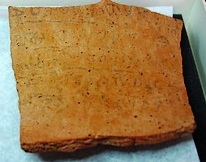
interesting discovery esp in light of recent events…
posted January 15, 2010 at 1:32 pm
I don’t have the expertise to evaluate the claim that this is Hebrew – or that the translation is correct.
But assuming that the translation is correct – I find the content fascinating. What we seem to see here is essentially the theme behind James 1 and other parts of the NT and OT … Pure and undefiled religion in the sight of our God and Father is this: to visit orphans and widows in their distress, and to keep oneself unstained by the world.
posted January 15, 2010 at 3:23 pm
From the LiveScience article about it:
“The content, which has some missing letters, is similar to some Biblical scriptures, such as Isaiah 1:17, Psalms 72:3, and Exodus 23:3, but does not appear to be copied from any Biblical text.”
http://news.yahoo.com/s/livescience/20100115/sc_livescience/biblepossiblywrittencenturiesearliertextsuggests
posted January 15, 2010 at 4:25 pm
Since the earth is only 6,000 or so years old, it was obviously placed by God into the earth with the appearance of age, to encourage our faith.
posted January 16, 2010 at 7:20 am
Very interesting Scot. I would love to hear your take on this, in terms of what that we might learn from this discovery and its implications. Thanks for posting this.
posted January 16, 2010 at 7:40 am
Jim, I’d need more evidence and context to know what to make of the text, but as it is this text shows clearly that there was poverty and that it was right to protect them. The word “judge” will mean “judge in favor of” — at least that is how I’m reading it.
The other thing is who is grouped: slaves, widows, orphans and strangers. Israel was not permitted to take advantage of the marginalized.