Jesus Creed

Jesus Creed

Virtual Sermons, Virtual Churches, Virtual Christians

posted by Scot McKnight | 12:02am Friday July 16, 2010

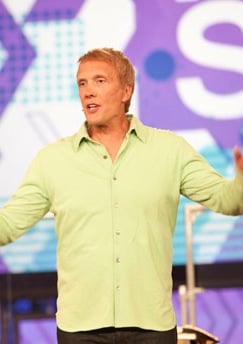
VirtualSermons.jpg Overall, I’m against it. Yes, there are probably situations where virtual sermons are needed. Yes, I’ve actually participated in this sort of thing… but… 


What do you think? What does this say about pastoral theology? About ecclesiology? About what a Sunday morning service is? What would happen if the congregants decided they, too, wanted to be virtually present?

(CNN) – The Sunday morning service at Fellowship Church in Dallas, Texas, was humming along with hymns and prayers when something unusual happened.

The lights in the sanctuary suddenly dimmed, and members of the church hushed as they peered at a pulpit shrouded in darkness. The parishioners then erupted in cheers and whistles as Ed Young Sr., the church’s senior pastor, emerged from the darkness with a microphone in hand.

“Please be seated, be seated,” Young said as he grabbed the Bible. “How are you guys doing today? Doing well?”

Young delivered his sermon, but he couldn’t hear or see his congregation respond: He wasn’t physically there.

Young’s parishioners were instead looking at a high-def video image of their pastor beamed into their sanctuary from a “mother” church in Grapevine, Texas.

Young is part of a new generation of pastors who can be in two places at one time. They are using technology — high-def videos, and even holograms — to beam their Sunday morning sermons to remote “satellite” churches that belong to their congregation….

Geoff Surratt, author of “The Multi-site Church Revolution,” said at least 3,000 churches nationwide use some variation of high-def video to spread their pastor’s Sunday morning sermons….

It may not be a better way, though, said the Rev. Thomas Long, a nationally recognized authority on preaching and author of “Preaching from Memory to Hope.”

Preachers who don’t think they need to be physically present in their church should ask how they would feel if they were forced to preach to high-def images of their congregation every Sunday morning, Long said.

“There’s something about embodiment — that the person who delivers the sermon is actually there — that’s important,” Long said. “It’s important in the same way that someone physically visits someone in a hospital or buries a loved one — they don’t fax it in.”

Long said the New Testament accounts of Jesus’ interaction with people show him constantly touching and being physically present with people.

“We don’t think God sent a message to us; God sent a person and the word became flesh,” he said.


Previous Posts

This blog is no longer active
This blog is no longer being actively updated. Please feel free to browse the archives or: Read our most popular inspiration blog See our most popular inspirational video Take our most popular quiz

posted 3:10:39pm Aug. 31, 2010 | read full post »

Our Common Prayerbook 30 - 3
Psalm 30 thanks God (vv. 1-3, 11-12) and exhorts others to thank God (vv. 4-5). Both emerge from the concrete reality of David's own experience. Here is what that experience looks like:Step one: David was set on high and was flourishing at the hand of God's bounty (v. 7a).Step two: David became too

posted 12:15:30pm Aug. 31, 2010 | read full post »

Theology After Darwin 1 (RJS)
One of the more important and more difficult pieces of the puzzle as we feel our way forward at the interface of science and faith is the theological implications of discoveries in modern science. A comment on my post Evolution in the Key of D: Deity or Deism noted: ...this reminds me of why I get a

posted 6:01:52am Aug. 31, 2010 | read full post »

Almost Christian 4
Who does well when it comes to passing on the faith to the youth? Studies show two groups do really well: conservative Protestants and Mormons; two groups that don't do well are mainline Protestants and Roman Catholics. Kenda Dean's new book is called Almost Christian: What the Faith of Ou

posted 12:01:53am Aug. 31, 2010 | read full post »

Let's Get Neanderthal!
The Cave Man Diet, or Paleo Diet, is getting attention. (Nothing is said about Culver's at all.) The big omission, I have to admit, is that those folks were hunters -- using spears or smacking some rabbit upside the conk or grabbing a fish or two with their hands ... but that's what makes this diet

posted 2:05:48pm Aug. 30, 2010 | read full post »

Advertisement
Comments read comments(30)
post a comment
Chad

posted July 16, 2010 at 1:02 am


This goes way beyond sermons. I wrote a piece for Leadership Journal on the topic last year and in my research I was surprised to find that churches offer sermons, communion, prayer, and even baptism all as part of the virtual church experience.


report abuse
 

Gus

posted July 16, 2010 at 3:19 am


Its not only in Mega Churches, I’m a minister in a semi rural area in South Africa.
Sometimes when we can’t get preachers we use video for the sermon; it works, and I can be in two small congregations at once at the same time.
I think – in Paul’s day the use of a letter to be read to a congregation was a similar idea?


report abuse
 

Peter

posted July 16, 2010 at 4:05 am


There are a number of criticisms that could be levelled against this practice (“presence” and “touch” already having been mentioned), but what jumps right off the page at me is the problem of celebrity. It only seems reasonable to assume that in that crowd of listeners there are qualified teachers and preachers because the Holy Spirit continues to be faithful to dispense these gifts. The approach of daughter churches listening to the one celebrity preacher, besides preventing the congregants the pastoral oversight that they need, inhibits the development of the gifts in their midst.


report abuse
 

Mike Bird

posted July 16, 2010 at 5:27 am


Scot,
I am against this when it’s just a case of consumer driven Christian empire building. But having spent time in rural Scotland where you have some small parishes of 10-30 people in country areas, who cannot afford a full-time pastor, some kind of virtual technology might well be the solution to getting a regular diet of good solid preaching to these people.


report abuse
 

paul

posted July 16, 2010 at 7:04 am


if there is a problem here, I don’t think it’s with the pastor preaching in one church and being seen in others. that seems more of a symptom of a deeper issue. i mean, how many people in the original church (where the pastor is preaching) are going up to him to talk, and be touched, and loved on? the purpose of the guy on stage (in these churches) is usually to teach and to lead others (usually other leaders who lead others, etc) in the mission of their church…who cares if the guy chooses to teach in person or not… he is still doing his job and i can’t imagine the take away of the congregation would improve just because he was in the building (in fact, i would argue the takeaway from sermons like this is really low regardless)
to me the debate is over pastoral theology. what is the role of a “pastor”? those who talk about pastors as needing to be present and have the ability to “touch” others seem to have a view of pastors as more relational and “shepherd” type people. in smaller congregations the pastor seems to have this role. in larger congregation, this role is often filled by small group leaders & sometimes pastors of specific ministries that you are apart of outside of the main church service. i’ve been apart of large churches before, and i never had a relationship with the teaching pastor at all (even when i was heavily involved in those churches).


report abuse
 

RJS

posted July 16, 2010 at 7:27 am


Scot,
Are you going to link the original article?
On the topic – while there are times and places for this as Mike Bird and others have noted, I don’t think megachurch with celebrity speaker is either the time or the place.
I don’t even like the idea of overflow rooms with video connection.
But in all of this we have to get back to the purpose of church and the meaning of “pastor.”
I would suggest that someone like Hybels who is an excellent speaker and leader, is in fact ‘pastor’ to a rather small number of people, if any. Such a model must delegate the role of pastor to others in the community.


report abuse
 

Jason Lee

posted July 16, 2010 at 7:49 am


This reminds me of the discussion of “celebrity” and decoupling word from reality in contemporary Evangelicalism. James D. Hunter discusses this in “To Change the World.”


report abuse
 

Rob

posted July 16, 2010 at 8:02 am


I agree with Peter on this. The development of the gifts of the Holy Spirit is critical in every church. While offering certain advantages, the multi-site church model with virtual preaching limits the development of certain gifts like teaching and leadership. Moreover, in the case of celebrity preachers (like the slant of the CNN article), the concerns over personality cults or misplaced loyalties become relevant. I suppose every model has its tradeoffs, but this is one I’m not willing to embrace right now.


report abuse
 

Rick

posted July 16, 2010 at 8:13 am


I understand the concern about celebrity, but many, previously unchurched people are coming to these churches because they appreciate the teaching of these specific pastors.
If these speakers are getting people in the door, then working to get people connected in deeper ways (campus pastors, small groups, etc…), should we not have a more positive view of this?


report abuse
 

JoeyS

posted July 16, 2010 at 8:42 am


Rick, of course one could contend that God creates beauty out of ashes but it isn’t his hope that we should then celebrate the ashes ;)


report abuse
 

josenmiami

posted July 16, 2010 at 8:43 am


Rick, can you give any objective data to support your assertion that many previously unchurched people are being “churched” as a result of this type of ministry? I seriously doubt it, unless it is “church” Christians who have stopped going to church and are sitting in the sidelines.
My problem with this is that it seems to be an extension of the whole tendency toward Christian “heros” and celebrities … an intensification of modern Christian narcissism and celebrity cults.


report abuse
 

Travis Greene

posted July 16, 2010 at 8:46 am


What do you think? It’s quasi-gnostic idolatry.
What does this say about pastoral theology? That only one in 10,000 is the chosen one who God has placed on a pedestal to preach to the ordinary masses. That being a follower of Jesus is about receiving the right information.
About ecclesiology? That branding is more important than community, and dependence is more important than development.
About what a Sunday morning service is? A place to “get fed”, to be impressed, where professionalism is key and where one size fits all.
What would happen if the congregants decided they, too, wanted to be virtually present? Sounds like the logical endpoint to me. Just stay home and watch Nooma videos or listen to podcasts.


report abuse
 

George Davis

posted July 16, 2010 at 9:00 am


I’m curious…
When Bethlehem Baptist in the Twin Cities went multi-site with video technology, does anyone know how Piper explained/defended this approach?


report abuse
 

Fish

posted July 16, 2010 at 9:21 am


I don’t see how a video projection of a preacher would draw unchurched people. As a formerly unchurched person, that would have turned me off. It implies that the sermon is what converts people, where for me at least it was the relationships. And the Holy Spirit working through them.
I have to confess that during the time I was unchurched and being dragged into church by my wife, I rarely even paid attention to the sermon.
Captcha: two padre


report abuse
 

Geoff Surratt

posted July 16, 2010 at 9:55 am


After 8 years I am still surprised that the use of video as a tool to help people connect and grow in Christ causes so much angst. Every church that I know of who uses video teaching also has onsite pastors/shepherds for every congregation. These pastors serve the local congregation in every way a traditional pastor would serve except for standing on a platform for 30-40 minutes on the weekend and teaching. This allows them to focus on the other aspects of caring for , teaching, and growing the flock rather than spending hours locked away alone studying for a sermon.
It has been acceptable for as long as I have been around church to use curriculum written elsewhere for Sunday School or for small groups. Pastors using material from 150 year old sermons are admired. But sermons delivered by video is taboo. I know I am simplifying the issue, but it still surprises me.


report abuse
 

Phillip

posted July 16, 2010 at 9:57 am


“The lights in the sanctuary suddenly dimmed, and members of the church hushed as they peered at a pulpit shrouded in darkness. The parishioners then erupted in cheers and whistles as Ed Young Sr., the church’s senior pastor, emerged from the darkness with a microphone in hand.”
It sounds more like a rock concert than a worship service. At the end, who receives the cheers and celebration, the pastor or God? I can see the value of this perhaps for some of the situations described above, where a single pastor serves multiple small isolated churches, whose denominations require an ordained pastor to preach. But surely the Spirit is able to speak through someone who is actually in the room, even if without the flash–jars of clay.


report abuse
 

Travis Greene

posted July 16, 2010 at 10:29 am


Geoff @ 15, “It has been acceptable for as long as I have been around church to use curriculum written elsewhere for Sunday School or for small groups…But sermons delivered by video is taboo.”
Good point, but frankly I think that kind of curriculum is too much of a crutch as well. And anyway, there are still local teachers in the room doing actual teaching.
Is there really no one who can actually teach in the satellite congregation? The celebrity pastor is just so good that they are indispensable for forming a new congregation, so they have to be piped in?


report abuse
 

Rick

posted July 16, 2010 at 10:45 am


Josenmiami:
From a 2009 Hartford Institute study on megachurches (the ones typically doing this type of service)
“?Nearly two-thirds of attenders have been at these churches 5 years or less.
?Many attenders come from other churches, but nearly a quarter haven?t been in any church for a long time before coming to a megachurch.
?Attenders report a considerable increase in their involvement in church, in their spiritual growth, and in their needs being met.
?New people almost always come to the megachurch because family, friends or co-workers invited them.
?What first attracted attenders were the worship style, the senior pastor and the church?s reputation.”
You wrote: “I seriously doubt it, unless it is “church” Christians who have stopped going to church and are sitting in the sidelines.”
Is that such a bad thing?
Travis #17
“Is there really no one who can actually teach in the satellite congregation? The celebrity pastor is just so good that they are indispensable for forming a new congregation, so they have to be piped in?”
Many of these churches mix it up now and then. The campus pastor may speak to his/her specific church, or the campus pastor from one location may be the one doing to video to all the other locations.


report abuse
 

Tim

posted July 16, 2010 at 11:15 am


Another factor in this discussion is the wise and strategic use of the gifted people within a church community. If a church has a gifted handful of teachers, video venues allow those individuals to spend their time focusing on what they do best; it also allows people with stronger relational, pastoral and care gifts to do what they do best, be with people and care for them. Almost all multi-site video venue churches do in fact have pastoral leaders for every church-site who are there.
This form allows teachers to teach, and pastors to pastor; it’s a different division of labor than a traditional model, and it comes with some costs, but it also opens up other opportunities; as well.
sweeping dismissals are not helpful when it comes to this issue, and it’s easy to caricature. In my view, there are many strengths in this model which actually allow more *presence* because the site-pastors don’t have to spend all their time in study-prep every week, they can invest their time with people.


report abuse
 

Jonathan

posted July 16, 2010 at 12:01 pm


So, setting my beef w/ the over-emphasis on sermons in evangelical “worship” aside, I think the most startling thing this indicates is the extent to which we’ve dispensed with dialogue in Christian learning. Granting that this is anecdotal, my own experience has been Christian learning in evangelical circles is either passive sermon-reception or rather lightweight small group settings where we exchange cliches in answer to questions to which we largely already know the answers.
It seems to me that the Gospels evidence a rather different mode of discipleship/spiritual learning: an individual asking a question that results in teaching to the crowd.
Video sermons seem to especially preclude that kind of interaction. But so does the culture and structure of most evangelical worship services, so maybe its unfair to pick on these folks in particular.


report abuse
 

T

posted July 16, 2010 at 12:30 pm


I think Paul had a continuing influence and form of leadership in the churches he founded, even after he physically left, by relationship with local leaders and by letters (which seem to be an inferior mode of communication and presence than video, on the face of it).
So I don’t want to rush to the “this is inherently bad” conclusion that I feel pulling me.
That said, I think this is worth thinking about within the larger question of what we protestants sacramentalize; i.e., in what activities or things or people do we believe God is especially active and effective for building people up in the faith?
What I see in this is an extreme example that we have put way, way too many of our sacramental eggs in the basket of the dynamic teacher/preacher/sermon. I’m concerned that our sacramental imaginiations are being totally filled with the dynamic speaker and that he is increasingly eclipsing all other sacramental opportunities, which are many and varied. Unfortunately, I’d say the same about our ecclesiology. I think we’ve hit the point that the single most necessary component of evangelical ecclesiology is that someone talented be giving a sermon to someone else. I don’t know if we feel we’ve been to “church” without that ingredient. All others are optional.
This strikes me as a dangerously undiversified sacramental theology and a weak ecclesiology. If that medium could be used without taking a church further in both of those harmful directions, great. If not, I’d focus on training a Timothy or two (who will also train others) rather than broad-casting the Pauls.
We want, chiefly, to give these truths to faithful men who can do the same. We don’t want, cheifly, to put these truths in various media forms which we can broadcast to lots of people, who can also show the videos to others.


report abuse
 

MD

posted July 16, 2010 at 1:06 pm


It is my opinion that this type of discussion is going to continue with a higher degree of difference of opinion than necessary until the meaning of “church” is narrowed. Much of what commonly falls under the heading of church could be understood to be Christian ministry of one sort or another without considering it be “church.”


report abuse
 

Darryl Schafer

posted July 16, 2010 at 1:41 pm


I’m still trying to process two million dollars…


report abuse
 

TJJ

posted July 16, 2010 at 1:56 pm


Yeah, I hear ya on the concerns and critque. And yes, the people who come to those mega churches and the satellites, comne for the show, the pastor, etc.
I remember Bill Hybels and the Willowcreek format was criticized alot back when I was at Trinity in the mid 80s, and it was similar concerns. People came to be entertained and wowed by the slick service and mega pastor (ok, well he was not yet mega back then, but he was dynamic).
Certain people and Christians are attracted to those ministries. They have their weaknesses and shortcomings. but they get people out of bed and off their couches and off the golf courses, etc., and into a “church” service where ther is worship and teaching. whatr it amounts to ultimately perhaps, it an opportunity, and opportunity for those ministries to then be dilligent and intentional in reaching out to those attenders and try to connect them to more deeper and significant ministry opportunities. I think Willow Creek does/did do that, and hopefully Ed Young and his ministry staff and leaders have that same vision and goal.
Let’s not just shoot this down. We have all sat through enough boring and lifeless “orthodox/traditional church services over the years and heard enough bad sermons and heard enough bad music to understand why teaching and music done with excellence is attractive to people, and that is not necessarily a bad thing. It can be an opportunity for some really good things to happen too!


report abuse
 

Josh

posted July 16, 2010 at 2:12 pm


To paraphrase Tozer, Virtual pastors make virtual Christians.


report abuse
 

Anderson

posted July 16, 2010 at 2:30 pm


I have less of a problem with the virtual sermon than I do with cheering and whistling for the pastor as he emerges from the dimmed lights.


report abuse
 

Randy G.

posted July 16, 2010 at 3:13 pm


I believe that it depends on the need and context.
On first read, this reminds of John Perkins’ comments at the beginning of his ministry in Jackson MS. The pastor had to pastor several churches in order to make a living at a certain level. This meant that he did not know the members of each church or their situation.
I believe this local knowledge of congregants is very important. This is why mega-churches have always struck me as well, MEGA.
Here in the US, the phenomenon strikes me as more of evangelicalism’s personality-driven ministry. I think that anyone engaging in such multi-site church ought to seriously consider whether there are others fit to lead worship and even preach at each site. If such leaders are not producing other leaders who are able to take over, they should seriously consider what they are achieving.
OTOH I understand the need in some places, such was what GUS (#2) mentions. The circuit riders of antebellum Indiana come to mind as people struggling to keep congregations alive, although usually with more local assistance than the circuit-rider myth readily reveals.
Peace,
Randy Gabrielse


report abuse
 

Bruce G White

posted July 16, 2010 at 3:41 pm


My biggest concern with the multi-site movement is that many churches adopt this model because (a) it’s promoted as a way to “grow the crowd” and (b) it’s trendy [and many pastors fear not being part of whatever is not new or hot or considered to be "cutting edge."]
I consult with, and interact with, a variety of church leaders. Sadly, most of them are pre-occupied only with the pragmatic question, “Will it work?” That’s fine as far as it goes, but within my experience few (very few) of them are asking the important kinds of questions that are being discussed in these posts.
“What is our understanding of the role of the pastor?”
“In what ways might this new approach change the nature of the pastoral role?”
“What does Jesus call His church to do and to be?”
“Will this new model help or hinder our efforts to become the church Jesus wants us to be?
“In what ways – good or bad – might the multisite model alter our understanding of what it means to be a “community” in Christ?
These and other foundational questions should be prayerfully discussed before a church ever moves on to the pragmatic questions.
There are certainly are times and places where the multi-site model is appropriate. But even where it is working, and working well, in most cases it profoundly changes the nature and structure of the church. So I despair when I see churches plunging into this model with little evaluation of the critical underlying biblical, theological, and philosophical issues. Therefore, we need to help church leaders within our spheres of influence learn how to wrestle with these kinds of questions before they implement such major changes, so they will be making intelligent and informed decisions.
As one elder said to me after his church had started to open new sites, “I had no idea what we were getting into.” Sad. Very sad.


report abuse
 

RJS

posted July 16, 2010 at 8:27 pm


I agree with Anderson (#26). Virtual sermons may have a place, as may satellite campuses and overflow rooms – but the entrance described in the article? No equivocation here at all – in person or virtual this is just plain wrong.


report abuse
 

Bob Smallman

posted July 16, 2010 at 9:46 pm


I’m working from memory here (an increasingly scary idea!) because I long ago gave the book away, but I seem to remember that in volume 1 of Carl Henry’s “summa,” he warned against Evangelicalism’s growing fascination with “image,” talking about it in light of the second commandment. We are “word people” not “image people.” I often think of his discussion when I attend a contemporary worship service that seems to me so often to be one image piled on top of another.
While I can understand “remote preaching” in settings where a group of congregations can’t afford a full-time pastor, it just strikes me as inappropriate for most churches. I’m also aware that this may be a generational issue (and I’ve already been given my fuddy-duddy sign in an earlier discussion!), and, in the interests of full disclosure, I’ve never attended such a service or been a part of such a church.
I can only say that as a pastor I would find such an arrangement highly unsatisfying. (On the other hand, I think I would find pastoring an extremely large church equally unsatisfying.) I remember hearing a megachurch pastor a few years ago observe that he wanted to be available to any of his church members — though it might take six months for a parishioner to get an appointment! In some ways, that might not be that much different from having a virtual pastor!


report abuse
 

Post a Comment

By submitting these comments, I agree to the beliefnet.com terms of service, rules of conduct and privacy policy (the "agreements"). I understand and agree that any content I post is licensed to beliefnet.com and may be used by beliefnet.com in accordance with the agreements.

Share this story


About Beliefnet

Our mission is to help people like you find, and walk, a spiritual path that will bring comfort, hope, clarity, strength, and happiness. More about Beliefnet.

Help

Media Kit

Subscribe

Legal

Copyright © Beliefnet, Inc. and/or its licensors. All rights reserved. Use of this site is subject to Terms of Service and to our Privacy Policy. Constructed by Beliefnet.

Advertisement

Report as Inappropriate

You are reporting this content because it violates the Terms of Service.

All reported content is logged for investigation.