Daily Prayers:
- A. Book of Common Prayer
- A. Book of Common Prayer 2
- A. Divine Hours
- A. Evening Prayer (Anglican)
- A. Morning Prayer (Anglican)
- Celtic Prayer
- Creeds of Christendom
- Eastern Orthodox Prayers
- Lectionary
- Liturgy of the Hours
- Missio Dei
Emerging Movement:
- Andrew Jones
- Andrew Perriman
- Anthony Stiff
- Art Boulet
- Bob Robinson
- Br. Maynard
- Dan Kimball
- David Fitch
- Dogwood Abbey
- Ecclesia Network
- Emerging Women
- Eugene Cho
- Henrik Holmgaard
- Jamie Arpin-Ricci
- Jazz Theologian
- John Frye
- John Lagrou
- Jonny Baker
- JR Briggs
- Leonard Hjamarlson
- LeRon Shults
- Lukas McKnight
- Peggy Brown
- Sivin Kit
- Stephen Shields
- Steve McCoy
- Steve Taylor
- Tamara Buchan
- The Practicing Church
- Tim Miekley
- Todd Hiestand
- Tom Smith (RSA)
- Tony Jones
Other sites I frequent:
- Allan Bevere
- Andy Rowell
- Attie Nel
- Barna
- Brad Boydston
- Chris Ridgeway
- CC Blogs
- Don Johnson
- Ed Gilbreath
- Erika Haub (Carney)
- Faith Blogging
- Falsani
- Fr. Rob
- Hummers
- iMonk
- James McGrath
- Jim Martin
- John Stackhouse
- JR Woodward
- Karen Spears Zacharias
- Laura Barringer
- LaVonne Neff
- LeaderFOCUS
- LL Barkat
- Luke/Annika
- Mark Galli
- Mark Roberts
- Michael Kruse
- Nexus
- Owen Youngman
- Ted Gossard
- Tom Wright
Recommended Online Readings:
Scholarly Books I’ve written:
- Dictionary of Jesus and the Gospels
- Hist Jesus Anthology
- Interpreting the Synoptic Gospels
- Introducing NT Interpretation
- Jesus and His Death
- Jesus in Memory (ed.)
- New Vision for Israel
- Synoptics: Biblio
- The Face of New Testament Studies
- Who Do They Say I Am?
Scholarship Online:
- Apollos
- Books & Culture
- ChristianityToday
- CS Lewis
- EAC
- Early Xian Writings
- Euaggelion
- Gospels
- Jesus and His Death Blog
- Karl Barth Online
- Mark Goodacre’s Weblog
- Online Journals Access
- Online Pseudepigraph
- Pete Enns
- Prime Time Jesus
- Theopedia
- ThinkTank
Stuff online:
- 5 Streams
- Big Muddy
- Catalyst Scripture
- Catching the Wave
- DaVinci Code
- Forgiveness
- Future or Fad?
- Gospel of Judas
- High Calling
- Interview on Emerging
- Interview with LL Barkat
- IVCF Eikons
- IVCF Gospel
- John Bunyan
- Keys of the Kingdom
- Lake Emerging
- Mary in CT
- Missional in Seattle
- Missional Matrix
- Nativity Story
- Never Alone
- New Perspective
- Pepperdine Interview
- Professor as Scholar
- Recl Mind Mary 1
- Robust Gospel
- Social Justice
- Trojan Horse 2
- WiredParish Mary Interview
- Word/World NPP


posted August 23, 2010 at 6:59 am
I think this relates to your post from yesterday, “Christ the Center”.
posted August 23, 2010 at 7:44 am
I spent many years teaching children in church, and I will say that you really have to watch the curriculum. Points 1 and 2 are usually pretty central, especially for the younger children. Point 4 is learned by the way we pray – especially in how we ask for prayer requests.
I think point 3 is cultural – maybe we just don’t do enough to counteract that one.
Let me also say that I am sure that there are fine children’s programs out there. But these are things that tend to creep in, whether by the program or by those teaching it.
posted August 23, 2010 at 8:16 am
As a parent of younger children, I think about this a fair amount. At the end of the day I think church activities, teaching, etc. are less than half the equation for most kids over the long term. How we parents and the rest of our church communities largely translate “agape” to “nice” and the bible’s theism for our (materialistic?) deism with our lives is the slow, steady culprit.
I wonder, how many teens have parents about whom the teens believe, for instance, that God is their favorite thing in the world or beyond?
posted August 23, 2010 at 8:44 am
i have often thought that we sort of innoculate them with Christianity and they get just enough to ward of the full blown disease.
They have antibodies… but no disease. I would love for us to be fully infected with the life of God.
posted August 23, 2010 at 9:24 am
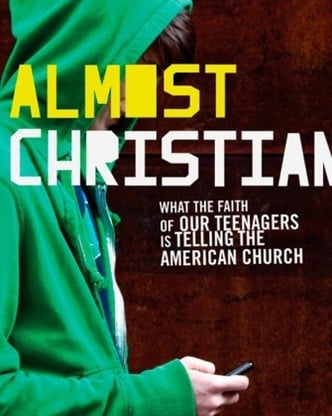
Looks interesting, I may order the book.
From what you say here, other things I read, and my own practice and intuitions, I wonder if a logical conclusion of this is the demise of youth ministry; at least in the model of taking young people into a different context to worship and learn.
This type of ministry gets fast results, but short-lived. There are lots of things I see, including the basic assumptions of this book which suggest that this shortcut in no longer helpful (if it ever was).
A further conclusion of this is that the church family has to change if it is going to welcome the teenagers to sit and eat at the same table with it again.
Thanks for highlighting this book Scot.
posted August 23, 2010 at 9:31 am
They key is to break down MTD and build up the Gospel in preaching and teaching. Differentiate the two and make it clear. Use the terms: “This is Religion and what it teaches and this is the Gospel and what it teaches.”
Don’t move on to a ‘series on purity’ or ‘series on friends’ without establishing a foundation on the Gospel. Don’t tag Jesus on the end of a sermon/message – because then kids will pick up that you can just tag Jesus because He’s secondary. Christ and the Gospel have to come first.
Matt Chandler talks about this a little bit:
http://www.youtube.com/watch?v=XzTm3W2Ai7s
posted August 23, 2010 at 9:33 am
I worry that my daughter is too involved with church. There are a lot of unhealthy influences that come from Christianity. Not just the male-dominance referred to in the other post, but things like the incestuous relationship between Christianity and libertarianism that is currently in vogue.
As a parent, my kid’s works will show me her faith. There’s plenty of time later in life for her to learn about institutional, organized Christianity with all its theological nuances.
posted August 23, 2010 at 9:35 am
“2. God wants us to be good, nice and fair to each other.”
“5. Good people go to heaven when they die.”
Self-righteousness doesn’t get us into heaven. I tried niceness and it made me miserable because I was looking to get my needs met by being nice to others. I wrote my spiritual memoir about that subject. Good deeds are part of a bigger scheme, but not the core of Christianity.
“3. The central goal of life is to be happy and to feel good about oneself.”
This is such a secular assumption whereas we are called to give up our life to find it and to take up our crosses for real joy and peace.
“4. God is not involved except when I need God to solve a problem.” Lord, forgive us when we get trapped in this notion. We need you all the time!
posted August 23, 2010 at 10:14 am
“is not durable enough to survive long after they graduate from high school.”
Is this true? I’m seeing this challenged more and more as people misreading Barna or Barna making too much of the most sensational part of his data.
The challengers argue Barna’s data actually say that kids stray from organized religion for a brief period (a few years) and then return. That’s not great, but it’s not so bad. But that doesn’t sell as many books.
posted August 23, 2010 at 10:26 am
ChrisB-
“The challengers argue Barna’s data actually say that kids stray from organized religion for a brief period (a few years) and then return. That’s not great, but it’s not so bad.”
But that does not mean we should not try to improve the stats. Having a more grounded, mature college/early adult generation can impact the society as a whole. Keller has his theology of the city, and I think the same can apply to colleges.
Also, the author seems to be indicating that MTD is more of a new trend that needs to be corrected.
Finally, this is as much about the faith and message of the adults as it is about the younger generations. How many in the older generations also hold to an MTD outlook?
posted August 23, 2010 at 10:55 am
To answer the questions:
Yes, I believe that their logic is correct. The faith of a teen most often reflects the faith of his or her parent(s) or other adults with whom there is a significant relationship. You see the same thing with politics–youth tend to hold to the same political views of their parents as well.
And of course fixing it starts with us as parents, as adults. We are the ones wielding the lion’s share of the power to change.
Two of the conclusions of the National Survey of Youth and Religion which continue to echo in my life are, “They [teens] will become what you [parents, significant adults] are,” and “you [parents/churches] get back what you invest [in teens], and normally not a lot more.” If I had the book with me, I would include the page numbers.
Kenda Dean is right, and for the sake of our youth, we had better pay attention.
I’d also include my own question: If we were going to take the five tenets of Moralistic Therapeutic Deism and transform them into five tenets of vibrant Christianity, what would you say those five should be?
posted August 23, 2010 at 11:41 am
Does nearly unrestricted access to media, entertainment and the influence of popular culture play a major role in this problem?
posted August 23, 2010 at 11:47 am
I believe that some of the MTD comes from us. Most churches have a long way to go in terms of teaching the radicality of Christianity, and even further in modeling it.
But I believe that there is more to it as well. I believe that part of the issue is developmental. How complex/radical/nuanced can we expect most (not all) teenagers to be in their faith? Another issue is the extent to which many churches reduce Christianity to a certain set of beliefs. This weekend I visited a town where evangelicals compete so much over a segment of the society that they then use those beliefs to differentiate themselves from the church down the street.
My wife and I are working through James in preparation for our pastors’s 10-week sermon series. We will see after that how our church is doing at educating the youth and practicing what we preach to them.
Peace,
Randy G.
posted August 23, 2010 at 1:33 pm
I think MTD is a huge part of our culture, including our “Christian culture” and our “civic religion”. It is nothing new; what’s different is that now it’s been quantified and there’s a vocabulary to describe it.
Dana
posted August 23, 2010 at 2:02 pm
“Almost” carries no weight in matters
of eternity !!
posted August 23, 2010 at 2:17 pm
While I have no trouble believing that this is reflective of the youth culture, I am also well aware that the youth take after their parents. Moralist Therapeutic Deism is a very interesting and useful term, and it aptly describes not only the youth culture, but culture generally. It may be helpful to isolate an age group and determine what they think and believe, but it may be deter us from realizing that many full-grown adults believe and live exactly the same way.
posted August 23, 2010 at 2:19 pm
Scot I am so glad your blogging about this book – I am currently reading it and as a youth pastor it has been very interesting – I don’t know what conclusions or directions she will give at the end of the book but I think she nails it in the beginning!
posted August 23, 2010 at 3:00 pm
Sorry, I guess I should probably have said: I agree with question 1: their faith, to an extent, does indeed reflect our own faith. At least, in the sense that it reveals our worldview. In answer to the second question: I don’t know. I guess I should keep it safe and say a little of both. Sound, Biblical teaching is definitely crucial, but I grew up in a church that has solid Biblical teaching and many of my fellow congregants do not have a Biblical worldview. Teaching and learning are both active- learning cannot be seen as passive (something that we accept without struggle and contemplation). I think that, for many, there is no sense of ownership. By that I mean, there is no (apparent) desire, much less effort, to truly conform our minds to the mind of Christ, and to see the world through a Biblical lens. Of course I am generalizing, but that is because I have found this to be generally true, both in my experience, and the experiences of others as this book makes clear.
posted August 23, 2010 at 4:03 pm
Scot,
I just finished an article about this book in Modern Reformation magazine. It sounds interesting, except that it seems a little too packaged for what is really going on. Yet another acronym with an alternate counter-solution defined as traditional, orthodox faith. Doesn’t the culture always teach MTD to everyone, not just youth? Couldn’t we argue that MTD was the prevailing understanding in Paul’s time? The solution then was the same now. Preach the life, death and resurrection of our Lord Jesus Christ and hold fast to all we have inherited as a result of his life, death and resurrection. The authors will later suggest a full-time youth minister is part of the solution. Really? I doubt it. I think this is overblown because there is a deeper fear – that someday we will no longer be a “Christian culture”, Whatever that is. If only the children would attend church, just like the good old days (even though before the mid-1800s only 20% of the country attended church). If only the right theology were taught, just like it was…when was that again? I don’t mean to be mocking. What I really mean is, we have been here before as a nation, a religion and a culture.
posted August 23, 2010 at 4:11 pm
i have often thought that we sort of innoculate them with Christianity and they get just enough to ward of the full blown disease.
That’s an interesting way to phrase it, and quite astute.
posted August 25, 2010 at 8:57 am
Thank you for the post. We added a link to this post on Kenda Dean’s website. Please let us know if you write more and we will link to that as well.
God Bless
http://kendadean.com
posted August 31, 2010 at 2:45 pm
This book has been popping up a lot all over the place, especially in like of the CNN.com article. I’m a bit late to seeing this on Jesus Creed, though. To answer your question, Scot, I do think that the faith of teens is an indicator of the faith of their parents, but not descriptive of their parents’ faith. While many times parents are directly responsible for the beliefs of their children, I think we translate that into parental apathy or some sort of intentionality in parents passing on lack of faith to their children. Over the past 18 years of working with children and parents in church, I’ve found that most “Christian” parents do have some semblance of faith and want their children to have faith and follow Christ as well. They simply do not know what to do. They’re products of a Dr. Spock generation where they’ve been told they aren’t good enough to raise their children; they need experts to tell them how. So, parents are made to feel impotent, inadequate and naive. What we need to do is empower and encourage parents to live out their faith WITH their kids… not just “in front” of their kids.
On another note (having not read the book, yet, I admit I may be misinterpreting it based on reviews I’ve read), but I don’t believe an MTD mindset isn’t necessarily due to a lack of “right teaching.” It is a worldview that is indicative of the greater western culture. To simply focus on how it manifests itself in Christianity denies the fact that we are more influenced by the greater culture around us than we are willing to admit.
Pingback: "Almost Christian" Response – Part 1 « Abnormal Anabaptist