Once again, the National Day of Prayer is upon us, and once again, it comes in a whirlwind of controversy. This year, however, the typhoon has been augmented by a judge’s decision that the National Day of Prayer is unconstitutional. Her ruling is being appealed, and folks from all sides are weighing in on the legal issues. Since I am not a constitutional scholar, I’m not going to offer an opinion on the legal battles that lie ahead. We certainly don’t need more amateurs mucking up the conversation.
If you’re interested in some history on the National Day of Prayer, I have found two helpful (and diverse) sources. First, there is a Research Report on the National Day of Prayer published by The Pluralism Project at Harvard University. Then, there’s the “History of the National Day of Prayer” web page from the National Day of Prayer Task Force website. This Task Force is a private group of conservative Christians who use the official day (approved by the federal government) to encourage prayer for the nation. This web page includes several “Fun Facts,” such as: “1) The President of the United States has called for a National Day of Prayer every year since 1975.” Then there’s my personal favorite: “6) 33 of the 44 U.S. Presidents have signed
proclamations for National Prayer. Four of the Presidents who did not
sign a proclamation died while serving in office.” Yikes! Maybe that’s why President Obama favors the National Day of Prayer. He doesn’t want to join the group of presidential naysayers who died in office!
Though I’m not going to weigh in on the legal issues associated with the National Day of Prayer, I do have a significant concern, however, related to this Day and the controversy its has engendered. My concern is that there are some features of the National Day of Prayer that are absolutely legal and absolutely crucial and quite likely to be overlooked. I not thinking of the Day itself (Thursday, May 6, 2010), but rather of what the National Day of Prayer Task Force encourages churches to do on the Sunday prior to the Day itself (Sunday, May 2). Here’s the statement from their website:
What is the National Day of Prayer Sunday?? On Sunday, May 2, 2010, in churches, when 40 million Christians come together to worship, the Task Force is encouraging groups to take seven minutes to pray for the Seven Centers of Power (pray one minute each for these 7 centers of influence: government, military, media, business, education, church and family). Pray for renewal in our hearts and repentance to come to America.
Now that, to me, seems like a fine idea. Surely there’s no legal problem with churches praying for the Seven Centers of Power. Moreover, I expect that most churches do not regularly prayer for these Centers, or at least for all of them.
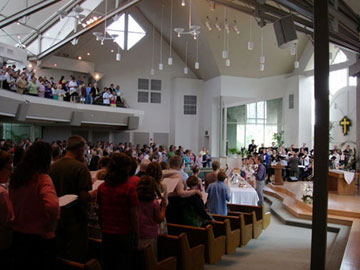 When I was senior pastor of Irvine Presbyterian Church, in our worship services we prayed weekly for the government (president, administration, congress, courts, state officials, county and local officials). We prayed regularly for people serving in the military (but not for military leadership). We often prayed for teachers, police officers, and fire fighters. We always prayed for the church: our church, churches in our community, and the Church of Jesus Christ. And we often prayed for families. (Photo: A worship service at Irvine Presbyterian Church in Irvine, California.)
But we rarely prayed for the media or business. In retrospect, this seems to me like a grave oversight, especially since Irvine Pres had many members who were leaders in media and business. Yet, for some odd reason, they were usually forgotten in our corporate prayers. Why this was the case is worth much more conversation, and I expect I’ll get into it sometime soon. Nevertheless, I wish I had done a better job leading our church to pray for those who were called to serve the Lord in the media and business. I actually believed (and still do) that God calls people into these fields. Yet my prayers did not follow my convictions.
My hope is that, with the encouragement of National Day of Prayer Task Force, many churches will begin to pray in broader ways, realizing that the kingdom of God has everything to do with government, military, education, church, and family . . . and also with media and business. And one might include the arts as well.
 Read Previous Post