At some point during the Mumbai terror attacks, somewhere between the first shot fired on November 26, 2008 and the tragic end on November 29, 2008, the Mumbai police officially declared a state of emergency. In the heart of downtown Mumbai, mere walking distance from where some of the worst carnage took place (and where one of the terrorists was gunned down by Indian military commandos), the Radha-Gopinath temple was ordered closed by government order. Within that temple, His Holiness Radhanath Swami spoke to a group of shaken followers and friends — a collection of monks, businessmen, homemakers, simple laborers — about how to understand the tragic events surrounding them.
Below is a transcript of excerpts from that exchange, light edited for style and content.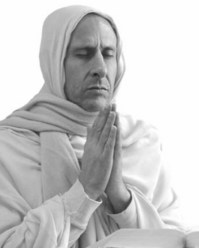 Q: We are taught that God is sarva-jna, the knower of all things, and that He is Bhagavan, all powerful. But where was God when the terrorists were attacking? Why did He allowthis to happen? Why didn’t he stop this?
A: At times like this, it is natural that many doubts and questions will emerge in our minds. What kind of God is this that allows innocent people to be slaughtered? Maybe God isn’t good, or maybe He is good but not all that powerful – there’s nothing he can do about these things, so who really need him? Or maybe, there’s no god at all.
It is natural to feel such things; even if we weren’t directly affected, a devotee is softhearted and cannot bear to see others suffering. At the same time, we can also turn to the knowledge that philosophy provides to try to put things in perspective. Philosophy is very important to maintain a strong foundation for our devotion. Especially when storms come, either personally or around us, we need to have a strong foundation. If you build a house on a strong foundation, no storm can knock it down. But if we build it on sand, any storm can demolish and destroy it. So, our faith and devotion is very much in need of a strong solid philosophical foundation to withstand onslaughts of this world.
So how do we understand this philosophically? Did God sanction these
attacks? Well, in one sense, yes, not even a blade of grass can move
without God’s sanction. But it is sanction in the sense that God gives
freewill. He tells us – through the sacred texts, through the
teachings of great saints, through our own conscience and morality –
what to do and what not to do, but then gives us the freewill to do or
not to do. That is the sanction. In the Bhagavad-gita, Krishna tells us
what is the demoniac nature, what is the mentality of someone who
exploits and hurts others. And he forbids us from acting in that way.
But still he gives us freewill; it doesn’t mean that he wants us to
exploit and hurt others. He wants us to choose for ourselves, how to
love and serve others rather than hurt and harm them. So when one human
being commits an aparadha (offense) to another – yes, by giving
us freewill, God sanctions it. But we should not think that this is
what the Lord wants. God gives us a choice at every moment, and
sometimes human beings make a mess of things. We are sanctioned by the
Lord, ultimately we are responsible for our own actions, for our own
choices. We should not think that God was the cause of this terror
attack; that’s not what sanction means. Bhagavan gives the sanction by
which we can choose to love God, to hate God, to reject God, to
dedicate our lives to prove that God doesn’t exist, to do great harm in
God’s name. We have freewill to do it. At the nd of the Gita, Krishna
says: “I’ve told you everything, now you can follow or not…” God
wants us to love him and to love all his parts and parcels, all beings,
but he will not force us to. Force is not love. He wants for us to make
the choice freely.
But in every situation, he is there for us. Even if someone does
something wrong, he is there for them if they turn to him. I truly
believe that he was there for the victims. Of course we don’t know, but
we can consider that many of the people who were killed in these
attacks, in the intensity of that traumatic situation could have become
so God conscious that they gave up their bodies thinking of God and
were liberated. So some of them, perhaps many, could have given up
their lives thinking of God and been liberated.
But I do not think we can give a simple answer. The more one
understands, the more things make sense, and to really understand takes
time. It takes hearing and questioning and discussing.
Q: The terrorists also claimed to be doing God’s will. How can we understand this?
A: Real religion is not a sectarian concept. The Bhagavata Purnana
gives a very nice, very broadminded definition of religion: “The
supreme occupation for all humanity is loving devotion, and such
service must be unmotivated and uninterrupted.” Whatever religion
teaches people to actually love God, that is good. Ultimately, this is
not a sectarian concern. It is not a matter of what family you
happened to be born into or what you were taught as a child. Those
things are important too, but ultimately real religious principles
transcend them. Real religion doesn’t mean saying “I am a Hindu,” or a
Muslim, or a Christian, or a Jew, or a Sikh, or a Zoroastrian; it
means humbly serving in a spirit of love and devotion. This is what all
religion is meant to teach us.
But when, envy, and ego, pride, anger, greed – when these enemies
become prominent in our heart, then we even interpret our religion to
fulfill their dictations.
So we do not hate any religion, we hate the enemies within ourselves.
And the world should unite – those who want to apply God’s will to
their life – but we should know that God’s will is never to harm or
exploit or destroy innocent lives. God’s will is to show compassion.
When love of God is applied to the world, it manifests as compassion.
Q: As aspiring devotees of God, how do we understand the different emotions that we are feeling right now?
A: It is not a disqualification to be affected it is natural; anyone
would be affected. It is not that as devotees we have to be devoid of
human emotions. But we can also learn to see these feelings in relation
to our spiritual life.
These feelings can exist on many levels. For instance, we might be
experiencing anger. We can channel this anger. We can be angry at
injustice, at the root causes of terrorism and evil acts like this. In
the Ramayana, Hanuman was not thinking “I’m transcendental so
let Ravana do his thing.” No. But his anger was not based on
frustration and tremendous amounts of false ego like terrorists and
others. He used his anger to help others and to fight injustices.
We can also feel compassion for all those who suffered. We should do
all that we can, internally and through our words or actions. We can
make a tangible difference; however big or small, Krishna sees our
sincerity and reciprocates.
Finally, we can see this tragedy and understand and experience a deep
sense of urgency. One of the qualities of my guru, Srila Prabhupada,
that deeply struck me was his sense of urgency. I had heard so many
saintly people speaking very deep philosophy, so many nice social and
religious thoughts, but Prabhupada had the most intense sense of
urgency to benefit the world and for each individual person he came in
co0ntact with. He was not just asking us, he was begging us, pleading
with us, because he saw our condition and condition of world: “Take
this Krishna consciousness and share it with others.” When he said it,
it was so deep, so real, so urgent. He was feeling the suffering,
seeing how people were victimized.
In the Gita, Krishna tells us that this material world is a place of
misery. From the highest to the lowest, from penthouse apartments to
slums, they are all places of misery. Not inconvenience or pain; he
says misery. Why? Misery is a very intense is deep graphic experience.
Because the material world is the realm in which people are simply
trying to exploit one another. God gives all the freewill, and
practically our whole history is a history of misusing that freewill to
kill one another. Look at Europe–a history of wars after war,
suffering and exploitation. Plagues, disease, earthquakes, droughts.
Hitler–6 million Jews, 2 million others… all just innocent civilians.
They were tortured and murdered. And so many more that suffered among
their family and friends. Just 60 years ago. Not very long ago. And
Stalin–20 million people estimated, civilians, tortured and died. In
of course, in America – in India, so many of us think, so many think,
let me just go to America and be happy – the same history or exploiting
the natives, exploiting others.
So yes, we should feel a sense of urgency to help people rise above the
enemies of lust, anger, envy, greed, illusion. These are the real
terrorists within the heart, driving us all to misuse our freewill and
exploiting and killing others. And devotees of God are like commandos,
trying to free the soul who is like a hostage of the enemies of anarthas,
the exploitative tendencies within the heart. This is compassion, real
compassion. Whether we die in a terrorist attack or die in a hospital
bed or die in a car accident: we all have to die, and quite soon. The
only way to permanently make material world a better place is by
pursuing spiritual realization and helping others to do so. This is the
greatest need, and we should feel the greatest urgency to do it.
 Read Previous Post