My post Freedom From Religion: Buddhism Wins Best Religion in the World Award last week set off quite a stir around these here ‘nets. Over at Paramita they offer to send an 11 month old girl to pick up the award. Shambhala Sun had a few things to say too. Today In Religion weighed in, as did Thailand’s Thaivisa site, which had the best comment thread. And finally Pipal Tree ran the story from Singapore.
Either way, if it was a reliigon Buddhism would be the best religion in the world perhaps precisely because it lacks some of the key elements that make it a relgion (I’m speaking here of approaching it as a philosophy of life, rather than the codified and cemented bureacuracy that it has become in some quarters). Like practicing Jesus’s true teaching about living without glopping on all the rules and constrictions that basically say “practice true goodness or else”, Buddhism’s core teachings are just totally freakin’ awesome and are more a study of self than a giving up to a higher power.
Speaking of giving up to a higher power, this past week I’ve developed a healthy new habit that I wanted to share.
My new habit? I’ve been reading as much of Jonathan Mead’s writing over at Illuminated Mind
as possible. Check out Jonathan’s story at “my story” on his about
page for one of the most intimate descriptions I’ve ever read online
about how he came to a path of compassionate personal transformation.
As if on cue, Jonathan’s article from yesterday The Death of Becoming Something is a perfect linke from a Buddhist blog. Admission: I kind of have a crush on Jonathan’s brain and his writing.
Speaking
of brain crushes, another brain crush that I’ve been wanting to share
for a few months is on former monster movie maker, punk rocker, and
ordained Zen Monk Brad Warner. Brad’s book Hardcore Zen
was the first thing I’d ever read that made me think “hey wait a minute
this Buddhist business IS relevant to young freaks like me.” Brad’s
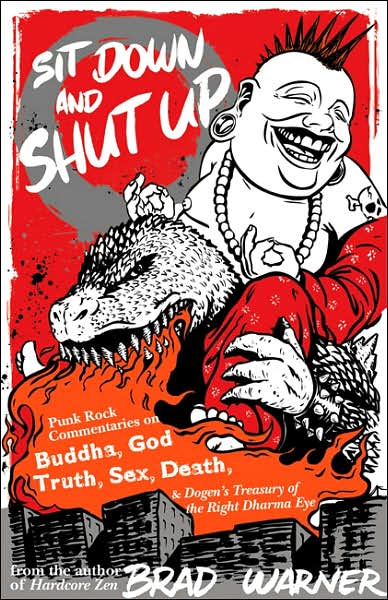
second book Sit Down and Shut Up: Punk Rock Commentaries on Buddha, God, Truth, Sex, Death, and Dogen’s Treasury of the Right Dharma Eye
was just as awesome full of holy-crapifying ideas. I’ve had the
pleasure of hearing Brad speak at the Interdependence Project twice
now; one of those times actually makes it into a chunk of his new book Zen Wrapped in Karma Dipped in Chocolate.
I read the book while on a trip with my father in the Grand Canyon,
totally disconnected from electricity, phones, internets, and
television – and all other people save those on the trip with us.
His hilarious story about his relationship with a cat involving fellow IDP blogger Ellen and his shoutout to the Interdependence Project
mid-way through the book (of his gigs in NYC he says “The best was
definitely my talk at the Interdependence Project” and goes on to say a
few very nice things about us and our communal practice) was really odd
to read while isolated in the Grand Canyon with my father Cliff (himself a fantastic nature photographer) yet gave me this nice,
unexpected sense of connection to things back home.
Brad’s
excruciatingly intimiate and honest description of how his Zen practice
actually worked when his job, career, and family were disintegrating
around him is funny, touching, and helpful to the max. If you want to
hear the real deal of what it means to put practice into action when
faced with big neon displays of impermanence, check out the book. In
fact, I’d suggest reading all three of his books in order because you
will literally see how his practice, and his thinking about and
application of his practice, evolve before your eyes.
I quote at
length here from Zen Wrapped in Karma Dipped in Chocolate:
“The universe is yours, and all you want to do with
it is write your name in spray paint on the wall. You’re like a dog
pissing on a fence. No one who sees the mark you left behind on the
world could give a shit. You’re just exactly like me.
But sit
quietly, and even a piece of gibbon’s dung like you can see it.
There’s no one in the universe but you. You spread all the way out
past the farthest galaxies, and that’s just the beginning. Your
thoughts are all stupid. Your perceptions are completely wrong. There’s
nowhere you can be but here. There’s nothing you can know that’s worth
knowing. You have no future or past, yet you’ll always be here. And
because of this you are God’s eyes and ears on this world. You are God
himself.
So pay a little attention, butt-wipe.”
For another refreshingly honest look at meditation practice, check out Julia May Jones article HeyJhana HoJhana here at our blog. Hilarious awesome and full of insight as usual.
Finally a bit of self-promotion which I won’t bother dignifying
with the term “shameless”. Over at my own site I’ve got a little piece
called Five Reasons to Turn off the Internet that has been brewing around in my brain since my trip to the canyon.
My biggest brain/talent/body crush ever happens to be performing in NYC this weekend and lucky for me he is also my boyfriend. If you want to hear the kind of amazing music you might make if you
lived with someone with a daily meditation practice, check out Tater’s new project Allies
(how’s that for a clever way to work in more promotion?) Allies is
dancey, fun, occassionally dark and always luxurious. He’ll be DJ’ing
Italo and Freestyle and making the debut Allies performance this
Saturday night July 25 at The Hose so if you happen to be in East Village NYC check it out, I’ll be there.
 Read Previous Post