While studying Buddhism and practicing meditation feel rather natural to me, integrating a yoga practice continues to be a struggle. Living in New York, there are a dizzying number of options when it comes to selecting a yoga class and, over the years, I’ve tried quite a few.
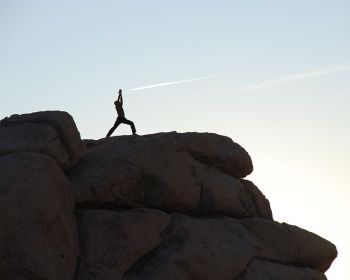
I attended a yoga class today for the first time in quite a while and found that though it was difficult, I quite enjoyed it. Like meditation, or any other pursuit, I think it comes down to finding the right fit- type of yoga, teacher, etc. What I’m curious about is how people feel yoga enhances their meditation practice or vice versa. When I tell people that I practice meditation and study Buddhism, they often assume I also do yoga and I have the nagging feeling that I should be. Are meditation and yoga necessary companions? Also, I’d love to hear about how folks went about selecting a specific type of yoga and any suggestions they might have for those of us that are feeling a bit overwhelmed with the choices.


posted July 20, 2009 at 2:37 am
If I am not mistaken, yoga was considered a usual practice in the times of the Buddha. The asana practice (I would like to distinguish between yoga as a system and the physical aspect of it that was popularised in the West) helps me to energise the body before a sit and to get rid of the falling alseep leg situation. After a while doing yoga has developed into a practice of its own. In a way I find it easier than the sitting meditation because the mind has something to do – follow the body, be one with it while it still reveals all kinds of inner resistance. Also the asana practice offers a more somatic experience that I have been missing in meditation, for example in zazen.
For me the two now go hand in hand. Good luck with the practice!
Namasté,
Irina
posted July 20, 2009 at 7:56 am
I am exploring “yin yoga,” a practice that has one hold a challenging pose for what seems like a long time (e.g., 5 minutes). The idea is that one learns to transit the discomfort and find a stillness beyond it. I also practice Vinyasa yoga, a moving practice that includes work with the phrana (breathing) so helpful to meditation. This later practice employs the bundas (energy locks) to retain the energy developed in moving exercise. Forgive the perhaps unfamiliar terms, but my point is that there are many options for linkages between my yoga practice and my meditations and devotions.
posted July 20, 2009 at 9:56 am
From a historical textual point of view, the objective of asana has been stated as being primarily to prepare the individual for pranayama, and subsequently, seated meditation. In the seminal texts of Patanjali Yoga Sutras, the Gheranda Samhita and Hatha Yoga Pradipika the poses represented or eluded to are either seated, or poses designed to facilitate sitting for long periods of time.
posted July 20, 2009 at 12:10 pm
Sometimes our attention to this moment can be severe; we inadvertently slow our actions to help our sluggish consciousness keep up.
Kundalini yoga can shake that crusty attention into more hands-off awareness. The movements, which are too fast for thought, help you move with awareness at the speed of life.
posted July 20, 2009 at 1:32 pm
i have the exact opposite experience.
i have yoga teacher training and people assume i love meditation.
i find it incredibly difficult to practice consistently–although it has helped me greatly to be able to watch my mind in crisis.
yoga though, allows me to see the judgments i have with myself more clearly, or at least in a way that doesn’t debilitate me mentally/emotionally.
if i can’t do a pose i love, or the room is too hot, or there are too many people, i can watch my thoughts about it and release it. in meditation, i tend to be harder on myself which makes it difficult to sit.
posted July 20, 2009 at 2:57 pm
Hi! I am of the same mind as Lenny in every way, where meditation and yoga are concerned. I find that what I learn of mySelf in yoga practice can always be applied to every other part of my life. It’s as if teaching the body helps train the mind – it’s a pretty cool process. That said, I don’t believe that one must practice yoga in conjunction with meditation rather, that we can find a similar experience in walking meditation and/or, in my case, bodybuilding/weight-training. I like to think that we can slow down just about anything that we do and find meditation in it.
P.S.
I am particular to Anusara yoga (http://www.anusara.com/).
“Anusara yoga is a school of hatha yoga which unifies a life-affirming Tantric philosophy of intrinsic goodness with Universal Principles of Alignment.”
I find that it is both challenging and gentle all in one go.
Good Luck!
posted July 20, 2009 at 3:11 pm
Yoga and Buddhism are both influenced by Samkhya, Indian Philosophy. Zen is the Japanese sound for dhyana the seventh step in the Yoga Sutra of Patanjali. Enlightenment is the samadhi of the eigth step of the Yoga Sutra. So much of Yoga and Buddhism are related and interrelated particularily Tibetan Buddhism such as the five Tibetans.
So how can someone take advantage of this interrelation. It may not be easy because as a buddhist myself, been in a Buddhist monastery, that did and does yoga for many years it was 20 years before I saw the link.
In a more practical answer to your question I would try to find a Yoga teacher that is very well trained. Since my experience is with Iyengar Yoga I would look for a senior teacher or someone with more that 20 years of experience. That kind of teacher may be able to help you relate Buddhist meditation and yoga meditation.
Feel free to contact me if your would like some advice on how to study about comparative Buddhism and Yoga.
posted July 20, 2009 at 9:56 pm
I’m a yoga teacher, psychotherapist, and meditator- for me all three disciplines go together. But this is an individual decision.
I started yoga while I was in high school, first studying from a book, then at Swami Satchidananda’s ashram on the Upper West Side of Manhattan. Later I became a therapist. Later still I began meditating on the breath, then with a mala.
For me, yoga asana is a moving meditation as powerful as other kinds of meditating. So my day begins and ends with a seated meditation, and most mornings includes Yoga Asana, which is another meditation.
My favorite yoga styles are Integral Yoga and Vinyasa. Pick out what feels best to you, but if you’re beginning, remember, Integral Yoga classes were judged the safest of all types by Yoga Journal.
posted July 22, 2009 at 10:36 pm
It is a sad reflection that yoga is generally now seen as just asana practice, a mere single limb of the eight limbs of yoga (#3), while three of the others pratyhara(#5), dharana(#6) and dhyana(#7) address meditation.
The relationship of each of the eight limbs is an integrated system, asana practice in isolation still has benefits but they are limited without the integration and support of the other seven limbs.
That people assume you do yoga because you study Buddhism and meditation is itself a further sad reflection of the pop culture spirituality of our times
Some view asana practice as preparation for meditation, and certainly it is both physically and energetically. Importantly practicing asana gets us in our bodies and develops body mind integration. So many of us today life in a mental experience of ourselves and the world, so this is really important to root our meditation practice into our physical system.
What kind of yoga will suite you depends on many factors, sometimes it’s not the style but the teacher that you just click with. A good place to start is to ask yourself what you want from asana practice and look for what matches.
posted December 28, 2009 at 6:12 am
Look, Every one have different method for every thing that not important but main thing is that how you are get benefited with concern thing.
posted January 22, 2010 at 4:34 am
Look there are so many Companions of yoga but main are these rules and regulation and posture those are very necessary to increase yoga effects.
posted January 25, 2010 at 4:14 am
All concern companions are Necessary Companions? for the yoga and meditations and if they would not follow in proper order so they can reflect in irregular order.