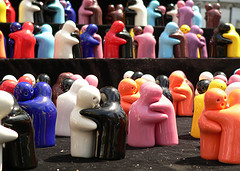
I’ve just rolled my cart down aisle five at the spiritual supermarket under the sign that reads “Mind Training and Contemplative Based Spiritual Practices”. After sitting regularly for over two years I’m ready to get down with the masters of mind training. The choices are a bit overwhelming as the shelves of spiritual possibilites are stocked high with cans of Tibetan Lama Beans, Rinzai Ridges, Thich Nhat Hanh Dogs and Jack Kornfield‘s Extra Crunchy Granola Bars.
It’s time to comparison shop.
First stop on the tradition train is Shambhala Training Level 1, a one evening, two dayintroduction to the training method founded by Chogyum Trungpa Rinpoche inAmerica in the 1970’s. A quasi-western repackaging of Tibetan Kagyu and Nyingma Buddhist lineages, Shambhala training puts strong emphasis on meditation practice and the concept of “basic goodness”
or as they put it on their website:
“It is the Shambhala view that every human being has a fundamentalnature of goodness, warmth and intelligence. This nature can becultivated through meditation, following ancient principles, and it canbe further developed in daily life, so that it radiates out to family,friends, community and society.”
The training weekend started softly, with John Ankele introducing the theme for the weekend as “Ordinary Magic”. The intention being that we were going to meditate so much that “stepping out of the shower” and “brushing our teeth” were going to seem like magical events, that “quieting the mind” was going to tap us into our “basic goodness”.
After this insidiously soft introduction we mostly just sat..
then walked
and then sat some more
and then walked some more…
for the greater part of the 14 hour program.
There was a little bit of discussion and instruction, but for the most part the weekend was a really great opportunity to get deeper into practice. I really had a chance to ride the mental waves of habit and emotion and work that mindfulness muscle hard.
My first experience with the “Ordinary Magic” occurred on the afternoon of the second day as I sat in the foyer waiting to be interviewed by one of the directors. To my right, in the tokonoma alcove I saw a beautiful spherical shaped flower head with lots of tiny pink-and-white six-petalled tips. Just behind the flower was a large framed color photograph of Chogyum Trungpa Rinpoche. The flower was just sitting there, and the photograph was just hanging on the wall, but both seemed present in a way that I remembered grass and dandellions being as a child. There was an intrinsic dignity to their presence that warranted investigation and fascination, rather than classification and utilization. I was operating in a matrix of space that was vast, wondrous, terrifying, and direct.
 Read Previous Post