by Paul Griffin
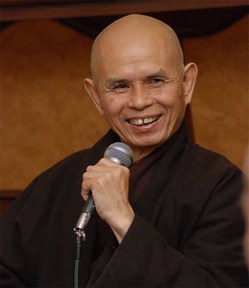
I’ve just returned from a day of mindfulness with Thich Nhat Hanh. This wonderful daylong program at the Beacon Theater in Manhattan was sponsored by the Omega Institute. The focus of TNH or Thay’s message was building a more peaceful and compassionate community through the practice of personal or inner mindfulness. In this post, I want to tell you more about what Thay taught today.
Thay, in remarkably good health of body and mind at the tender age of 83, gave a dharma talk after a opening hour of meditation and chants. I felt Thay’s presence as powerful and peaceful. He began by telling the inspiring story of his relationship with Martin Luther King in the 1960s. They first met in Chicago on June 1st, 1966, when they sat down together to discuss civil rights and the war in Vietnam. Thay related the details of another extended meeting with MLK in Paris in 1968, only months before King was assassinated. Thay said that when he heard the tragic news he cried in his hotel; he knew that a great bodhisattva had been lost to the world. And he knew that he personally was called to continue with King’s work of creating an enlightened society of mindfulness and compassion.
In 1967, it was MLK himself who nominated Thay for a Nobel Peace Prize. Thay’s comments today on the bestowing of the Nobel Peace Prize to President Obama were interesting…
He made it abundantly clear that he supports the decision to give Obama the prize. He said, “Obama needs the support to keep him on the path.” I was moved by Thay’s heartfelt insistence that this award was perfectly timed–despite the criticism to the contrary–that now was the ideal moment for the Nobel committee and for the world to support and protect Obama as he attempts to lead the world with courage, compassion, and open communication.
The heart of Thay’s talk concerned the Four Nutriments of mindfulness, namely, a. Edible food, b. Sensory impressions, c. Volition or intention, and d. Consciousness. Essentially Thay talked about mindful consumption in a very focused and intense way.
For example, in discussing how important eating right is, Thay resorted to a story the Buddha told of two parents and their child crossing the desert. They were struggling, they were starving, so the parents said, rather outrageously, “Let’s eat the boy, then when we cross the desert and settle down, we can have more children.” So they did so. And with each bite of their boy’s flesh, they felt immeasurably sad. Nevertheless, they crossed the desert. When the Buddha told this story, he asked his students, “Where the parents happy to eat the flesh of their own boy?” And his students answered, “No.” And the Buddha said, “Learn to eat in a way so that you are not eating the flesh of your own children.”
A shocking story. The point is that in our culture, we do precisely that. Forty thousand people die of starvation every day. Thay encouraged his listeners to eat less meat and to eat more mindfully all the time. He said, “Just the practice of mindful eating can already save our planet.” He said, 1 cubic meter of water produces 1 kg of rice, whereas to produce 1 kg of meat, it takes 30 cubic meters of water. He also talked about the negative effects of drinking alcohol. He said, “If we drink that alcohol or eat that meat, we drink the blood of our children and we eat their flesh.” An unsettling way to discuss the problem, yes, but a powerful and memorable way to effect change.
Today we practiced mindful eating as we shared a vegetarian meal with Thay. Then we practiced mindful walking around the block of the Beacon Theater on Broadway and West 74th Street. The program ended with an extended deep relaxation meditation.
But what most moved me today was Thay’s discussion of the strong desire–the volition or intention nutriment–that is required along the path. His face lit up when he talked about the motivation he had at age 16 to become a monk. How strong that desire was! How it burned inside him like a “bowl of fire”! This strong desire must be wholesome. This strong volition must manifest always as beginner’s mind. This essential intention is the very source of the energy required to continue along the path.
Thich Nhat Hanh helped reignite that fire in me today. And I too wish it for President Obama. And for all of the readers of the One City blog. And for all sentient beings.
 Read Previous Post