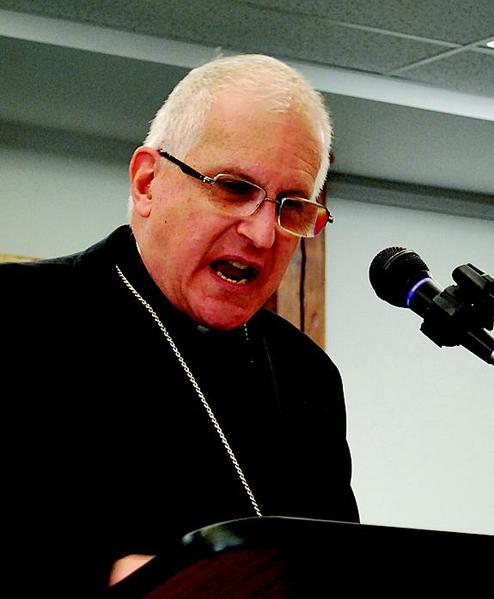
Earlier today at Progressive Revival, I wrote about the latest round in “The Battle of the Bishops.” Now it looks like things are getting really raucous…A remarkable story, via Whispers, about Scranton Bishop Joseph F. Martino, who has become one of the most vocal proponents of the “single-issue” theory of voting and a fierce opponent of voting Democratic. Martino’s recent letter on voting was the centerpiece of this NYTimes story, and according to this story in The Wayne Independent yesterday, Martino “walked the talk” as he crashed a parish forum on the election and rebuked the panelists (who seem to represent diverse political views) for a one-sided discussion that included the U.S. hierarchy’s voter guide, “Faithful Citizenship,” but not his letter. The money quotes:
“No USCCB document is relevant in this diocese,” said Martino. “The USCCB doesn’t speak for me.” “The only relevant document … is my letter,” he said. “There is one teacher in this diocese, and these points are not debatable.”
Martino apparently wanted the forum canceled. Many broke into applause at his “intervention,” while about a quarter of the audience walked out. Martino soon followed. Ugly for the parish, for the diocese, for civil discourse, and for the hierarchy, which seems increasingly divided. They are to meet after the election to discuss their collective response. This sort of witness is clearly not working. As Rocco notes, Martino wasn’t present at last November’s USCCB meeting in Baltimore which passed the Faithful Citizenship statement with 98% approval rate.
|
Previous Posts
Moving on, and many, many thanks...
So...my recent vacation and related absences also coincided with an offer from PoliticsDaily.com to cover religion for them, as editor Melinda Henneberger announces here in her roundup on the site's very successful first 100 days. That means, in short, that I'll have to sign off from blogging h
posted 8:29:24pm Aug. 02, 2009 |
read full post
»
Calvin at 500, Calvinism 2.0
If you thought you knew John Calvin--who turned 500 last week--you probably don't know enough. For example, that he was French, born Jean Cauvin. And if he was in fact scandalized by dancing, he was also a lot more complex than that. I explored the new look Calvin in an essay at PoliticsDaily, "Patr
posted 11:53:35am Jul. 16, 2009 |
read full post
»
Apologia pro vita sua...Kinda
In my defense, I've had computer outages and family reunions and a few days of single-parenthood, which is always a bracing reminder of what many parents go through all the time.
And this weekend it's off for a week's vacation.
Anyway, hence the long absence. Apologies to those who have chec
posted 10:51:36am Jul. 16, 2009 |
read full post
»
When Benny met Barry: "I'll pray for you!"
The first word via Vatican Radio and first image (that I saw) via Rocco:
Speaking to Vatican Radio, Press Office Director Fr. Federico Lombardi said "moral values in international politics, immigration and the Catholic Church's contribution in developing countries" were key topics of discussio
posted 12:54:28pm Jul. 10, 2009 |
read full post
»
Signs of the times: Obama's eye
Yes, this photo of Obama ostensibly eyeing a young woman (apparently a 17-year-old delegate from Brazil--where are her parents?!) at the G-8 Summit is the hottest Google search item. And of course the question of what Obama was thinking is a leading Fox News story.
So it goes, even as the
posted 12:26:05pm Jul. 10, 2009 |
read full post
»
|
posted October 21, 2008 at 2:02 pm
I find things like this just as difficult to digest as your blog entry suggests you do. But to say that ”this sort of witness clearly is not working” is a perhaps throwing too big of a stone in the bishop’s direction. What sort of witness would you advocate? Are you in a position to judge the bishop on what goes on in his diocese and the paricular prudential decisions he takes to inform the moral consciousness of his faithful? There was a general collective USCCB imposed episcopal silence, and the same bourgois platitudes present in Faithful Citenship were handed out to the faithful during the last election. Was that a qualitatively better witness? Dis anyone rush to the baptismal font or was anyone inspired to purchase a Cathechism or sign up for St. Vincent de Paul because of that outstanding witness? I don’t think anyone Catholic or non-Catholic was particularly inspired then or now. And to be bluntly honest, I think we have to admit that no one, Catholic, Christian or otherwise has been inspired by the verbose Faithful Citizenship this time around, neither by its content nor its unanimity among the bishops, nor the cheap IPOD tricks designed to get people to read it. And what ordinary Catholic in the pew reads that sort of thing anyway? God bless them if they finish the parish bulletin during the intercessions. If anyone, only aficionados, journalists, and the bishops themselves were impressed at the document. A mutual admiration society. A bureaucratic achievement, but a evangelical witness? Let’s not kid ourselves. It gives the impression of a celebrity endorsed public service ”get out the vote” advertisement. And like most conference produced documents, its broad enough to please everyone and no one. Certainly we don’t want bishops taking the place of politicians, but we need to be honest and thoughtfully examine the ”we help you to form your moral conscience” method which to the ordainary Catholic sounds like the IRS tax code: this and that are important except when this or that and only when this or that if/but/and this or that. Good luck. You also have to meet the people where they are at and not presuppose that everyone has a doctorate in moral theology. And sometimes that will require a bishop actually explaining the very real consequences of the moral teachings of the Catholic Church instead of washing his hands by supposedly leaving it up to the consciences of the Catholics who have been for many decades not very educated in the faith at all by their pastors and appealing to a long and complex document the grand majority of the faithful will never read nor have the philosophical or theological sophistication to read. And that teaching might not be politically correct and may not give inspire cozy bourgois sentiments that pass for our concept of evangelical witness nowadays, but perhaps Jesus’ hard sayings wouldn’t either. I’ve got no idea whether what the guy did was right or wrong, but at least Martino was man enough not to wash his hands by falling back on one of the most UNpastoral methods a bishop has at his disposal- ”here, read this document drawn up by bureaucrats in Washington, pay close attention to the footnotes, and good luck in November” – and actually engaging Catholic where they are, in the trenches with the rest of an American society — ordinary folks run over by the train of mass-media disinformation and who probably don’t even know what the initials USCCB stand for.
posted October 21, 2008 at 3:08 pm
Arrogance does not befit clergy or those who (pretend to, in this case) shepherd them. The priest was trying to bring some balance and care to a divisive situation, but the Bishop had to have the only voice in the room. He may find himself shouting to an empty room some day. What a sad commentary on the Church in Scranton. He should be embarrassed, but I am sure he is so filled with righteous indignation that he knows only his cause and no other. Lousy pastoring, but I guess it is great that someone feels they can afford the luxury of prophesy, even if it is only their own. Most of us cannot afford that kind of single minded, unsympathetic, divisive stance. The RCC in Scranton must be so lush with funds that they won’t miss the folks so turned off they leave the Church.
posted October 21, 2008 at 3:13 pm
“No USCCB document is relevant in this diocese,” said Martino. “The USCCB doesn’t speak for me.” “The only relevant document … is my letter,” he said. “There is one teacher in this diocese, and these points are not debatable.” –Bp Martino of Scranton
Bishop Martino is Canonically correct. The USCCB is an association of bishops; it rarely has any legislative powers (none in this case), and has no executive or judicial powers.
posted October 21, 2008 at 3:43 pm
Tough to be Catholic these days in the face of such egregious behavior by our so-called pastors. Shameful.
posted October 21, 2008 at 5:44 pm
I live in the Scranton Diocese. The bishop’s letter was read at Mass a couple of weeks ago. It was a very good letter and made a lot of valid points. I do think that it will sway a lot of voters here not to vote for Obama. I think a lot of older voters in our region are uneasy about voting for a bi-racial/African-American for President. Inter-racial marriages are not that popular in our region. They are just as bad as same-sex marriages to some people. We are a conservative area. I don’t think the letter will make that much difference to younger people because Obama is popular with them and the younger people are more accepting of diversity.
Mark from PA
posted October 21, 2008 at 10:41 pm
Bishop Martino is a prime example of a Bishop who believes that his authority is unilateral. He is threatened by anyone who even wishes to discuss issues that differ from his positions. People get the Bishops that they deserve and Bishops only have as much authority as the people that shepherd give them. The people of Scranton must love tyrants!
posted October 22, 2008 at 4:25 pm
Little Bear should be reminded that authority in the Church is derived from Christ as given to the Apostles and their successors. The idea that authority derives form the people is a enlightenment theory employed in the US Constitution and pertains to civil government, not the Church. That is just fact, not opinion. jestrfyl uses the lowest of devices in an argument, accusing the bishop, and by extension, the church of being only concerned with money. Such an argument usually indicates a severe lack in the ability to critically evaluate.
Did anyone notice that the teachng of the Church is rather objective? Bishop Martino was courageous, and stuck his neck out to teach the truth. If he had not, everyone would have complained that he did not have the courage of his convictions. The sad fact is that no matter what any person in authority in the Church does today, is is always going to be “damned if you do and damned if your don’t!”
posted October 22, 2008 at 6:34 pm
Fred, doesn’t know his church history. Up until the 6th century, the people elected the Pope. And up to the 11th century they elected their Bishops, and priests. In the Patristic Ages, the Fathers of the Church stated that the people should not obey any Bishop that they (the people) have not had a hand in selecting.
There is ABSOLUTELY no indication that Jesus wanted the leaders of his church to act like medieval Lords, with servants to wait on them (Episcopal MC’s), to wear Prada shoes, fancy rings and crosses. And to operate with unilateral authority, like Lord Martino of Scranton.
The Church adopted the ways and manner of the Roman Courts at the time of Constantine. There is no decree from God stating that the leadership of the Church should continue in this manner. We live in a democratic country (and many other countries have modern democratic republics as well), and we have every right to want our Church leaders to adopt democratic methods as well.
posted October 22, 2008 at 7:32 pm
Bishop Timlin was an excellent bishop and cared about people. We don’t love tyrants here. We don’t have any say in who our bishop is.
Mark from PA
posted October 23, 2008 at 4:07 pm
You’re not Catholic, are you Little Bear? (At least your theology is not) I have no intention of getting into an inter-denominational argument on this.
posted October 24, 2008 at 7:30 pm
To the contrary, Fred—-I’m an official teacher in the Church.
Do you know the Rights of Catholics in the Church? Here they are.
Right out of Canon Law—-to the chagrin of many Bishops.
Know your basic rights in Canon Law
1. All Catholics have the right to follow their informed consciences in all matters (Canon 748.1)
2. Officers of the church have the right to teach on all matters both of private and public morality only after wide consultation with the faithful prior to the formulation (C212. C747, C749, C752, C774.1)
3. All Catholics have the right to engage in any activity that does not infringe on the rights of others: e.g. they have the right to freedom of speech, freedom of the press and freedom of association (C.212, C. 215.C.223)
4. All Catholics have the right of access to all information possessed by Church authorities concerning the former’s spiritual and temporal welfare, provided such access does not infringe on the rights of others (C.218, C221, C 223 C537).
5. All Catholics have the right to a voice in all decisions that affect them including the choosing of their leaders. (C.218 et al)
6. All Catholics have the right to have their leaders accountable to them. (C.492. C. 1287).
7. All Catholics have the right to form voluntary associations to pursue Catholic aims. including the right to worship together: such associations have the right to decide on their own rules of governance (C.215, C.299, C.300, C305, C 309).
8. All Catholics have the right to express publicly their dissent in regard to decisions made by church authorities (C.212, C.218, C.753).
9. All Catholics have the right while being mindful of Gospel norms to follow whatever paths will enhance their life in Christ; that is their self-realization as unique human beings created by God. They also have the right to guidance that will foster authentic human living both on a personal level and in relation to their communities and the world (C.213)
10. All Catholics regardless of race, age, nationality or sex and sexual orientation ,state of 1ife or social position have the right to receive all the sacraments for which they are adequately prepared. C.213 C.843)
11. All Catholics have the right to have church office-holders foster a sense of community. (C.369)
COPYRIGHT 2006 Catholic New Times, Inc.
COPYRIGHT 2008 Gale, Cengage Learning
posted October 26, 2008 at 10:39 pm
Little Bear…you have an unique way of reading Canon Law. For example, you say “All Catholics have the right to a voice in all decisions that affect them including the choosing of their leaders. (C.218 et al)”
But Canon 218 actually says:
“Can. 218 Those engaged in the sacred disciplines have a just freedom of inquiry and of expressing their opinion prudently on those matters in which they possess expertise, while observing the submission due to the magisterium of the Church.”
A bit of stretch. I would also assume that as an official teacher of the Church, you are familiar with the Profession of Faith, which states, in part “Moreover, I adhere with religious submission of will and intellect to the teachings which either the Roman Pontiff or the college of bishops enunciate when they exercise their authentic magisterium, even if they do not intend to proclaim these teachings by a definitive act.”
Regarding the source of the authority of Bishops, “Lumen Gentium” states, in #21: “And just as the office granted individually to Peter, the first among the apostles, is permanent and is to be transmitted to his successors, so also the apostles’ office of nurturing the Church is permanent, and is to be exercised without interruption by the sacred order of bishops. (14*) Therefore, the Sacred Council teaches that bishops by divine institution have succeeded to the place of the apostles, (15*) as shepherds of the Church, and he who hears them, hears Christ, and he who rejects them, rejects Christ and Him who sent Christ.(149)(16*)”