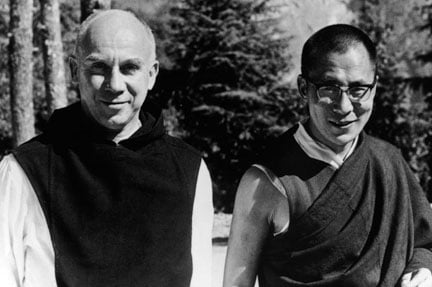
1968 was a true annus horribilis, as the Queen (upending Dryden) might have said, with the assassinations of Robert Kennedy and Martin Luther King and the social upheavals surrounding the Vietnam War ramping up. Then, on Dec. 10, 1968, came the bizarre death of Thomas Merton, the Catholic convert, Trappist monk and enormously influential spiritual writer who was accidentally electrocuted when he touched a poorly-grounded fan as he stepped out of his bath while he was on a trip to Thailand. (merton is pictured here with a young Dalai Lama.)
Merton, author of the great spiritual memoir, "The Seven Storey Mountain," had grown increasingly interested in Eastern spirituality, which, since his death and the growing conservatism in Rome dduring that period, has raised suspicions about the example of a man many believe should be canonized. Indeed, a few years ago the U.S. bishops replaced a bio entry of Merton in the new Catechism for Adults with an entry on St. Elizabeth Ann Seton. There was an uproar, understandably, as Merton is perhaps the most accessible of Catholics for so many people--I'd include myself in that group, as I am a convert too, and I find Merton's writings an endless source of inspiration.
In an essay at BustedHalo called "The Belly of a Paradox," Jesuit priest and Merton devotee (and no mean spiritual writer himself, James Martin, explores the contradictions of Merton's life, and afterlife:
"Why is this devout Catholic writer, whose autobiography proclaims a triumphal view of Catholicism and faintly mocks other religions, so beloved by seekers, doubters and agnostics? Conversely, why is this Catholic priest rejected in so many contemporary Catholic quarters?"
Also worth checking out is Father Robert Imbelli's post at dotCommonweal on the coincidence of the death of Merton this day, and the great Swiss Reformed Protestant theologian, Karl Barth.

Add to Newsvine
Add to StumbleUpon

"Why is this devout Catholic writer, whose autobiography proclaims a triumphal view of Catholicism and faintly mocks other religions, so beloved by seekers, doubters and agnostics? Conversely, why is this Catholic priest rejected in so many contemporary Catholic quarters?"
Which contemporary Catholic quarters have rejected Merton? I am not aware that he has been "rejected," but I would be interested in learning more about it.
“Merton, author of the great spiritual memoir, "The Seven Storey Mountain," had grown increasingly interested in Eastern spirituality, which, since his death and the growing conservatism in Rome dduring (sic) that period, has raised suspicions about the example of a man many believe should be canonized. Indeed, a few years ago the U.S. bishops replaced a bio entry of Merton in the new Catechism for Adults with an entry on St. Elizabeth Ann Seton.”
This comment is too complex for me. What has raised suspicions? Merton’s interest in Eastern spirituality? The growing conservatism of Rome? Both? Or possibly something else? Who has expressed suspicions?
Regardless of how some U.S. bishops might favor St. Elizabeth Ann Seton over Merton, he remains a great spiritual mentor of mine and I am greatly disappointed to hear that the hierarchy has possibly soured on him. On another web page, see http://blog.beliefnet.com/news/2008/11/40-years-later-mertons-legacy.php , a comment by writer Judy Valente about Merton’s relationship with a Louisville nurse caught the interest of a number of readers. It seems to me that Merton has become, in the minds of at least a few, a romantic figure of the 1960’s notorious hippie era. But to my thinking, Merton was then, and remains today, the Church’s great interpreter and teacher of contemplative prayer as practiced by the mystic saints Theresa of Avila and John of the Cross. He is a standout figure of twentieth century monasticism and the Church’s pluperfect answer to the hippies’ ethos, the Hari Krishnas and the excesses of America’s incipient secular society with its drug culture that erupted in and around the anti-war protest movement of the era, even as he himself was a principled and intellectually peerless peace advocate in the nuclear age.
But if the current Church establishment is down on Merton, then so be it because that is a sure sign of Merton’s bona fides as a pillar of the Church’s theological thinking. Just consider the reaction of the clergy, at least the Burgundian and English bishops to Joan of Arc. Or consider the reaction of the Spanish Inquisition to Theresa of Avila. Remember how their superiors regarded St. John of the Cross and St. John Vianney, the Cure of Ars. Unless there is a substantive reason for abusing Father Louis, I say let the hierarchy scourge his image, rub him out of the new Catechism, if they care to - - and right into the canonization process and establishment as a Doctor of the Church in his own right.
Dear Thomas Merton – wasn’t he such a gentle man for his times? His writing is so perceptive. His expressions of thought and analysis are profound and insightful, yet so apparent and readily accessible. He is a delight to read. His books and essays are to a lover of flowers like a garden in the peak of the summer season. Who is his equal as an effective interpreter of Catholic thought?
Post a Comment
By submitting these comments, I agree to the beliefnet.com terms of service, rules of conduct and privacy policy (the "agreements"). I understand and agree that any content I post is licensed to beliefnet.com and may be used by beliefnet.com in accordance with the agreements.