 The U.S. hierarchy gathers for its spring meeting tomorrow, in San Antonio, in the wake of one of the most divisive and ugly stretches the Catholic Church has seen since, well, Joseph Bernardin was alive. And the bishops themselves have been the perpetrators and victims of much of the nastiness, much of it centered on Barack Obama’s election and Obama at Notre Dame.
It is important not to talk about “the bishops” as if they were of one heart and mind on these controverted issues. In fact, they’re not, and it has been a vocal minority–albeit a large minority of 80-plus prelates out of 285 or so active ordinaries–that has challenged not only American Catholics but also their fellow bishops. And that silent majority has remained largely silent. This hasn’t been an edifying witness on either side.
So what to do? Some want the bishops to “man up” and adopt a harder line (the minority line) for Catholic universities, Catholic pols, and Catholics themselves. There are other options, and two editorials, in the Jesuit weekly America, and the lay-edited bimonthly, Commonweal, offer constructive suggestions and encouragement.
From Commonweal‘s editorial, “Episcopal Vacancy”:
It is not apparent that the bishops as a group are fully aware of the damage that has been done both to the unity of the church and to its ability to effectively engage the larger culture. To begin with, there remains the widespread perception that the bishops have learned little from, and shown even less honest regret over, clergy sexual abuse. That is unfair, but such suspicions are kept alive by the defensive, sometimes hostile way in which many bishops deal with the media. Nor is the laity’s or the larger public’s skepticism on this score helped by the lack of financial transparency in many dioceses. In the aftermath of the abuse crisis, one might expect a degree of modesty and humility from bishops when they criticize the errors or failures of others, especially from leaders of a church that has lost a third of its baptized members. What we too often hear instead is strident and self-righteous “prophetic” rhetoric. Too many bishops, in a misplaced effort to emulate the heroic example of John Paul II, seem to imagine that they are battling a new kind of totalitarianism, rather than the more subtle temptations present in any free society.
SNIP:
When the University of Notre Dame invited President Obama to deliver this year’s commencement address, the political animosity among Catholics that has been assiduously cultivated by some for years seemed to reach critical mass, and the damage from the fallout will take months, if not years, to measure. More than eighty bishops denounced the university. “We are at war!” declared Bishop Robert W. Finn of the Kansas City-St. Joseph Diocese in Missouri. (Such words are especially worrying after the murder of Dr. George Tiller in Kansas.) Bishop Finn darkly warned that the church’s most dangerous enemies were not its public antagonists, but Catholics who “attack the most fundamental tenets of the church’s teachings.” This suspicion regarding the loyalty and goodwill of other Catholics seems to be increasingly prevalent in the bishops’ conference.
From America’s editorial, “Community of Disciples”:
This rhetoric has threatened the credibility of the church, as the Catholic tradition of trust and toleration has been de-emphasized. Even a few bishops have made statements like “We are at war” and “Tolerance is not a Christian virtue,” suggesting that any notion of the common good has given way to a sharply defined “us versus them” mentality. Such rhetoric also subtly undermines the Catholic principle of subsidiarity first put forth by Pope Pius XI in Quadragesimo Anno, according to which a pluralistic social structure allows and encourages constructive input from a variety of groups on the grass-roots level.
This polarization must stop; otherwise our identity as a faith community will be torn asunder and Catholicism will cease to be an elevating force for change. How can we decrease the polarization? A vital first step is to seek out our common ground in the major civic areas where almost all Catholics agree: religious liberty; the sacredness of all human life; the goal of reducing and eventually eliminating abortion; support for social programs that provide a safety net for the poor; the elimination of segregation, racism and discrimination; and respect for differing religious and social traditions and diverse cultures. Few are the Catholics who do not share these principles, which provide a ready-made common ground.
The editors conclude by citing the late Cardinal Avery Dulles (SJ, natch) and his view of the church as a “community of disciples” on the way to conversion, in a church “led by the Spirit, not yet in full possession of the truth.”
This more humble view of a pilgrim church always in need of purification and improvement may help to tone down the rhetoric and encourage Catholics to work together in addressing the great issues of our day, especially those involving the culture of life. True dialogue, as Cardinal Dulles noted, enables the church “to understand its teaching better, to present it more persuasively and to implement it in a pastoral way.”
The editorial begins, as any good Jesuit editorial should, with the wisdom of St. Ignatius, who suggests that in any exchange, “it is necessary to suppose that every good Christian is more ready to put a good interpretation on another’s statement than to condemn it as false.”
If correction is necessary, it ought to be delivered with respect and kindness, the editorial says.
Good advice from a great saint, and others on the way.
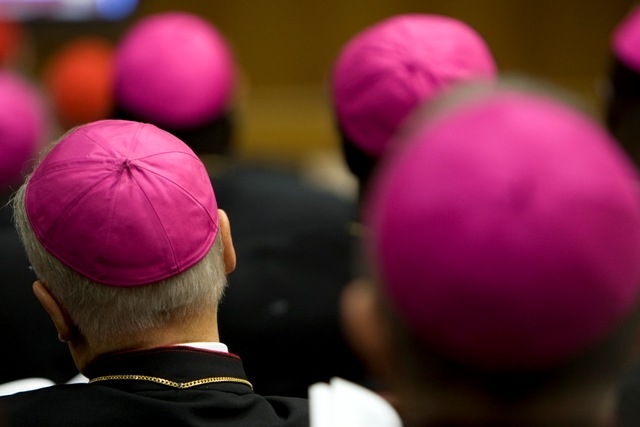
–Photo via Reuters “FaithWorld” blog, “A Flock of Shepherds” via the title of Tom Reese’s study of the episcopacy.
 Read Previous Post