Category: Events
It feels strange holding a cup of coffee in my hand today, just like it felt strange eating pizza for lunch over the weekend. Everything looks normal, but deep down I know it is not. I have just spent a month refraining from food and drink and trying constantly to keep God in my mind, and I am still in that mindset.
But how long will this last before I fade back into my old routines, where the responsibilities of daily life overwhelm that call from the Divine in the background?
As I've shared with you this month, Ramadan has many facets that help to enrich the lives of Muslims -- spiritual, social, charitable, and physical. The great struggle post-Ramadan is figuring out how to extend those benefits through until the next Ramadan. There's no one, universal way to do it. Each person needs to come to their own conclusion as to what works best for them. That is my task for the weeks ahead.
I hope that readers now get a sense of what Ramadan means for Muslims, and I encourage those of other faiths to borrow liberally from our traditions in ways that you feel might strengthen your own faith. I especially recommend looking back into your own fasting traditions -- nearly every religion has one -- and explore ways you can enrich your life with that. The framework of fasting is, I believe, an effective counterbalance to a modern society that is too often based on self-indulgence.
» Continue Reading This Post
Category: Events
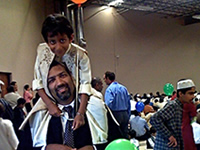
Why is it that Eid is a three-day affair? Perhaps it is because Muslims (despite their best efforts) end up celebrating it on different days. For those Muslims who follow the lead of Saudi Arabia (as some of the more conservative mosques do), the Eid celebration is today. However, for most Muslims in America who follow either the calculation or the moon sighting methods, Eid is tomorrow, on Saturday. A weekend Eid is something special -- we don't have to take time out of work or pull our kids out of school for the day -- and I intend to make the most of it.
If you're not used to seeing Muslims, Eid is the day where you are most likely to see groups of them. Unfortunately (and we're working on this), it will probably be because the parking situation around the location of Eid prayer is horrific, or because all the cabs seem to have disappeared off the streets. With the Muslim population in America growing as fast as it is, the average mosque is not big enough to accommodate all the worshippers, so larger venues are booked, often with many local mosque communities joining forces.
I've been to Eid services in convention centers, football and basketball stadiums, concert halls, and large city parks. Despite the larger size of the venue, multiple prayers (usually at 8 am and 10 am) are needed. Even in small towns, thousands of Muslims show up, because many otherwise non-observant Muslims show up for Eid. Here in Austin, we expect around 10,000 worshippers, and I've been to prayers in larger cities where the numbers approach 75,000. You'll probably see footage of your local Eid celebrations on the evening news.
» Continue Reading This Post
Filed Under: eid mubarak, eid-ul-fitr
Category: Spirituality
As the fading crescent moon can attest to, the month of Ramadan is coming to a close. All around the world, readings of the Qur'an that started on the first page 30 days ago are reaching their conclusions. The long nights in the mosque over the last 10 days, in eager search of the Night of Power, have left many exhausted yet spiritually alive. For me, this month has been a time to look carefully at my life as a Muslim in America.
Is my life being lived in accordance to the principles of my religion? Is there anything I have done in the past for which I need to seek forgiveness? Are the big decisions I am making in my life ones that will keep me on the the straight path, and keep me from wronging others? These questions have kept me up at night for the last month, as I ask God for guidance in the coming year.
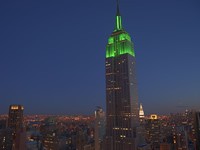
But in addition to recommitting oneself to the principles of my religion, Ramadan has also been a time for reinforcing social bonds, both within the Muslim American community and between Muslims and other Americans. As Muslim American institutions -- mosques, schools, community centers, and media -- continue to grow, the resources available to Muslims celebrating Ramadan increase. And as awareness of Ramadan increases among the American population at large, opportunities for interfaith understanding and shared celebration present themselves. One need only look up at the Empire State Building -- clad in green over the coming weekend in commemoration of the end of Ramadan -- to see how far we've come, despite the challenges of living in a post-9/11 America.
» Continue Reading This Post
Filed Under: eid, Moon sighting
Category: Traditions
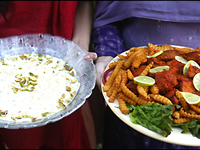
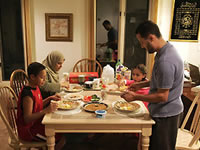
One of the unique pleasures of Ramadan is the tradition of specially prepared Ramadan sweets that originate from a host of different cultures and nationalities across the Muslim world. These Ramadan sweets and pastries help create a festive mood around the iftar table, and the best thing about Ramadan in America is that we get to sample them all. Just as the Muslim American community is a melting pot of diverse cultures, our Ramadan plates are adorned with treats from every corner of the Muslim world.
My parents immigrated from South Asia, so our house was filled with Ramadan treats from their homeland - seviyan (roasted noodles served in a sugary, milky sauce), fruit chaat (cut up fruits served with masala spices & black pepper), and of course, Rooh Afza (a sweet, rose-flavored milk drink).
But the mosque I attended while growing up was very multicultural, so I got a chance to experience the Ramadan treats of the parents of many of my friends. Kunafa (shredded, sweetened phyllo dough) from Syria, katayef (kind of like a fried sweet pancake) and umm ali (a decadent bread pudding) from Egypt, raisin cookies from Iran, and güllaç (phyllo again, with pomegranates and walnuts) from Turkey. There are tenuous cultural links between all of these desserts, but they each retain a cultural uniqueness that all can appreciate.
» Continue Reading This Post
Filed Under: dessert, eid, sweets
Category: Traditions
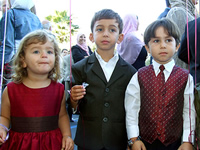
Now that Ramadan is slowly drawing to a close, take a few moments to think about the ones not fasting -- the little ones who sneak a date from the iftar table at sunset while everyone is frantically getting ready to eat, the ones who are usually asleep in the morning while the adults wake up to eat their pre-dawn meal and pray, the ones that unintentionally taunt the fasting grownups with ice cream cones and juice drinks. That's right - what about the children?
For much of the month, children are merely bystanders, exempt from the fasting until they reach puberty and, perhaps, many of the optional prayers (though they are encouraged to learn). But kids are kids, they see how religious festivals and holidays in other religions often emphasize the "fun stuff" - the Christmas trees and presents, the Hanukkah dreidels and songs, the colorful dances of Holi.
But Ramadan does have its share of "fun stuff" too, centered around the 3 day holiday of Eid, expected in a few days time. Eid in a predominantly Muslim country is as colorful and vibrant as the Christmas season is here in America. Over here, we're still working on ways to create a similar atmosphere for Muslim Americans and their children -- and we're not quite there yet.
» Continue Reading This Post
Filed Under: carnivals, children, eid, gifts
Category: Practice
Each morning during Ramadan is the suhoor (the pre-dawn meal), the private antithesis to the usually congregational and public iftar at the end of the day. It is the fasting Muslim's daily opportunity to set the tone for the day, both physically and spiritually. When done right, the suhoor allows you to properly focus on your daily responsibilities as well as your religious ones, and when done wrong (or not at all), it just plain makes your day miserable.
There are few opportunities to be truly alone with yourself (and by extension, God) than the early morning hours before the break of dawn, when the fajr prayer normally takes place. The world outside is still, and having just woken up, your mind is clear and in the best shape for communication with the Divine. Ideally, if you can leave enough time for both prayer and eating before dawn, it is an enriching experience. Even those who don't have the time to do this normally are making up for it in this last ten days of Ramadan, when extra prayers are recommended and the "Night of Power" (said to be on one of the odd-numbered days in the last third of the month) awaits.
» Continue Reading This Post
Filed Under: breakfast, fasting, suhoor
Category: Traditions
I've often struggled with the question of how best to share my faith with those who are not Muslim. While I have spent many years being involved in interfaith work, there was something about it that seemed at arms-length or academic. I believe that educating people about Islam and Muslims requires a more nuanced approach than lectures or brochures. But I also feel that it is important to bring some tangible benefit to the community at large.
One of my personal goals is that I want to help create an society where Americans feel that this country is better off having Muslims here than not. Right now, it's hard to get over the impression that Muslim Americans are a net liability. But how do we get to that promised land?
As with many innovative ideas coming out of the Muslim American community, one great answer has come from young Muslims. In 2002, Muslim students at the University of Tennesee, Knoxville came up with a unique way to share the meaning of Ramadan with their non-Muslim peers and raise money for local homeless charities. The idea was to have people sign up to fast for a day, and for local businesses to sponsor them at $1 for each person fasting.
» Continue Reading This Post
Filed Under: charity, fastathon, fasting, homelessness, hunger
Category: Benefits
One of the restrictions during Ramadan, aside from the obvious food/drink/sexual relations, is smoking. And one of the saddest things I have seen in my life is the group of smokers gathering just outside the mosque, craning their necks to hear the adhan (call to prayer) that signifies the end of the fast, waiting to break their fast not with a date, or a glass of water, but with a cigarette.
Smoking has always been a questionable practice from an Islamic perspective -- some scholars deem it to be forbidden because it harms the body, while others find it allowable if distasteful. But you wouldn't know it from walking down the street in any Muslim-majority country. As the pool of customers for cigarettes dries up in the West, the tobacco industry has targeted the developing world, including the Muslim world. In some of these countries, cigarette smoking among men has reached reached alarming proportions.
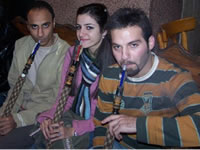
Also, it's not just cigarettes. The Middle East has a long tradition of shisha (or hookah) pipe smoking. With the more explicit prohibition on alcohol, shisha pipes are seen as a lesser evil in the context of social activities. Even today in Western countries, the practice has caught on with young people seeking a cultural alternative to bars and clubs where alcohol is served.
» Continue Reading This Post
Filed Under: addiction, fasting, ramadan, smoking
Category: Ramadan
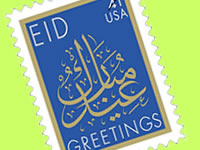
With Eid-ul-Fitr -- the three-day holiday signifying the end of Ramadan -- approaching soon, many Muslims are getting ready to send Eid greeting cards to their friends and family. And what better way to send them than with the official Eid stamp issued by the US Postal Service (USPS) adorning the corner of the envelope? The stamp, which has been in circulation since 2001, was reissued last week at the new $0.41 rate, just in time for the Eid holidays (the other Eid being Eid-ul-Adha, which occurs later this year and commemorates the hajj).
For those who aren't familiar with the history of this stamp, it is an intriguing one. It all started ten years ago, when Cincinnati housewife Aminah Assilmi started a campaign to have the stamp issued, after a friend's son saw a Hanukkah stamp and asked what the Muslim equivalent looked like.
For the next several years, Muslim children and women's groups sent thousands of postcards and drawings to the USPS in an effort to push the stamp forward. After all, each year the USPS receives 50,000 stamp recommendations, of which only 30-40 become stamps. For years, the campaign seemed like an uphill struggle.
» Continue Reading This Post
Filed Under: eid, stamp, usps
Category: Events
Muslims have spent two-thirds of the month of Ramadan in physical restraint and silent contemplation, and it is in the last third - the last ten days of Ramadan - where the remembrance of God approaches its peak. It is during this time that the practice of fasting and prayer is perfected, and the uninhibited communication between God and His servants takes place. This is the time for the most heartfelt prayers for forgiveness, for deep soul-searching, making amends to friends, and spending freely in charity.
One of the mysteries of this part of the month is Laylat al-Qadr, the Night of Power/Majesty/Destiny (translation varies), which is said to occur on one of the odd numbered days during the last third of the month. It is on this night -- which the Qur'an says is better than 1,000 months -- where sincere prayer wipes one's sins clean. It is also during this period when it is encouraged to spend time in spiritual retreat (i'tikaf in Arabic), praying throughout the night.
» Continue Reading This Post
Filed Under: dhikr, fasting, night of power, retreat
About Hungry for Ramadan
The last update to the Hungry for Ramadan blog was in October 2007. We welcome your comments about Ramadan and Islam in general in our Muslim forums.
Shahed Amanullah, a frequent Beliefnet contributor, is one of the country’s foremost Muslim journalists. He has harnessed the power of the Internet to spread a positive view of Islam. Amanullah is the editor of altmuslim.com, a Muslim news website, and founder of Halalfire Media, a network of Muslim-themed websites with more than five million annual visitors. Through his work Amanullah has tapped into a strong force of online activism. He lives in Texas with his wife and two sons, and looks forward to the spiritual rewards of Ramadan every year.
Subscribe
RSS Feed
Recent Posts
[an error occurred while processing this directive]
|