Hungry for Ramadan

Why I Really Fast, and What I Gain

Wednesday September 19, 2007

Categories: Spirituality

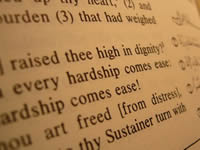
hardshipcomesease.jpgThere is a communal and public aspect of Ramadan that helps to bind Muslims as a community (ummah in Arabic), and there are the logistics of fasting that help us balance our daily responsibilities around the commitment to fast. But the act of fasting is, at its heart, a very personal spiritual experience--a contract between ourselves and our Creator that helps to reestablish our place with respect to Him.

Fasting serves the mental purpose of taming our ego, the physical purpose of putting mind over body, and the spiritual purpose of submitting ourselves to God's will.

It is human nature to empower and elevate ourselves. This isn't necessarily a bad thing, but when left unchecked, it can become an addiction that upsets the critical balance between people that is needed for a civil society. Muslims, like all humans, are no exception to this instinct. Left to our own devices, we would worship only ourselves and resist any attempt to put rules and restrictions on our behavior. But there is an inner voice or state--Muslims refer to it as our fitra--that recalls a primordial covenant with God to recognize His authority over all things. It is this basic relationship between human and divine that Ramadan seeks to reestablish.

It is one thing to set aside time to give thanks for the blessings one has. It is another thing altogether to take away some of the most basic blessings--the gifts of clean water to drink and nourishing food to eat--in order to drive the point home. Sometimes we humans need to lose something of value in order to realize how lucky and blessed we are. And at that point, we remember what the Qur'an tells us: "With every hardship comes ease."

As Muslims, we declare that we submit ourselves to the will of God. Ramadan is a means of testing that commitment. It is too easy to cheat on the fast to make it of any use to us in our worldly life--we could always sneak a drink of water or bite of food in a secluded place, or engage in gossip (backbiting) and impure thoughts--and appear pious as we join others breaking their fasts at the end of the day.

But in those moments of difficulty, when the body begs for your attention, it is as if there is no one else but your soul, your body, and God. And in hundreds of moments during the month of Ramadan, whether conscious or not, you reaffirm that commitment: First comes the Creator, then my soul, then my body.

I have related many of the reasons why I fast--the controlling and taming of desire, the elevation of the spirit over the body, the remembrance of the divine writ, and the thanks for the blessings that I take for granted the rest of the year. But there is really only one reason that I fast, and it is the only one that matters.

He asked me to. And I obey.

Advertisement
Comments
Rachel Barenblat
September 19, 2007 11:22 AM

There's a lot here that resonates for me. I'm reminded of some of what I've read in the book God In Your Body by Jay Michaelson, who writes:

I have found the effects of fasting on body, heart, mind, and spirit are far more powerful than the reason the fast may have been instituted by rabbis two thousand years ago... [O]n the emotional plane, fasts are like vacations from the pursuit of pleasure. Sometimes the appetites and desires of the physical body really can become our masters, rather than our servants; without getting carried away, it's useful to think about fasting as correctives at such times.

Often I am "led" by fasts to places which are achingly beautiful. I find myself more loving, more accepting, more grateful. Sometimes I'm overwhelmed with humility, as I see how much the "I" that I'm so proud of is dependent on daily nourishment. Just one skipped meal, and look what happens to this supposedly self-sufficient ego!

It's traditional in many Jewish communities, on fast days, to wish others "an easy fast." I like to wish "a meaningful fast."

Gabistan
September 19, 2007 2:26 PM

Shukran ya akhi - Ramadan Mubarak.
I just started reading your blog and have passed it along to all my sisters. I've been trying to control my backbiting, although i can't say i do so all that often but this month reminds me to be extra careful and i feel just a bit more guilty for doing it. As the Prophet (saws) said -paraphrasing-, "If you backbite and lie Allah doesn't care if you refrain from drink or food." Yikes!!

the nafs! it's a wild animal sometimes, no?

thanks again for your blog. i love it.

Nailah
September 19, 2007 3:30 PM

Thank you

Boyd
September 20, 2007 12:44 PM

Please give your time to your family and community during Ramadan. Also, backbiting is a contagious disease. Many of us do it because we surround ourselves with the main offenders. Isolate yourselves and do extra work if you're in an office. At home, decrease the length of phone calls you have with those not committed to the required fast. Read your Quran until you have it memorized. Love one another as Allah does.

Advertisement

Search This Blog

About Hungry for Ramadan

The last update to the Hungry for Ramadan blog was in October 2007. We welcome your comments about Ramadan and Islam in general in our Muslim forums.

Shahed Amanullah, a frequent Beliefnet contributor, is one of the country’s foremost Muslim journalists. He has harnessed the power of the Internet to spread a positive view of Islam. Amanullah is the editor of altmuslim.com, a Muslim news website, and founder of Halalfire Media, a network of Muslim-themed websites with more than five million annual visitors. Through his work Amanullah has tapped into a strong force of online activism. He lives in Texas with his wife and two sons, and looks forward to the spiritual rewards of Ramadan every year.

feed icon Subscribe

RSS Feed

Receive updates from Hungry for Ramadan

Advertisement

Advertisement


About Beliefnet

Our mission is to help people like you find, and walk, a spiritual path that will bring comfort, hope, clarity, strength, and happiness. More about Beliefnet.

Legal

Copyright © Beliefnet, Inc. and/or its licensors. All rights reserved. Use of this site is subject to Terms of Service and to our Privacy Policy. Constructed by Beliefnet.

Advertisement

Report as Inappropriate

You are reporting this content because it violates the Terms of Service.

All reported content is logged for investigation.