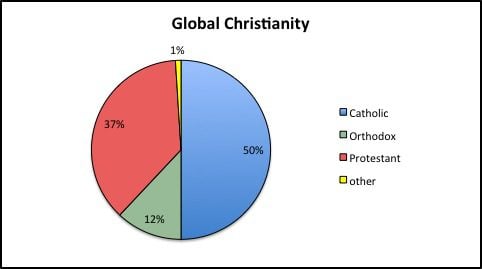
For those who may not know, Christianity is the single largest religion in the world. Of course, by “Christianity” I do not merely mean, say, evangelical Christianity alone, or any other single subset of the Christian faith (some of whose adherents tend to monopolize the term, applying the epithet “Christian” exclusively to themselves alone). By “Christianity,” I mean to refer to the entire Christian spectrum — Roman Catholics and Eastern Orthodox alike, as well as Protestants of every denomination and none.
While Christianity may be the religion with the greatest number of adherents in the world, it nevertheless remains a minority when compared to the total human population of the world:
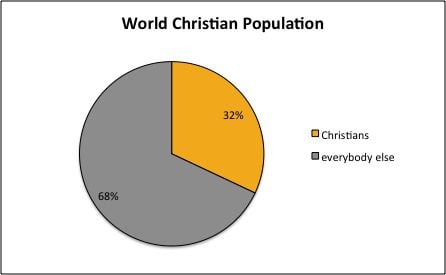
As the above chart amply illustrates, Christianity in all of its forms (Catholic, Orthodox, Protestant, etc.) together only amounts to roughly one-third of the total global population. It may indeed be the largest of the world’s religions; but even so, more than two-thirds of the global populace is non-Christian.
That’s the size of Christianity’s worldwide footprint. Moving from this global perspective to a national one, however, presents us with a very different picture.
The United States is often said to be a “Christian” nation. And while this would be incorrect if one is talking about its government (the U.S. is a secular republic, not a Christian theocracy), it is correct if instead one is talking about its demographics. Just how correct such an assessment is can be seen by viewing the following chart:
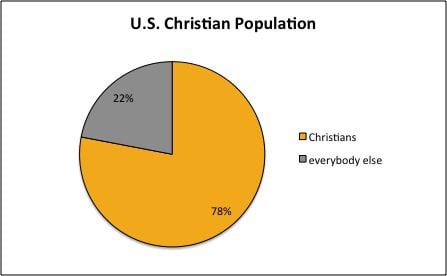
The United States is clearly an overwhelmingly Christian nation, in the strictly limited demographic sense that nearly 80% of its population self-identifies as “Christian” of one sort or another. (Bear in mind that Christianity is vastly more diverse than many people seem to realize).
Christians therefore constitute a large majority (78%) of the domestic U.S. population, whereas on the wider world stage Christians constitute only a minority (32%) of the total global population.
Now, how does all of this break down, in terms of Christianity’s major wings, branches, denominations, and other internal subdivisions (all of that “vast diversity” I mentioned)?
Well, on the global scene, the Christian world as a whole breaks down like this:
Note first of all that fully half (50%) of the world’s Christians are Catholics, making Catholics the single largest group or subdivision within Christianity. (This fact stands as self-evident, despite the protestations of some conservative evangelical and fundamentalist Christians who insist that “Catholics aren’t Christians.”) Catholics are unique in their recognition of the binding religious authority of the Pope, whom they regard as the earthly head of the Church and divinely ensured to be error-free with regard to dogmatic matters of faith and morals; other Christians (Orthodox, Protestants, etc.) do not recognize the Pope as their spiritual leader, or as an infallible religious authority.
The Eastern Orthodox churches constitute a much smaller number, accounting for only about 12% of the total global Christian populace. The Greek-speaking Eastern (Orthodox) and Latin-speaking Western (Catholic) churches split from each other in a “Great Schism” over various theological disagreements and political disputes way back in the 11th century (Rome and Constantinople excommunicated each other in 1054 AD). Whereas the Roman Catholic Church today remains a single monolithic church or entity, Eastern Orthodoxy exists in the form of multiple national churches (Greek Orthodox, Russian Orthodox, Romanian Orthodox, etc.)
The second-largest slice of the global Christian pie belongs to Protestantism, which as a whole accounts for a little over one-third (37%) of the world’s Christians. Protestantism began with Western European reformers in the 1500s (such as Martin Luther, John Calvin, and John Knox, among others) who protested what they viewed as serious theological and other sorts of problems plaguing the Catholic Church; these protesting voices sought to effect reform within their Church, but instead they ultimately broke away from it altogether in another major schism or split, this one being the Protestant Reformation of the 16th century.
Protestantism’s insistence upon independent thinking snowballed, however, resulting in it further splintering itself into innumerable separate sects and distinctive denominations. There is no single actual “Protestant church,” in the way that there is a Roman Catholic Church, or various state Orthodox churches; instead, there is simply a Protestant branch or wing, composed of a large number of individual churches and communities — e.g., Baptists, Methodists, Lutherans, Presbyterians, Episcopalians, Quakers, Amish, Mennonites, Pentecostals, Seventh-Day Adventists, various independent nondenominational congregations, various independent Bible churches, ad infinitum. All of these are rolled up together under the Protestant umbrella.
Finally, the remaining 1% of American Christianity — the “other” category — consists of Mormons, Jehovah’s Witnesses, and an additional miscellany of other small and obscure Christian groups that don’t properly fit into the three main subcategories.
So, that’s how global Christianity breaks down, worldwide and as a whole. However, if we now move once again from a broadly global perspective to a narrowly national one, how does American Christianity itself break down, using these same sorts of categories?
(To be continued, in Part Two.)
 Read Previous Post