Having previously looked at the demographics and “denominations” (major branches, movements, divisions) of Judaism, Christianity, Islam, and Hinduism, we turn now to Buddhism. And, just as the other four of the “Big Five” among the world’s major religions are by no means homogeneous and uniform in content but instead heterogeneous and diverse, so is this also the case with Buddhism.
While Buddhism is ranked as the fourth largest major world religion (after Christianity, Islam, and Hinduism, in descending order), specific numbers reliably reflecting the precise number of Buddhists in the world today are tricky to come up with for a number of reasons. Perhaps foremost among such reasons is the the fact that, in some countries, it is possible to be a practicing Buddhist while also actively observing other faiths simultaneously.
In China, for example, one can be a Buddhist, a Confucian, and a Taoist, all at the same time (and without any inconsistency or self-contradiction). In Japan, one can likewise quite happily be an adherent of both Buddhism and Shinto simultaneously. This sort of thing can happen because Buddhism and the other religions of East Asia tend not to be viewed as being mutually exclusive; rather, they tend to be seen as complementary, rather than as contradictory, religious traditions.
However, such freewheeling mixing and matching of multiple religious commitments can wreak havoc for pollsters attempting to sort out just how many actual Buddhists there are in the world. If an individual self-identifies in a religious survey as both Shinto and Buddhist, or as Taoist and Confucian as well as Buddhist, how is that individual to be counted or classified, without skewing the totals?
Taking such complicating factors into account, estimates regarding the actual total world Buddhist population vary greatly, ranging anywhere from around 350 million to upwards of a billion. Most conservative estimates seem to hover around a number on the lower end of that range, however — perhaps somewhere around 500 million (about 7% of the total world population) is not too far from the mark, and still keeps Buddhism in its number four slot among world religions as ranked by size.
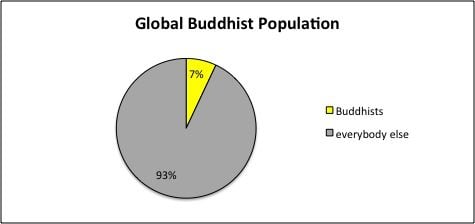
And that, in a nutshell, is what the global picture of the total Buddhist populace worldwide adds up to (give or take perhaps a hundred million, or so).
Domestically, by contrast, Buddhism today remains a tiny minority religion within the United States. American Buddhists account for only 0.7% of the total U.S. adult population.
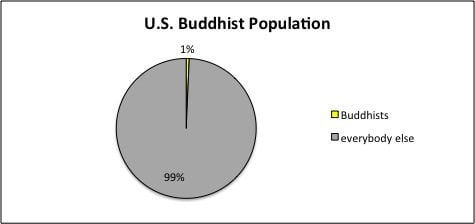
So, that’s the big picture, with regard to Buddhism generally. Now, what happens when we put Buddhism under the microscope, and zoom in on it? How does Buddhism subdivide into multiple major branches, sects and schools, or “denominations”?
(To be continued, in Part Two.)
 Read Previous Post