Longtime readers may recall my blogging last year about the work of Philip Blond, the English theologian and political economist who advocates “Red Toryism,” a conservative middle way advocating for a strong civil society to mediate between the excesses of left-wing statism and right-wing market fundamentalism. Here’s a bit from a New Statesman profile of him:
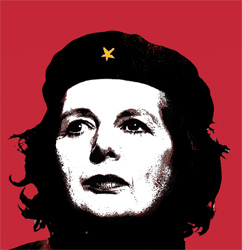
One left-of-centre politician who does take Cameron and Blond seriously is Jon Cruddas, the MP for Dagenham, and another speaker at Blond’s coronation last month as the Conservative Party’s philosopher-king. “We, Labour, ignore Blond’s work at our peril,” Cruddas says. “There’s a fault line running through the history of conservatism, between liberal-economic conservatism and a richer, more paternalistic tradition. Phillip’s trying to rehabilitate the second one. What it does is allow the Conservatives to use a different language, a discourse about our obligations to others that is much richer than the Thatcherite brutality built around a notion of atomised economic exchange.”
Blond saw Thatcherite “brutality” close up. He was born 42 years ago in Liverpool into a large working-class family. His experience of growing up in the city as it was being ravaged, first by recession and then by deindustrialisation, has clearly shaped his politics, giving it an elegiac, nostalgic tone. “I lived in the city when it was being eviscerated,” he says. “It was a beautiful city, one of the few in Britain to have a genuinely indigenous culture. And that whole way of life was destroyed.”
He left Liverpool to go to Hull University, and then moved to Warwick to study for a Master’s degree in Continental philosophy. One of his contemporaries there remembers him announcing himself as a “Catholic socialist”, though Blond disputes that.
“I’m not a socialist and I’m an Anglican. But I have always been interested in Catholic social thought, which always made the argument that capitalism and communism are species of the same thing. Both are forms of disempowerment. But I also think that’s a Tory insight.”
Read Blond’s original blockbuster “rise of Red Toryism” article for Prospect here. (Excerpt: “Thankfully, conservatism is a rich and varied tradition, and re-examinating its history can provide the answers Cameron needs. These ideas are grounded in a conservatism with deeper roots than 1979, and whose branches extend into the tradition of communitarian civic conservatism–or red Toryism.”) To me, Blond’s writing is what my book and output would be if it had been written by an actual intellectual.
Anyway, it’s great that Patrick Deneen and the crew at Georgetown’s Tocqueville Center will host
Blond speaking on Thursday night on the Georgetown campus in Washington. He’s going to discuss the Red Tory vision for reviving and renewing conservatism in specific and our left-right politics in general. As the bit above indicates, at least some leftists have found common ground with the religious conservative Blond. The lecture is open to the public, but do follow the link above to RSVP, to guarantee a seat. On Friday, Your Working Boy will join Ross Douthat of the NYTimes and Dan McCarthy of The American Conservative on a panel to deliver a response to Blond’s speech. The succeeding panel will involve academics. I hope to see at least some of this blog’s readers at one or both events.
Oh, and if you’re in the Philadelphia area, come hear Prof. Blond speak on Monday night at Villanova.


posted March 17, 2010 at 2:04 pm
Glad to see you posting this – I am so psyched to hear him speak at Villanova.
I don’t think I would characterize his ideas as “nostalgic”. And I strongly suspect that when some conservatives hear his agenda – re-moralization of the economy, re – capitalization of the poor and re localizing of the community they’ll knee jerk themselves into apoplexy. The “re-capitalization of the poor” thing will have a hard time among your free market conservatives. But I do think that his distributist message – offering as it does something other than the socialist – capitalist set of limited choice could use a lot more exposure here in the US.
posted March 17, 2010 at 2:58 pm
I’ve had this on my calendar for a while. I’m looking forward to meeting you at Georgetown tomorrow or Friday — and I expect you’ll really enjoy the Tocqueville Forum experience . . .
posted March 17, 2010 at 3:09 pm
One of the most remarkable changes in the Tories in recent years has been their embrace of the rights of gay people. This is so different from what has happened to the GOP that terms like “stark antithesis” seem too weak to describe the difference between these two sister versions of conservatism.
A quick Google search seems to indicate that Blond does not share this Tory reversal of position, but it’s hard to determine for sure because he’s SO different in SO MANY ways from traditional British conservatives that gay-related issues seem to get just passing mention.
It would be interesting to hear more detail. Here’s hoping Andrew Sullivan shows up at the meeting.
posted March 17, 2010 at 3:14 pm
On behalf of the small Orthodox student contingent at Georgetown, welcome to the Hilltop! (I’m the OCF president as well as one of the Mathewes-Green’s parishioners when I’m at home.)
posted March 17, 2010 at 5:26 pm
The only way the poor will be capitalized, re or otherwise, is if there is some way to find a way to market them, and they will have to lose a lot of weight to be a marketable commodity.
posted March 17, 2010 at 6:06 pm
It’s interesting that this Blond fellow crops up just as I’m looking at reviews of Fintan O’Toole’s “Ship of Fools: how Stupidity and Corruption killed the Celtic Tiger”. O’Toole’s book is the story of how Ireland was unable to handle its period of prosperity, how its center Right ruling party and its Catholicism (heavily focussed on sexual mores) proved grossly inadequate to the moral demands of the times. And how Ireland’s smallness- its localism- was a pernicious factor in the corruption and persistently, knowingly, choosing the wrong things.
It looks like the full transition to Modernity and maturity is simply a difficult one, whether groups take a right-leaning track or a left-leaning one.
posted March 17, 2010 at 8:17 pm
Jillian – the question you beg is if a “transition to Modernity and maturity” is really that or just another version of conquest, dispossession and loss dressed up as historical inevitability. The folks at Goldman Sachs will be happy to fill in the particulars.
Rod – I hope there will be some audio or, better yet, audio-visual record available of the approaching conversation. You should have a perfectly wonderful time which can only benefit a political culture captured by the Democrat-Republican puppet show currently on view and making decisions in Washington.
posted March 18, 2010 at 7:31 am
dod,
To answer the question Jillian begs, “conquest” (of other people), “dispossession” (of other people), and “loss” (inflicted on other people) is exactly, precisely what she means by “the transition to Modernity and maturity.” There’s not one jot or tittle of Jillian’s worldview that’s incompatible at all with the machinations of Goldman Sachs, nor is there one jot or tittle in Goldman Sachs’s worldview that’s incompatible at all with Jillian’s machinations. Would that both Jillian and Goldman Sachs would make Jillian’s much-bruited “transition” to “maturity” — *moral* matutrity — but don’t hold your breath in either case, and especially not in Jillian’s.