Rod Dreher

Rod Dreher

‘Acting White’: Stuart Buck interview

posted by Rod Dreher | 8:10am Tuesday May 18, 2010

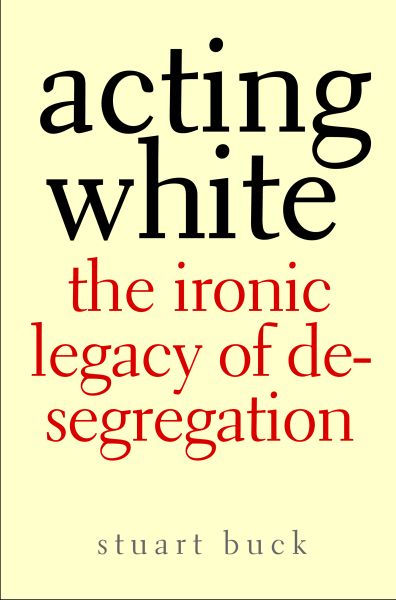
actingwhite.jpgOne of the most remarkable books I’ve read in ages is “Acting White: The Ironic Legacy of Desegregation” (Yale University Press). Its author is Stuart Buck, a Harvard-educated lawyer who is now working on his Ph.D. in education. Stuart is also a friend of mine, and one of the most intelligent and decent men I know. “Acting White” is a meticulously documented study of the phenomenon observed among African-American students, in which academically accomplished black students are often accused of being traitors to their race (“acting white”) because of their good grades and study habits. Here’s the Amazon.com description of the book’s content:

Commentators from Bill Cosby to Barack Obama have observed the phenomenon of black schoolchildren accusing studious classmates of “acting white.” How did this contentious phrase, with roots in Jim Crow-era racial discord, become a part of the schoolyard lexicon, and what does it say about the state of racial identity in the American system of education?
The answer, writes Stuart Buck in this frank and thoroughly researched book, lies in the complex history of desegregation. Although it arose from noble impulses and was to the overall benefit of the nation, racial desegegration was often implemented in a way that was devastating to black communities. It frequently destroyed black schools, reduced the numbers of black principals who could serve as role models, and made school a strange and uncomfortable environment for black children, a place many viewed as quintessentially “white.”
Drawing on research in education, history, and sociology as well as articles, interviews, and personal testimony, Buck reveals the unexpected result of desegregation and suggests practical solutions for making racial identification a positive force in the classroom
.

“Acting White” was a revelation to me. I had no idea, no idea at all, what the black community suffered with integration. I hadn’t even thought about it, because it seemed to me that to entertain that thought was to in some sense grant legitimacy to segregation. Of course that’s nonsense, and the taboo around the topic kept me from seeing that both can be true: that segregation was an evil that had to end, and that black communities paid a terrible price for it. “Acting White” explores that price, and explains a particularly nasty legacy of the change: the stigmatization of educational achievement among black secondary school students.
Stuart — whose blog is here — graciously agreed to do an e-mail interview with me about the book. It ran long, so I’m going to break it into three parts, spread over today and tomorrow. I strongly urge you to stick with the entire interview, and indeed to buy the book, which the African-American linguist John McWhorter strongly endorses. The first question I asked Stuart was about the difficulty of taking on such a radioactive topic, especially as a white man:

Over and over in “Acting White,” you make it clear that you are not supporting segregation, or trying to minimize its moral horror. It’s clear to the reader that you fear being misinterpreted. Why?
People are very one-sided in how they approach political issues. For example, people who support universal health care will tend to argue that we’ll both cover 47 million more people and save money at the same time, while people who oppose universal health care will argue both that it costs too much money and that it will diminish the quality of care so much that it won’t benefit anyone.
Few political writers take a nuanced view of their subject: “This policy would deliver substantial and meaningful benefits, but the cost is even higher,” or “the costs of this policy will be brutal, but the benefits are great enough to be worth it.”
As a result, whenever readers come across someone who claims that a particular policy (say, desegregation) came at a substantial cost, many will immediately assume that the writer is an opponent of the policy. I therefore took pains to ensure that no reader could possibly make such an assumption. This was particularly necessary given that race can be a third rail of policy discussion . . . no matter what you say, someone will find a way to demonize you for it.
I would put it like this: Segregation was like a cancer. But a powerful anti-cancer drug may have side effects — such as crippling nausea. You have to try to address the side effects, not sweep them under the carpet simply on the ground that anything is worth it to fight cancer. At the same time, I didn’t want any reader to think that because I pointed out a side effect, I was somehow in favor of cancer.

I then asked Stuart: What first interested you, a Southern white man of the post-integration era, in the “acting white” phenomenon? And why should people care about it?
His answer begins:

I first got interested in the “acting white” phenomenon when my wife and I adopted a black baby boy six years ago. In our readings on interracial adoption, many children adopted by white families were later accused of acting white or trying to be white.

(Interview continues below the jump)


(Stuart Buck, continued)
Around the same time, our nation observed the 50th anniversary of Brown v. Board of Education, and I came across a retrospective article by the journalist Jonathan Tilove. Tilove wrote of a perspective that I hadn’t heard before:

But to many, Brown – handed down May 17, 1954 – was also a dirge for something precious and irreplaceable: a network of black schools almost sacred to those they served and wholly devoted in their belief in black ability and pursuit of black advancement.
“Brown was turned against us. We lost our schools,” says Elias Blake Jr., who graduated in 1947 from Risley High School in Brunswick, Ga., and credits it with transforming him from an indifferent student, sights set no higher than a job at the local hotel, into someone who became valedictorian of his college class and ultimately president of Clark College in Atlanta.
Absent from the standard telling of Brown, the superior education that many black schools provided is a source of fierce pride for alumni, and the subject of a growing body of scholarship. . . . It is a remarkable tale of how black communities, under the thumb and under the radar of oppression, created schools that imbued black children with a sense of confidence and possibility in the very midst of a system determined to limit them.
. . . . Brown’s most profound irony may be that answers to closing the achievement gap lie buried in the history of the schools that Brown’s implementation destroyed. Glittering amid the ruins, the answers are straighforward: Dedicated teachers. Strong principals. Order. Discipline. High expectations. Community and parental support. What is astonishing, Siddle Walker says, is how many black children attended schools during segregation that delivered on these objectives, and how few do so now.

I started to put two and two together . . . . could it be, I wondered, that undermining the black school contributed to the feeling in some quarters today that education is “acting white”?
How do we know that the “acting white” phenomenon only arose during the integration period?
As I freely admit in the book, we don’t have perfect evidence here. No one was doing nationally representative surveys on “acting white,” and there could be lots of “acting white” sentiments that were uttered but never recorded.
All of that said, I think there’s a strong case that “acting white” began with desegregation. First, as far as I could tell, black people who went to school before desegregation have testified unanimously (whether in autobiographies, newspaper articles, or personal interviews) that “acting white” was a completely foreign concept in their school days. After all, why would a child whose most-admired peers and mentors within the school were black think of any type of school behavior as “acting white”?
Second, there are many personal stories of “acting white” occurring along with desegregation, as black children were put into an environment perceived as controlled by whites. Among many examples in the book, author Kitty Oliver notes that “there was a time when black students wouldn’t dare tease a student, but rather would applaud them for their achievements.” But then, “desegregation created a clearer division of white and black. Once black and white students started attending school together, the association shifted and black students began to tease one another by pushing their smart peers into the ‘white’ category.”
What I found fascinating and poignant was how many students on the front lines of desegregation faced criticism back home in their black neighborhoods. Leo Hamilton, one of the first to desegregate a school in Baton Rouge, says: “We were at a school where people didn’t want us there. But, you had a problem in the neighborhood because you didn’t go to school with these [black] people anymore, and there was a group of people . . . who resented the fact that . . . you were at school with those white folk. ‘What, you want to be white? You can’t come to school with us?’ So, you had to deal with these idiots at school. Then, you have to come home to deal with all these other idiots who were against you because you weren’t in school with them, and you were all of a sudden trying to be white.”
Ron Kirk, who later became the first black mayor of Dallas, was one of the first to integrate a junior high school in Austin, Texas. As he puts it, “After a day of all of us struggling to make this whole desegregation thing work, we would walk home and run into neighborhood friends, and they would ridicule us and want to fight us because we were going to school with white kids. So in the course of a single day we might get beat up because we were black, then get beat up again because we weren’t black enough!”
It was remarkable to me, reading your book, to come across the testimonies of African-Americans who had gone to segregated schools, and who remembered with great love the institutional role their schools played in their communities — something that disappeared with integration. And some of the stories blacks quoted in your book tell about how emotionally searing it was to have those schools destroyed or otherwise taken away from them, were not only surprising, but also heartbreaking. Why have these stories been suppressed all these years — and what can we learn from hearing them today?
Let me give an example of what you’re talking about here. Second Ward school in Charlotte had been important to the black community there. A former student said, “I don’t advocate segregated schools today. But there are attributes of that time that need to be in place today. Our teachers, they’d look at you, almost as if they were wanting to will a good education into your head.”
That school was demolished during desegregation, as can be seen in this poignant picture:
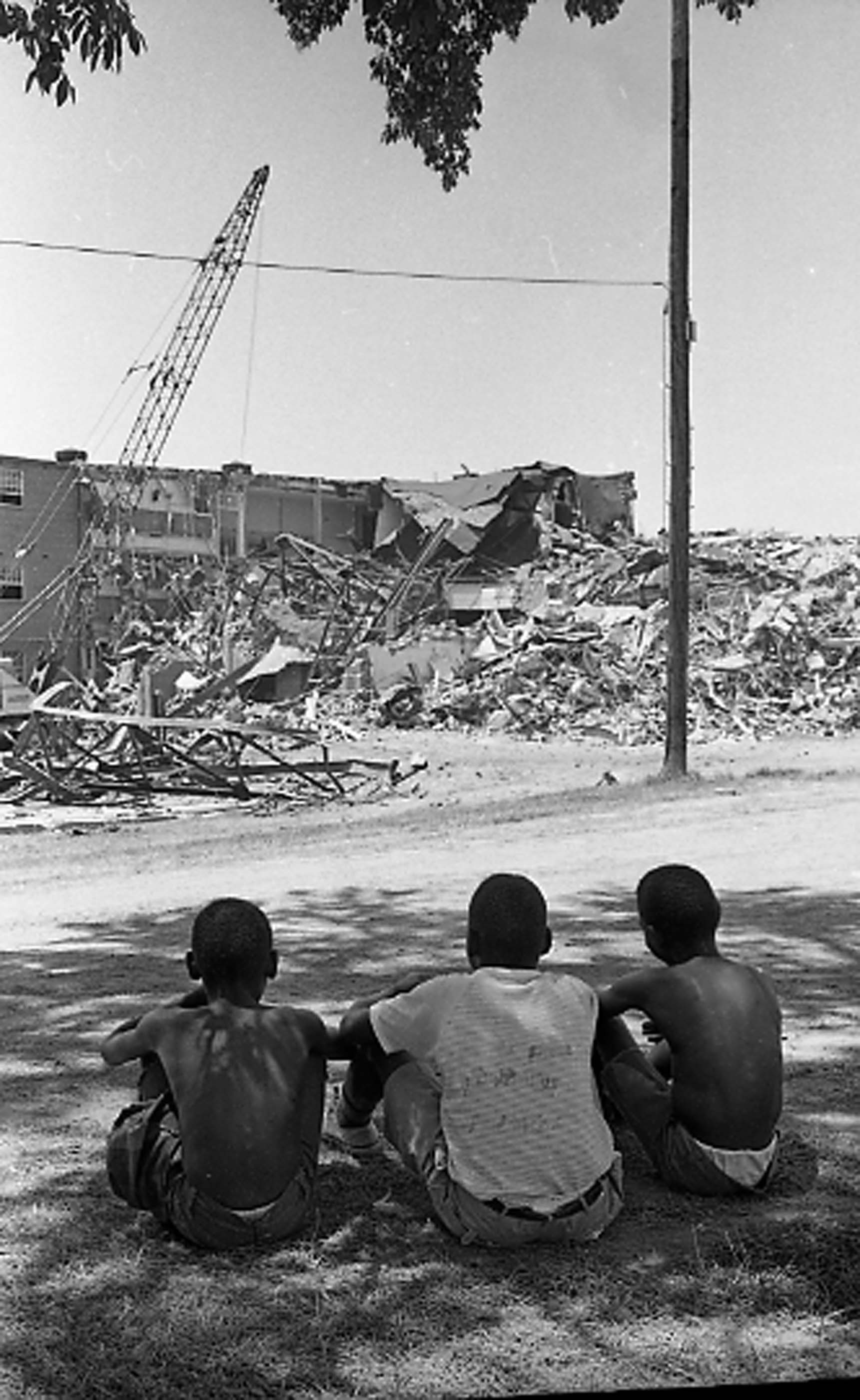
Figure_5.2.jpg
Students were devastated by the closing of the school. Said one person: “An institution was being closed. And not necessarily for progress, but because of integration. . . . Well, it was heartbreaking. It really was. It really was.” Another person said, “We thought that it was the utmost in betrayal.” A former teacher said, “I still kept contact with those kids from Second Ward, and they would call and sometimes cry.”
I’m not sure these stories have literally been suppressed as much as they’ve been ignored. I found plenty of such stories, but they tend to appear in relatively unnoticed local newspaper articles, interview transcripts from university “oral history” programs, and the like.
Why don’t we pay more collective attention to these stories? Probably because it upsets the traditional narrative wherein everything that happened under segregation was unremittingly evil while desegregation via Brown v. Board of Education was a national triumph. When we as a society have settled on a narrative with clear good guys and bad guys, we don’t like to be bothered by nuance and complexities.
[Part Two of this interview to come later today on this blog.]


Previous Posts

Mommy explains her plastic surgery
In Dallas (naturally), a parenting magazine discusses how easy it is for mommies who don't like their post-child bodies to get surgery -- and to have it financed! -- to reverse the effects of time and childbirth. Don't like what nursing has done to your na-nas? Doc has just the solution: Doctors say

posted 10:00:56pm Jul. 21, 2010 | read full post »

Why I became Orthodox
Wrapping up my four Beliefnet years, I was thinking about the posts that attracted the most attention and comment in that time. Without a doubt the most popular (in terms of attracting attention, not all of it admiring, to be sure) was the October 12, 2006, entry in which I revealed and explained wh

posted 9:46:58pm Jul. 21, 2010 | read full post »

Modern Calvinists
Wow, they don't make Presbyterians like they used to!

posted 8:47:01pm Jul. 21, 2010 | read full post »

'Rape by deception'? Huh?
The BBC this morning reported on a bizarre case in Israel of an Arab man convicted of "rape by deception," because he'd led the Jewish woman with whom he'd had consensual sex to believe he was Jewish. Ha'aretz has the story here. Plainly it's a racist verdict, and a bizarre one -- but there's more t

posted 7:51:28pm Jul. 21, 2010 | read full post »

Bad economy! Bad, bad economy!
Take this tour through some recent economic charts from the Federal Reserve to get a picture of how terrible our economy really is. Seriously, it's staggering stuff.

posted 5:37:08pm Jul. 21, 2010 | read full post »

Advertisement
Comments read comments(31)
post a comment
Mont D. Law

posted May 18, 2010 at 9:23 am


Does Mr. Buck deal with the fact that many of the negative outcomes of this policy are associated with resistance to segregation as opposed to segregation itself.


report abuse
 

Mont D. Law

posted May 18, 2010 at 9:29 am


Sorry. Desegregation.


report abuse
 

YrName

posted May 18, 2010 at 9:56 am


we don’t like to be bothered by nuance and complexities.
Ah, Southern nuance, that rarest of birds. Known more by its absence than anything else, except when it comes to slavery, treason, internal terrorism, and Jim Crow regimes. On the plus side, at least the book isn’t “Lynching: Who Will Speak for the Rope Manufacturers?”
Who knows? The book might even be accurate, good, and useful. (Though there is a long history of Southern apologists for appalling behavior.) Buck sounds like a good guy. But, as far as I can tell, John McWhorter is most respected by those most inclined to believe that segregation had an upside, so I wouldn’t hang much on that recommendation for the general audience.


report abuse
 

Liam

posted May 18, 2010 at 10:11 am


This is not only a legacy of the Black Power movement, but less directly and more fundamentally, a legacy of the era from the Civil War to WW2. Read Douglas A. Blackmon’s “Slavery by Another Name: The Re-Enslavement of Black People in America from the Civil War to World War II” to understand how deeply a very rational distrust of white culture and institutions was sown by white Americans in the black communities over several generations after the Civil War. That’s not to say it’s rational now, but actions and omissions of this kind and scale leave a deep residue, and only a utopian fool will ignore the role of white culture and institutions in setting this up.


report abuse
 

Rombald

posted May 18, 2010 at 10:12 am


This is only a thought, but my suspicion is that the US black/white race issue would be better seen as a caste conflict, rather than race in a biological sense. In the 1930s, my grandmother, from a working-class family in a northern English factory town, passed the exam to go to grammar school at the age of 11, and she then had to run the gauntlet every morning, of the neighbours’ children being sent by their parents to throw mud at her as she walked past.


report abuse
 

Rod Dreher

posted May 18, 2010 at 10:32 am


YrName is a perfect example of the kind of epistemic closure, indeed the regional and racial bigotry, that prevents any kind of rational discussion of this phenomenon. He has not read the book, but he is sure that Stuart Buck is an unreconstructed Southern racist who is nostalgic for segregation. Never mind that Stuart often says in the book that segregation was an evil policy that had to be ended. And never mind that the academic research and personal interviews he cites are all from black sources talking about the black experience. “Who knows?” offers YrName, “The book might even be accurate, good and useful.” But YrName is not going to trouble himself to actually read the thing, or to give Stuart Buck — the adoptive father of two black children, mind you — the time of day to present his findings.


report abuse
 

Joe Magarac

posted May 18, 2010 at 10:37 am


The desegregation of black schools took place at the same time as the physical destruction of black neighborhoods via urban renewal. In city after city, thousands of black families were moved into projects after the city destroyed the rental housing where they had been living.
A book called “Root Shock” by Mindy Thompson Fullilove argues that this latter phenomenon – the physical destruction of black neighborhoods – had a terrible impact on black cultural life.
I wonder to what extent Stuart Buck’s “Acting White” attempts to distinguish the effects of school desegregation from the effects of neighborhood destruction. It may not be possible to distinguish them.


report abuse
 

MargaretE

posted May 18, 2010 at 10:51 am


Rod, I am so sorry that you can’t post a thoughtful and illuminating interview like this one without being subjected to bitter, knee-jerk scorn like that of the first few commenters. As Buck says, the majority seems to have settled on a narrative with clear good guys and bad guys. Any evidence that might blur those lines is simply not worth considering, no matter who it comes from. Cased closed. How sad.


report abuse
 

TWylite

posted May 18, 2010 at 10:53 am


My dime store theory: There are pockets of anti-intellectualism in every racial group and geographic area. But it seems to be most pronounced in the large racial minority groups that have been here longer (blacks and Hispanics), versus smaller, newer groups (Asians, Middle Eastern people) because:
-Racial differences are immediately visible, so being in a minority racial group, you can’t really escape making a choice of your racial “allegiance”.
-Larger minority groups can form immersive communities, where you can spend all day surrounding by people of like genetics. Smaller ones generally cannot do this beyond a few local exceptions. This will breed a stronger groupthink, and the relative security to rebel against the dominant culture.
-Newer ethnic subcultures are less inclined to be rebellious in any way, since they can least afford it, and probably don’t have as much cause to do so compared to those with more history in place.
-Minority subcultures of any sort latch on to ways to be different from the dominant culture. If the dominant culture values good grades, work ethic, etc., minority culutures will be tempted to value the opposite.
That said, the very phrase “acting white” makes me cringe, because the implicit opposite of “acting black” confirms the worst racist stereotype of blacks as lazy, willfully uneducated people doomed to prison, welfare or menial work. And I’ll bet a lot of the plague of absentee fatherhood in the black community is rooted in these self-defeating assumptions. If Barack Obama accomplishes nothing else other than to make education and ethical ambition a “cool” thing for young black people, he will have accomplished plenty.


report abuse
 

Erik

posted May 18, 2010 at 10:56 am


There is something I’ve thought about from time to time on this subject. Going to school in northern Virginia in the 1970′s there were a handful of black kids bussed in to our school from the large black community in my hometown. The elementary school in that neighborhood had been repurposed as a sort of magnet school for kids throughout the county. The result was that most of the black kids in that one community were bussed out to different schools throughout the county. It seems telling that integration was, at least in my experience, the introduction of black kids into predominantly white schools. I wonder if there were any examples of white kids being bussed into black neighborhoods for school.


report abuse
 

YrName

posted May 18, 2010 at 11:51 am


he is sure that Stuart Buck is an unreconstructed Southern racist who is nostalgic for segregation.
Hard to square that with “Buck sounds like a good guy.” Unless you think I’m an “unreconstructed Southern racist who is nostalgic for segregation.” In which case…actually, I’m at a loss. I don’t think you can square it with what I’d previously written.
There is a long history of Southern apologetics. There is a good deal of work regarding the cultural and institutional breakdown of the African-American community in the wake of ameliorative efforts of Civil Rights era. Sometimes you find both in one work. I don’t know whether that’s true here, so it remains a live possibility.
As for “epistemic closure”: the term is effectively useless. The point of a culture, whether in a narrow field or the broad society, is to help you sort through those things to which you should pay attention and those to which you shouldn’t. You’re not supposed to approach every offering with equal respect. I would have thought that this was a bone-deep conservative truth.
Will I read the book? I don’t know. I’ll wait to see a review or recommendation beyond that of McWhorter. Maybe. As I said above, Buck sounds like a good guy.


report abuse
 

jp

posted May 18, 2010 at 11:53 am


“I wonder if there were any examples of white kids being bussed into black neighborhoods for school.”
my memory may be shaky, but I think this is what was attempted in Boston in the ’70s–busing white working-class kids from South Boston into Roxbury–and thus spawning the anti-busing protests/riots from that period.


report abuse
 

YrName

posted May 18, 2010 at 11:54 am


I wonder if there were any examples of white kids being bussed into black neighborhoods for school.
I’m almost certain that the answer is “Yes,” and the experience was often not a pleasant one for them. I think there were huge issues regarding this in, for example, Boston in the 70s.


report abuse
 

kenneth

posted May 18, 2010 at 11:57 am


Note to young black students: “Acting white” isn’t some unattainable level of academic achievement. In fact, you may want to aim higher. “Acting white” in school often leads to college graduates with a liberal arts degree, a C average and a future shilling lattes to Baby Boomers and living in mom’s basement. In my current academic career, I’ve decided to “Act Asian.”


report abuse
 

Randy

posted May 18, 2010 at 12:10 pm


Erik,
I am currently working on an essay that considers the same “One-way integration” of churches. In my experience here in Michigan, efforts to seek racial reconciliation seem to pre-suppose that African Americans may want to come to “our church,” but an equally strong presumption against any notion that whites would join the AME or COGIC or other African American churches.
Peace,
Randy G.


report abuse
 

bailey

posted May 18, 2010 at 12:34 pm


I was bused to a majority black school — JEB Stuart Elementary, ironically enough — in Norfolk when my dad was stationed there in the late 1970s.
There was a pretty clear cultural difference between the military kids and the neighborhood kids, particularly in terms of parental involvement, but I don’t recall any problems. My parents expressed no qualms about it and it wasn’t until years later that I realized that it was part of court-ordered desegregation.


report abuse
 

Jerry

posted May 18, 2010 at 12:39 pm


Thank you for this Blog! I am a Black man who has spent a life time “acting White” and paid a very steep emotional price for not being black enough! What I read so far has been very enlightening, and I can attest to the veracity of Stuart Buck’s premise. I attended racially segregated grade schools and only heard the “acting White” comments when I attended an intergrated high aschool. This continued when I attended a predominantly White college. My fellow Black students, who I was certain had the “acting White” label attached to them by other Blacks, accused me of “acting White” due to my academic achievements. Unfortunately, I started acting more Black, let my grades slide, and sank into an addiction to drugs and alcohol. I did manage to graduate and today I have recovered from my addiction by following the 12 Step tenet of “To thine ownself be true!” So I am back to “acting White” and striving to reach my full human potential as a sober black man. Once again, thank you! Thank you!! Thank you!!!


report abuse
 

Teena H. Blackburn

posted May 18, 2010 at 12:42 pm


“White trash appalachie cretins.” As an Appalachian with three college degrees, and who only wears shoes because she has to, I would really love it if people would stop using the words “white trash” and Appalachian in the same sentence as if they have a natural connection.
As an Eastern Kentuckian, I experienced all sorts of people from other places who came to my home with a great desire to find what they wanted to find, the real people there be damned. Usually this was connected to a desire to save us from ourselves, or make themselves feel virtuous. This thread is not about us, but that is a patently offensive remark. The word, by the way, is Appalachian-and cretins are found in lots of other places apparently.


report abuse
 

tscott

posted May 18, 2010 at 1:12 pm


Oy vey. In the spirit of the “Journey of Man” research and discoveries
I would like to say:
We all come from the same biological father and mother
Race as a term used today, is outdated and extremely unhelpful
There was a man who in LA who was living an “African roots
lifestyle”. His mother has Carribean roots, but he didn’t know that much of his heritage. So he had his blood tested by the Stanford based Luca Cavalli-Sforza research team. He sadly learned that the markers in his DNA placed him most directly in a journey that recently was northern European, and before that from northern Asia.
Aboriginal people in Australia despise this research, because they have passed down the theory that they are the original people of Earth. And although we traveled from Africa to Autralia very early, they have roots, as we all do, in Africa.
Many people in Europe suppose their roots are from the middle east, which is incorrect.
None of this contradicts what has happened in the segregation and subsequent desegregation in the USA. It all happened and I don’t doubt for a second that the way desegregation was handled had aftermaths as bad as chemicals used after a cancer surgery.
However, modern notions of race are wrong. Alot of ideas about superiority are quite young- going back only 8 to 10 generations. We need to learn the journey of man, the past 200 generations are traceable today.
Do you know we live in a time when this research is possible. Only in isolated groups of aboriginal types can the blood samples show the genetic markers necessary to trace the journey. Obviously with the mobility we have today this is going to change. Only now do we have the technology to do the bloodwork. A person like Tiger Wood’s offspring is so much more difficult to trace. But that person is the typical modern- this is true in all the innuendo you can summon.
Knowing the truth sets us free from so much untruth. The truth is that 200 generations ago we were all the same small group. Now if brother hated brother in that small group, there was probably murder involved, and certainly that hatred split groups. And so the wandering began.


report abuse
 

Teena H. Blackburn

posted May 18, 2010 at 1:23 pm


Your name:
Just goes to show you how silly stereotyping really is, since I voted for Obama, am to the left (politically) and at the same time am theologically conservative. Managed all that while being from the sticks-imagine.


report abuse
 

JMorrow

posted May 18, 2010 at 2:05 pm


Rod,
I appreciate Stuart’s foray into the subject and his subsequent caution. Being the child of parents who lived through segregation, its a volatile subject and unless you bore the brunt of it, its very difficult to know the deep pain and scars it leaves. Stuart had the “cancer” metahpor right.
While I’m interested in what Stuart has to say, this is not new territory among black intellectuals or sociologists. Henry Gates along with others have done research on how landownership among blacks, even within segregated housing, encouraged educational achievement, economic stability and upward mobility. The loss of economic diversity in geographically black neighborhoods is a major root of the issue Stuart identifies.
I’d also like to expand the analysis a bit and offer up that segregation itself, and the resistance to desegregation among the whites also made both social policies a loss for them as well. For years before, they lost out on competition from many capable black students and graduates.
Finally, while I do sympathize with the social losses, I’ll tell you just like I’m sure McWhorter or anyone else you point to will who has made it through institutions that would have denied us on account of color 30 or 40 years ago. We treasure and value our degrees and our education experience. I went to intercultural schools all my life and it has profoundly influenced (for the better) who I am, and my comfort level with my own identity.


report abuse
 

Rod Dreher

posted May 18, 2010 at 2:35 pm


Sorry, Teena, I missed that slur earlier. I’ve removed the jerk’s post.
JMorrow, Stuart’s book is filled with extensive quotes from research on various aspects of both the acting white phenomenon, and research on the kinds of schools and communities among Afr-Americans predating integration.


report abuse
 

Teena H. Blackburn

posted May 18, 2010 at 4:14 pm


Well, Rod, you didn’t have to pull the comment. I have always thought that neither I, nor anyone else, have the right to not be offended. People can say what they like, but then I can respond. You can offend me-and I can tell you that I’m offended. What a person does with that is up to them. My complaint is that the remark is just ignorant-as are most stereotypical comments. Thanks though for caring if people get called names. I admire your struggles to keep public discourse civil-it may be a losing battle. Peace to you.


report abuse
 

Mont D. Law

posted May 18, 2010 at 4:37 pm


But my question still stands – how much of the damage was caused by desegregation and how much was caused by resistance to desegregation? This is a very important distinction. My suspicion is most of the destruction etc. Mr. Buck finds relevant were not caused by desegregation at all but by forced desegregation.


report abuse
 

Franklin Evans

posted May 18, 2010 at 5:57 pm


Mont, “forced” desegration implies a certain degree of resistance to it. I believe I understand your question, even so, and it is an important question.
My personal take, based on my experience with desegragation both as a child and as a parent, is that the institutionalization of racism is the key starting point. Nepotism and identity-favoritism remains endemic in our society, with racism being the focus of this topic but hardly the only “criterion” that must be examined.


report abuse
 

Jon

posted May 18, 2010 at 7:59 pm


A lot of white ethnic enclaves were destroyed aroudn the same time, not by desgregation as by suburbanization. So we have ended up with most of us living in one-class neighborhoods where everyone is like us in terms of income and education and career, despite some diversity in race, religion and so forth. And I would submit that is bad for us: it produces Tea Party idiots who hav no idea what life is like for people with substantially less money than they; it produces snobbish professionals who live in sterile, gated subdivisions where fascistic HOAs rule everything; and it produces an underclass (and not just a Black one) with its own dysfunctinal norms of behavior and no hope of escape. We were better off when classes mixed on the street, at the store, in school and at church. The well-off had more empathy for the struggles of the less fortunate; the less fortunate had role models and perhaps practical assistance close at hand.


report abuse
 

stari_momak

posted May 19, 2010 at 1:43 am


“Lynching: Who Will Speak for the Rope Manufacturers?”
LULZ.


report abuse
 

Ruth Joy

posted May 25, 2010 at 1:24 pm


Great interview.


report abuse
 

Will Fitzhugh

posted June 8, 2010 at 1:54 pm


As long as the national standards omit asking students to read
a complete nonfiction book each year and to write one serious
research paper each year, most of our HS graduates will not
be ready for college nonfiction books or college term papers.
Why is that so hard to understand? Why is it taboo to mention it?
Will Fitzhugh
“Teach by Example”
Will Fitzhugh [founder]
Consortium for Varsity Academics® [2007]
The Concord Review [1987]
Ralph Waldo Emerson Prizes [1995]
National Writing Board [1998]
TCR Institute [2002]
730 Boston Post Road, Suite 24
Sudbury, Massachusetts 01776-3371 USA
978-443-0022; 800-331-5007
http://www.tcr.org; fitzhugh@tcr.org
Varsity Academics®
http://www.tcr.org/blog


report abuse
 

Siarlys Jenkins

posted June 25, 2010 at 2:56 pm


This is definitely going to be a book worth reading, which is not to say that every conclusion the author offers is correct. I know the problem is real, because I’ve run into it at the Boys and Girls Club where I volunteered, and just around town, and I talk about it all the time with a friend who knows the hood perfectly well, but is also a very erudite and successful graduate of Alabama State University who has held good jobs in business and in public service.
I would say the entire attitude needs to be smashed head on, and that begins by pointing out that those who mouth the “acting white” line have absorbed the worst stereotypes of white supremacy, and affirmed “Yeah, that’s me, that who and what I am.” How long are you going to let what some white m.f. said about your great grandfather define the limits you put on yourself?
On the other hand, if we are really going to throw racial categories away, those who could call themselves “white” need to go first, because the entire delusion was invented by men who called themselves “white” who saw a way to make money off the difference. The identity “black” was invented in relation to the identity “white,” A vernacular Biblical argument would be “Ain’t nobody white except lepers” (and maybe albinos). Source: II Kings 5: 27. I’ve never met anyone “black” either, but I’ve met people who are a lot of shades of brown, but then, aren’t we all?
Another good slogan would be “Nigger is a slave name” – perhaps with a photo of Malcolm X, who would NEVER have put up with the trash that is now ISSUED to children as “black culture.”
It is worth noting that Brown v. Board of Education was not about massive bussing across town, it was about a father who wanted his daughter to walk the few blocks to the nearest neighborhood school, rather than be bussed across town from a bus stop on the other side of a hazardous industrial area from her home. Part of the idea was also that if those parents with the most influence wanted THEIR precious children to have nice libraries and the best science labs, they’d better make sure EVERY school was thus equipped, because you never know which school your little darling will end up at. (I know someone who was part of the “black” student council committee meeting with the “white” student council committee preparing for integration of the Memphis TN high school — when she commented about the labs, her counterparts asked “Oh, you don’t have these?” (No, the didn’t.)
So, yes, we have a lot of baggage, a lot of things done clumsily, a lot of missed opportunities. But the “talking white” nonsense is about self-hatred, and it needs to be confronted boldly as such.


report abuse
 

Pingback: Stuart Buck’s ‘utterly necessary’ race book - Rod Dreher

Post a Comment

By submitting these comments, I agree to the beliefnet.com terms of service, rules of conduct and privacy policy (the "agreements"). I understand and agree that any content I post is licensed to beliefnet.com and may be used by beliefnet.com in accordance with the agreements.

Share this story


About Beliefnet

Our mission is to help people like you find, and walk, a spiritual path that will bring comfort, hope, clarity, strength, and happiness. More about Beliefnet.

Help

Media Kit

Subscribe

Legal

Copyright © Beliefnet, Inc. and/or its licensors. All rights reserved. Use of this site is subject to Terms of Service and to our Privacy Policy. Constructed by Beliefnet.

Advertisement

Report as Inappropriate

You are reporting this content because it violates the Terms of Service.

All reported content is logged for investigation.