Advertisement

Recently BioLogos' Karl Giberson was interviewed by Marcio Campos for the Brazilian newspaper Gazeta do Povo's Tubo De Ensaio (i.e. "Test tube") section. What follows is a translated transcript of that interview, which we will be posting in three installments. Here is the first.
Campos: Starting on more of a lighter note, when I read the subtitle "How to be a Christian and believe in Evolution," I remembered an article by Pepperdine professor Douglas Swartzendruber, published last July, saying that we don't "believe" in evolution the way we "believe" in God, angels or Santa Claus. Yet that's how people are asked in polls: "do you believe in evolution?" I'd like you to comment on this choice of words. Has evolution become a "belief"?
Giberson: Your question spotlights a significant issue in this whole controversy--what do people think the words we are using really mean? Many people think "evolution" means "an atheistic story of origins." If you ask a religious person do they believe in evolution, many thus feel bound to respond "Of course not."
There are two senses of the word "believe" that I think are relevant here. In the literal sense, "believe" can simply mean to "accept as true." We all "believe" that 2 plus 2 is 4. This bland sense of belief would apply, I think, even to people who believe in God but for whom that belief has no consequences. My guess would be that many deists believe in God like they believe in the laws of physics--something "out there" that exists but does not really engage them at any deep level.
But there is a sense--and I am sure this is what Swartzendruber is getting at--in which "believe" carries a more substantial meaning. My "belief" in God engages me in meaningful ways that my belief in gravity does not. However--and here I might depart from Swartzendruber--I think that belief in evolution can also engage one in deeply personal ways that go beyond mere assent. My belief in evolution motivates me to reflect on how I am related to all of life; how I am embedded in the natural history of the universe; how I should treat animals; what I should think about primates; and so on. I think evolution has a sort of transforming power that can change the way one relates to the world around them--in ways that are not unlike belief in God.
Campos: A recent Pew Forum research on how Americans and scientists view evolution and the science-religion relationship says that while 31% of the general public claim that humans and other living things have existed in their present form since the beginning of time and 32% say they evolved over time due to natural processes, other 22% say they evolved over time "guided by a supreme being". How to analyze this last number? Is this "guided evolution" possible, or do you see this expression as a disguise for ID or similar views?
Giberson: ID is not really a particular viewpoint. Their "big tent" is so big it includes people that have very little in common: 1) interventionists who accept evolution as long as God tinkers from time to time in detectable ways; 2) young earth creationists; 3) old earth creationists; 4) and even people who don't believe in God. The most recent ID book, Signature in the Cell by Stephen Meyer, argues that God created the first cell and then natural selection took over and did the rest--a sort of "biological deism." ID is really more of a political movement where anti-evolutionists have agreed to set aside their considerable differences and join forces to wage war on evolution. The political character of ID is becoming increasingly apparent and there are signs the movement may be dying.
"Guided evolution" is accepted by many people, especially scientifically informed Christians. It appears under different labels like "theistic evolution," "evolutionary creationism," and "BioLogos" the term we are using for our project--chosen to get out from under the negative baggage associated with the word "evolution."
The idea of God guiding evolution is actually very complex. To be meaningful, we cannot simply accept the secular story and say "God did it." We need to make some theologically sensible claim about what God is doing and how God is involved in the process.
So let me respond with a helpful anecdote. When I teach evolution to evangelical students at Eastern Nazarene College they are often uncomfortable with the idea that God might work, somewhat invisibly, "through" the laws of nature. This does not seem like the God of the Bible who speaks from burning bushes, makes Eve from Adam's rib, and rains fire and brimstone down on Sodom and Gomorrah. I always ask my students "How many of you believe that God guided you to Eastern Nazarene College?" Most of the hands go up. Then I ask "How many of you received this guidance through dramatic, supernatural interruptions of the natural course of events?" All the hands go down.
The conclusion is obvious: if God can "guide" people by working "through" the normal course of every-day events, then most certainly God can guide natural history by working through the laws of nature. This differs in one important way from all the ID positions--it does not require that God interrupt the natural course of events to "occasionally" do some of the creative work. Rather it views God as inhabiting the entire process.

Every Friday, "Science and the Sacred" features an essay
from a guest voice in the science and religion dialogue. This week's
guest entry was written by Peter Enns. Enns is an evangelical Christian
scholar and author of several books and commentaries, including the
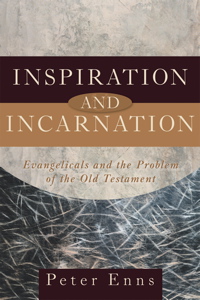
popular Inspiration and Incarnation: Evangelicals and the Problem of the Old Testament
, which looks at three questions raised by biblical scholars that seem to threaten traditional
views of Scripture. This is the fourth of his multi-part series on an incarnational model of Scripture.
Much of the concern surrounding the Christian faith and the acceptance of evolution and modern cosmology and geology centers on how to read the opening chapters of Genesis. Very often, and rightly so, that discussion turns to such issues as how modern data, such as extra biblical texts and scientific developments affect how we read Genesis.
That is all fine and well, but let's come at this from a different angle.
There is a factor that rarely enters the discussion among conservative readers of Scripture. It is only one factor, but it is very important.
If we want a clue as to how to read the opening chapters of the Christian Bible, we should go to the closing chapters.
At the end of the Bible, in the book of Revelation, in the very last chapter of the last book, we read the following:
Then the angel showed me the river of the water of life, as clear as crystal, flowing from the throne of God and of the Lamb down the middle of the great street of the city. On each side of the river stood the tree of life, bearing twelve crops of fruit, yielding its fruit every month. And the leaves of the tree are for the healing of the nations. No longer will there be any curse. The throne of God and of the Lamb will be in the city, and his servants will serve him. They will see his face, and his name will be on their foreheads. There will be no more night. They will not need the light of a lamp or the light of the sun, for the Lord God will give them light. And they will reign for ever and ever (Revelation 22:1-5, NIV).
The book of Revelation is an apocalyptic book, which means it is a figurative, symbolic description of what the "end" will look like. Much of Revelation is concerned with showing God's ultimate rule over history, and how he is bringing that history to its consummation in Christ.
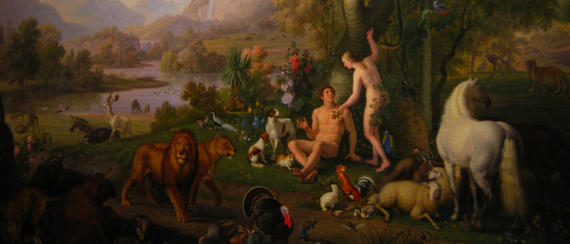
And note how history will end: in a garden, with a river, a tree of life, and the removal of the curse. I hope bells are going off right about now.
In a manner of speaking, the point of the entire story of redemption laid out in the Christian Bible is to get us "back into the garden," to regain what was lost, for the obedient Second Adam to undo the disobedience of the first Adam.
The book of Revelation, however, is not a literal description of events in time and space. To be sure, God will bring history to its consummation, but the description of that consummation in Revelation is figurative or symbolic. That is the nature of apocalyptic literature in the ancient world, and Revelation participates in that literary convention.
Although it has occasionally been tried, a "literal" (meaning time-space, historical) reading of Revelation does not work at all. The message behind Revelation is something God will do in history, but the description of those events are figurative. This is especially clear beginning in Chapter 21, where we read of a "New Jerusalem" descending from the sky. Its description is a symbolic amalgamation of Jerusalem, temple, and Garden of Eden imagery. It is not a literal city crashing down on the Earth, but a theologically potent, concrete, ancient description of what God will eventually do in time and space.
The use of such imagery was a powerful communicator of theological truth to ancient peoples--and it should be to us, as well. And here is my point to ponder: the symbolic, non-literal nature of the renewed Garden in Revelation 22 should suggest to us, quite strongly in fact, that the Garden of Genesis 2-4 likewise, although communicating theological truth, is also symbolic and non-literal. Both are "true," deeply so, but neither are literal, historical, or physical.
Discuss amongst yourselves, but try to keep it nice.
Leaders of the BioLogos Foundation share insights on the latest ideas on science, faith, and their integration.