Evolution and the Imago Dei

Monday May 11, 2009

Categories: Weekly Feature
bible_DNA.jpg

Genesis 1:26-27 reads: "Then God said, `Let us make man in our image, in our likeness, and let them rule over the fish of the sea and the birds of the air, over the livestock, over all the earth, and over all the creatures that move along the ground.' So God created man in his own image, in the image of God he created him; male and female he created them."

Immediately after Darwin published "The Origin of Species" in 1859, the consequences for human origins, biblical interpretation and people's relationship with God were apparent. The potential disparity between this Genesis creation story and Darwin's theory leads people to assume the church at the time felt threatened and opposed evolution. But many church leaders in the late 19th century actually embraced Darwin's theory as insight to the means by which God created the world. As just one example, the conservative Christian theologian B. B. Warfield wrote,"I am free to say, for myself, that I do not think that there is any general statement in the Bible or any part of the account of creation, either as given in Gen. I & II or elsewhere alluded to, that need be opposed to evolution."

The idea that humans might be related to the great apes was not universally well received, however. The wife of the Bishop of Worcester, England, upon hearing this news, reportedly responded with some alarm. "Descended from the apes? My dear, let us hope that it is not true," she said. "But if it is, let us pray that it will not become widely known."

Now 150 years later, we still seem to be fighting this battle. A recent Gallup poll indicates that 44 percent of people in the United States believe God created humans in their present form fewer than 10,000 years ago. The Washington Post writer Kathleen Parker points out one of the serious consequences of this situation in her recent column. "The problem of not believing in evolution as one might not believe in, say, goblins or flying pigs has repercussions beyond the obvious -- that the United States will continue to fall behind other nations in science education," she writes.

The study of DNA -- the hereditary material -- has enabled the study of human origins to achieve a level of detail Darwin never could have imagined. The decoding of the entire DNA sequence of humans -- the Human Genome Project, which I had the privilege of leading -- along with the genomes of dozens of other vertebrates has been a rigorous test of whether the data actually fits a model of evolution from a common ancestor. And the evidence is overwhelming. Although some people might still argue that DNA similarities do not prove common ancestry -- after all, God might have chosen to use the same DNA motifs for animals of anatomic similarity -- the details of the analysis make that conclusion no longer tenable.

Most mammals, for example, do not need dietary sources of vitamin C because they can make their own using an enzyme encoded in their genomes. But primates, including humans, require vitamin C in their diet, or they will suffer a disease called scurvy. What happened here? Well, if you search through the human genome, you will find a degenerated copy of the gene for this vitamin C synthesizing enzyme. But it has sustained a knockout blow, losing more than half of its coding sequence. A claim that the human genome was created by God independently rather than being part of descent from a common ancestor would mean God intentionally inserted a nonfunctioning piece of DNA into our genomes to test our faith. Unless you are willing to contemplate the idea of God as a deceiver, this is not a comfortable explanation.

This past week I attended a meeting about the human genome at Cold Spring Harbor Laboratory in New York. I heard many astounding presentations on comparisons of our own genome to that of other species -- all consistent in exquisite detail with an evolutionary explanation. A particularly interesting paper described the latest findings on Neanderthals, whose DNA sequence is being painstakingly pieced together from several 30,000-year-old bones of different individuals. The DNA similarity to Homo sapiens is striking; but the evidence is most consistent with a separation of humans and Neanderthals nearly 500,000 years ago.

One particular finding about genetic variation caught the audience's attention immediately. To explain this discovery, it's first important to know that we humans are a lot alike at the DNA level. But if you compared your DNA sequence to mine, about one of every 1,000 letters of the code would be different. Most of these differences are common in the human population and fall in parts of the genome that tolerate variation. Therefore, those differences don't seem to have much effect. But they are interesting reflections of our history. So here's the new information: about one-third of those exact same variations are also found in Neanderthals. That means a precise location of the human genome where some individuals have the letter A and others have the letter G will often show that same exact variation in DNA from Neanderthal bones. That does not imply there was interbreeding between humans and Neanderthals in Europe 30,000 years ago -- so far, there is no DNA evidence to support that. Instead, this new discovery points unequivocally to a population of common ancestors of both humans and Neanderthals with these exact genetic variations living more than 500,000 years ago.

Why do so many people find it difficult to accept these conclusions? First of all, there is the general problem that evolution is somewhat counterintuitive. Our own human experience does not easily accommodate the vast intervals of time necessary for natural selection to produce the marvelous diversity of living things we see all around us. For believers, there is the additional problem of fitting together the concept of the creator God and the imago Dei, or image of God, with the words of Scripture and a process that seems so random. But does this struggle need to exist? Suppose God chose to use the mechanism of evolution to create animals like us, knowing this process would lead to big-brained creatures with the capacity to think, ask questions about our own origins, discover the truth about the universe and discover pointers toward the One who provides meaning to life. Who are we to say that's not how we would have done it? If you believe that God is the creator, how could the truths about nature we discover through science be a threat to God? For many scientists who believe in God -- including me -- it's just the opposite. Everything we learn about the natural world only increases our awe of the God the creator.

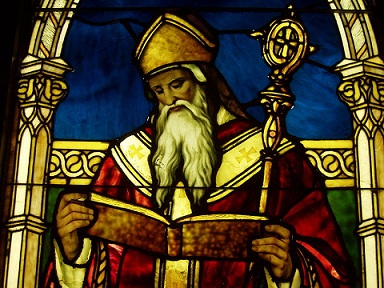
Yet many evangelical churches continue to fear the whole fabric of faith will be torn apart if the words of Genesis 1 and 2 are not taken literally. It surprises many to learn this ultraliteral interpretation was not considered necessary by many profoundly dedicated believers long before Darwin arrived on the scene. In A.D. 400, St. Augustine wrote no fewer than four books about the interpretation of Genesis, ultimately concluding it was not possible to arrive at a confident view of how creation occurred. In words that presciently warn against the current conflict, he writes, "In matters that are so obscure and far beyond our vision, we find in Holy Scripture passages which can be interpreted in very different ways without prejudice to the faith we have received. In such cases, we should not rush in headlong and so firmly take our stand on one side that, if further progress in the search for truth justly undermines this position, we too fall with it."

I urge us all to step back from the conflict and look soberly at the truth of both of God's books: the book of God's words and the book of God's works. As people dedicated to truth, let us resolve to move beyond a theology of defensiveness to a theology that celebrates God's goodness and creative power.

For answers to the most frequently asked questions about science and faith, see http://www.biologos.org.

Dr. Francis S. Collins is former director of the Human Genome Project and founder and president of The BioLogos Foundation. 

Share |
Advertisement
Comments
Robert
May 16, 2009 8:19 AM
http://www.bestillknowgod.com

Evangelical theology is suffering from its own limitations.

We are all witnessing its struggle to survive while holding to the ancient ideas of a "fall", "original sin", salvation, etc.

These handful of beliefs are the foundation of the church and the glue that holds them together and keeps Christians bound to those traditions.

As Suzanne pointed out - God can't be understood with our "puny" minds. We're dealing with the Infinite here right?

We humans have great difficulty seeing truth when we're looking right at it as long as we're holding on to our old beliefs.

The reason we have unanswered questions about God is because our belief system "box" isn't large enough to contain the answers. Once those limitations are dissolved the answers will come - all of them.

Robert Carstens Jr.
May 16, 2009 2:11 PM

Interesting article and comments. Perhaps the problem is not so much about "GOD creating Man in HIS own image" as it is that "Man is constantly trying to re-create GOD in the image of Man" limited to what Man can conceive of as possible and/or true.
In school I was taught that "Science is inquiry". To "inquire" about someting you have to know of its existance; and enough about it to know what questions to ask. At the bottom of all Human knowledge are certain basic assumptions, ideas that are accepted ,on faith, as being "true" because they can be neither proved or disproved with present data -- the validity of which, at some point, be taken on "faith".
With the advance of technology, the means of collecting new data/types of data, many old assumptions are being changed or proven "false" in the light of new data. Our biggest assumption or "leap of faith" as it were, is that there are certain constants/unchanging laws governing our universe. This is the assumption that drives our technology and our search for knowledge and truth.
As a Christian I've been taught that GOD is omnipotent and omnicient, as the Creator of all,
existing both in and outside of all time, the Alpha and the Omega. Scientific and mathematical inquiry into the workings and history of the physical Universe, only increase my awe of the unfathomable Majesty of our LORD! Who is MAN that he should limit or judge the means of GODs creation? Who among all of humankind can grasp, in its absolute enerity, even one thing?
For those who would use "scientific" facts/proof against GOD, the LORD speaks in the book of Job chapter 38: 2 Who is this that darkeneth counsel by words without knowledge? 4 Where wast thou when I laid the foundations of the earth? declare, if thou hast understanding. 5 Whohath laid the measures thereof, if thou knowest? or who hath stretched the line upon it? 6 Whereupon are the foundations thereof fastened? or who laid the corner stone there of; 7 When the morning stars sang together, and all the sons of God shouted for joy?
The term 'evoultion' simply means change. All of life faces continuous change; seasons, climate, etc. Isn't it marvelous that our Creator created a mechanism by which life can adapt to these changing conditions? Genesis as written by Moses was never intended to be a scientific tretesè or the creation of the world or man; how could it be? the language to do so didn't/dosn't even exist even if the necessary understanding did/does? language in and of itself is an imperfect means of communication (just read a good dictionary or thesarus and see!). Moses wrote what he did for the people and used the terms that they could understand and a history that would give them a community as a 'people' i.e. the 'Hebrews'; there is no reason to believe that he tried to make it all inclusive; how could any man know, let alone write, every detail of all of history?
The Bible tells us about GOD. His love. His constancy. His forbearance. In it, we are given examples of these through early Jewish history as well as the life/death/ressurection of Jesus and of the early beginnings of the Christian church through the writings of the Apostles. To study the Bible can bring wisdom and understanding; if done with an open mind. In gospel of John 20:29 Jesus says ...Thomas, because thou hast seen me thou hast believed; blessed are they that have not seen, and yet have believed.
In the end, there is no way that I can know the details of the Creation, I wasn't there, and I wouldn't have had the capacity needed for them, even if I was. As to what has happened since, there is no proof that can be made without first making some basic assumptions which themselves require a certain leap of faith. In the same way, nitpicking certain parts of the Bible, requiring absolute emperical evidence, may be interesting exercises in logic and stroke ones ego, but do little more than muddy the issue. As St Paul admonishes us in 1 Corinthians, the freedom to do a thing without sin, should not be done if in doing so it would cause someone else to come to harm.
I love science, and reading scientific speculation about how things work, what means GOD used in creating our universe and world. I love reading speculations (theories) about the history of our universe, planet, life on earth and evidence of life and human history that is dug out of the ground.
I am facinated by and led to wonder about many things that I can never know on this side of the grave. When I meet my LORD in the hereafter, perhaps I'll ask.

Robert Carstens Jr.
May 16, 2009 4:21 PM

My sincere apologies. After reviewing my previous Post I found that it contained several spelling and formatting errors that would make what I was trying to say unclear. I have discovered that "italics" don't transfer, and the limited time allowed to type this "on line" has cost me my content several times. With these limitations in mind, I've re-written/formatted my original Post in an attempt to make my thoughts more clear.
Thank you for reading/considering my ideas.
Robert Carstens Jr.
---------------------------------------------------------------------------------------------
Interesting article and comments.
Perhaps the problem is not so much about "GOD creating Man in HIS own image", as it is that "Man is constantly trying to re-create GOD in the image of Man" limited to what Man can conceive of as possible and/or true.
In school I was taught that "Science is inquiry". To "inquire" about something you have to know of its existence; and enough about it to know what questions to ask.
At the bottom of all Human knowledge are certain basic assumptions, ideas that are accepted ,on faith, as being "true" because they can be neither proved or disproved with present data -- the validity of which, at some point, be taken on "faith".
With the advance of technology, the means of collecting new data/types of data, many old assumptions are being changed or proven "false" in the light of new data. Our biggest assumption or "leap of faith" as it were, is that there are certain constants/unchanging laws governing our universe. This is the assumption that drives our technology and our search for knowledge and truth. For example, electronics absolutely DEPENDS on this assumption.
As a Christian I've been taught that GOD is omnipotent and omniscient, the Creator of all;
existing both in and outside of all time, the Alpha and the Omega. Scientific and mathematical inquiry into the workings and history of the physical Universe, only increase my awe of the unfathomable Majesty of our LORD! Who is MAN that he should limit or judge the means of GOD or HIStircreation? Who among all of humankind can grasp, in its absolute entirety, even one thing or event?
For those who would use "scientific" facts/proof against GOD, the LORD speaks in the book of Job in chapter 38 vs 2, 4 thru 7: Who is this that darkeneth counsel by words without knowledge? Where wast thou when I laid the foundations of the earth? declare, if thou hast understanding. Who hath laid the measures thereof, if thou knowest? or who hath stretched the line upon it? Whereupon are the foundations thereof fastened? or who laid the corner stone there of; When the morning stars sang together, and all the sons of God shouted for joy?
The term "evolution" simply means change. All of life faces continuous change; seasons, climate, etc. Isn't it marvelous that our Creator created a mechanism by which life can adapt to these changing conditions?
Genesis, as written by Moses, was never intended to be a scientific treatise of the creation of the world; or of man. How could it be? the language to do so didn't/doesn't exist, even if the necessary understanding did/does? Language in and of itself, is an imperfect means of communication (just read a good dictionary or thesaurus and see!). Moses wrote what he did for the people, using terms that they could understand and a history that would give them a sense of community as a 'people' i.e. the 'Hebrews'. There is no reason to believe that he tried to make it all inclusive; how could any man know, let alone write, every detail of all of history?
Does anyone know, at what point in his life that Moses wrote Genesis? Is the history from before his birth a compilation and editing of the oral histories of the Hebrews? Did it include things that he was taught as a prince of Egypt? Outside of a belief that Moses was inspired by GOD to write what he did, do we know anything about his sources?
The Bible teaches us about GOD. His love. His constancy. His forbearance. In it, we are given examples of these through early Jewish history as well as the life/death/resurrection of Jesus Christ; and of the early beginnings of the Christian church through the writings of the Apostles.
To study the Bible can bring wisdom and understanding; if done with an open mind. In gospel of John 20:29 Jesus says ...Thomas, because thou hast seen me thou hast believed; blessed are they that have not seen, and yet have believed.
In the end, there is no way that I can know the details of the Creation, I wasn't there, and I wouldn't have had the capacity needed for them, even if I was. As to what has happened since, there is no proof that can be made without first making some basic assumptions which themselves require a certain leap of faith. In the same way, nitpicking certain parts of the Bible, requiring absolute empirical evidence, may be interesting exercises in logic and stroke ones ego, but do little more than muddy the issue. As St Paul admonishes us in 1 Corinthians, the freedom to do a thing without sin, should not be done, if in doing so it would cause someone else to come to harm.
I love science. Reading scientific speculation (theories) about how things work; possible means/ways GOD used in creating our universe and world. I love reading speculations (theories) about the history of our universe, planet, life on earth and the evidence of life and human history that is dug out of the ground. I also realize that theories are just that, speculation. Attempts to explain our existing data.
I am fascinated and led to wonder about many things that I can never know on this side of the grave. When I meet my LORD in the hereafter, perhaps I'll ask.

Robert Carstens Jr.
May 16, 2009 4:25 PM

I see I still haven't figured out how to add "white space" between the lines that will transfer from WordPad!!
Robert Carstens Jr.

John Gravel
May 18, 2009 7:37 AM

I think it is important for us to understand the difference between understanding the real story behind the beginning of Genesis, and, alternatively, discounting any scriptures dealing with the miraculous, simply because we can not generate their repetition and we see them no where else today. The latter would be a serious error.

By this, I am not referring to the oft-adhered to confusion of epeleptics and those possessed by demons, but more greatly with miracles altogether. Was there a virgin birth? And would that virgin birth challenge the scientific mind as much as evolution might challenge the theological mind?

If we bow to science to explain all or scripture, we may make the same mistakes that the assumptions for the basis of this blog are trying to undo in those who will only look to their own understanding to assemble their world.

And we sadly may miss God trying to get our attention.

Read All Comments

Post a Comment

By submitting these comments, I agree to the beliefnet.com terms of service, rules of conduct and privacy policy (the "agreements"). I understand and agree that any content I post is licensed to beliefnet.com and may be used by beliefnet.com in accordance with the agreements.


Please type the text you see in the box below to verify your post and help us prevent spam. You have a limited time to type - you may wish to compose your comment in a separate document and paste it here upon completion.

Type the characters you see in the picture above.

Advertisement

Search This Blog

feed icon Subscribe

RSS Feed

Receive updates from Science and the Sacred

About the Authors

The BioLogos Foundation
The BioLogos Foundation promotes the search for truth in both the natural and spiritual realms, and seeks to harmonize these different perspectives.
» Posts by The BioLogos Foundation
Darrel Falk
Dr. Darrel Falk is Professor of Biology at Point Loma Nazarene University in San Diego, where he has taught since 1988. He is the author of Coming to Peace with Science: Bridging the Worlds Between Faith and Biology (InterVarsity Press, Downer's Grove, Il
» Posts by Darrel Falk
Karl Giberson
Dr. Karl Giberson is an internationally known scholar of science-and-religion and one of America’s leading participants in the creation/evolution controversy. He is the author of four books, including, “Saving Darwin".
» Posts by Karl Giberson
Pete Enns
Peter Enns is an evangelical Christian scholar, author of several books and commentaries, and Senior Fellow of Biblical Studies for BioLogos.
» Posts by Pete Enns
More »

About Science and the Sacred

Leaders of the BioLogos Foundation share insights on the latest ideas on science, faith, and their integration.

Advertisement

Advertisement


About Beliefnet

Our mission is to help people like you find, and walk, a spiritual path that will bring comfort, hope, clarity, strength, and happiness. More about Beliefnet.

Legal

Copyright © Beliefnet, Inc. and/or its licensors. All rights reserved. Use of this site is subject to Terms of Service and to our Privacy Policy. Constructed by Beliefnet.

Advertisement

Report as Inappropriate

You are reporting this content because it violates the Terms of Service.

All reported content is logged for investigation.