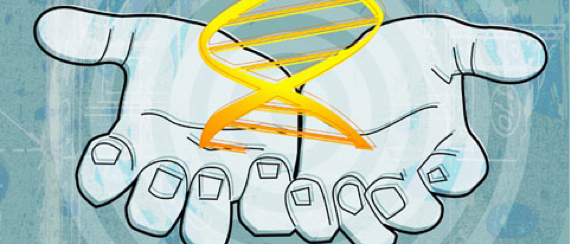
Has science forced God into the margins, or has it merely caused us to reconsider the "God question" in new ways? Can faith survive the challenge of science, or even find harmony with it? Test of Faith, an award winning three-part documentary from the Faraday Institute, seeks to shed light on issues at the very heart of these major questions about the intersection of science and religion. The DVD is scheduled for release on July 3rd, alongside an accompanying book and teaching materials that aim to help churches and laymen engage in these serious and important questions of faith.
For more on the film, as well as links to related websites and resources, be sure to visit the Test of Faith website.

Add to Newsvine
Add to StumbleUpon


I'm glad to see this documentary will address issues beyond creation/evolution, important as that conversation is, as I feel the Christian community will soon have to grapple with many more practical questions in bioethics, such as cloning, end of life decisions, regenerative medicine, and neural enhancement. (Not that all these will be addressed within this resource, but it will surely be an important start.) We need scientists of faith to help educate the church on how new technologies can be used in God-honoring ways.
It is a great step to go from unknowing mystery to filling that mystery anthropomorphically. The danger of exoteric religion is that the black box is falsely filled via projection. We must have the courage to stare deeply into the great mystery and not fill it with our wants, needs, and fears.
For a person of faith, the requirement would appear to be a form of negative theology, to become naked and unattached enough to be willing to look with open eyes and not fall back on the temptation to create a projected god to fill the void. Direct apprehension experienced a-gnostically (without prior knowledge), is to me the thing which is key if what is desired is a clear experience of what-is, without regard to what "i" would have it be.
Faith traditions, to be relevant in the scientific age to a human curiosity which does not want to stand outside in the vestibules of belief, should embrace a negative theology which can be made available to those within its community. The beauty of negative theology is that it does not fall into the traps of "belief" and the need form painful revision. The experience is real and transcends the boundaries of culture; it merely is not exclusive to a particular tradition. And therein lies the key to an inherent ecumenicalism, a meeting point where all can fellowship without conflict. It is not in the experience, but in its interpretations where conflict arises, and where the threat to belief becomes of existential importance to the believer. This is fundamental to why a threat to belief can entail such terrible reactions in a believer.
This looks like an excellent documentary. Any idea of when it will be available in the U.S. and how much it will cost?
Post a Comment
By submitting these comments, I agree to the beliefnet.com terms of service, rules of conduct and privacy policy (the "agreements"). I understand and agree that any content I post is licensed to beliefnet.com and may be used by beliefnet.com in accordance with the agreements.