Science and the Sacred

The Ancient Science in the Bible

Friday August 21, 2009

Categories: Guest Feature
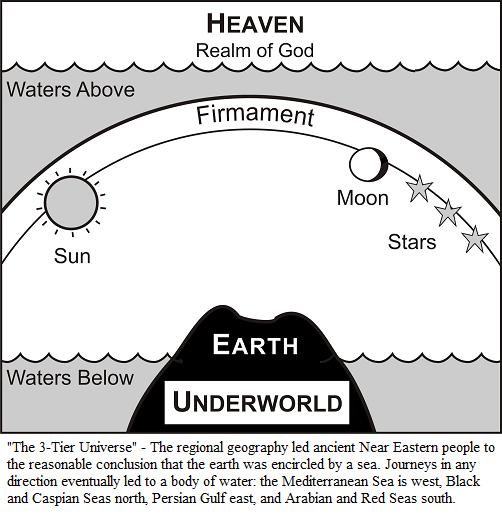
Ancient Science Diagram GIBERSON.jpg
Every Friday, "Science and the Sacred" features an essay from a guest voice in the science and religion dialogue. This week's guest entry was written by Denis O. Lamoureux, author of the books Evolutionary Creation and I Love Jesus and I Accept Evolution.

I am both an evangelical (born-again Christian) theologian and an evolutionary biologist. Stated another way, I love Jesus and I accept evolution. Of course, such a claim is not often heard in our churches. But if I am allowed only one argument to explain my views, it is this: the Bible is not a book of science, but a book to meet the Lord.

In fact, Holy Scripture features an ancient science of the structure, operation, and origin of the universe and life. The diagram presents the world as conceived by ancient Near Eastern peoples, including God's chosen people, the Hebrews. It may come as a surprise to most Bible-reading Christians, but a 3-tier universe is found in the Word of God. A few of these ancient conceptions of the natural world include:

(1) The earth is flat. The word "earth" appears over 2500 times in the Old Testament (Hebrew: 'eres) and 250 times in the New Testament (Greek: ge). Never once is this word referred to as spherical or round. Instead, the universe in the Scripture is compared to a tent with the earth as its floor (Ps 19:4, Ps 104:2, Is 40:22).

(2) A circumferential sea borders a circular earth. Proverbs 8:22-31 and Job 26:7-14 describe the creation of the world. The former states, "God inscribed a circle on the face of the deep" (v. 27); and the latter, "God has inscribed a circle on the surface of the waters" (v. 10). The Bible also asserts that the earth is circular. Isaiah writes, "God sits enthroned above the circle of the earth, and its people are like grasshoppers. He stretches out the heavens like a canopy, and spreads them out like a tent to live in" (Isa 40:22).

(3) The earth is immovable. The Bible records three times that "the world is firmly established; it cannot move" (1 Chr 16:30, Ps 93:1, Ps 96:10). The stability of the earth is understood to be like that of a building set on the solid foundations. The biblical writers frequently refer to this solid base as "the foundations of earth" (Job 38:4-6, Prov 8:29, Jer 31:37). For example, "God set the earth on its foundations; it can never be moved" (Ps 104:5).

(4) A solid domed structure, termed the "firmament," holds up a body of water over the earth. Created on the second day of creation, the firmament separated the "waters above" from the "waters below" (Gen 1:6-8). Notably, this heavenly dome and body of water did not collapse during Noah's Flood. As the psalms of King David's day reveal, "The heavens declare the glory of God and the firmament proclaims the work of His hands" (Ps 19:1); and God "stretches out the heavens like a tent and lays the beams of His upper chambers [i.e., God's celestial temple] on their waters" (Ps 104:2-3).

(5) The sun moves across the sky. Created and placed in the firmament on the fourth day of creation (Gen 1:14-18), the daily movement of sun is found in King Solomon's observation: "The sun rises and the sun goes down, and hurries to the place where it rises" (Eccl 1:5). It also appears in the psalmist's praise, "The sun rises at one end of the heavens and makes its circuit to the other" (Ps 19:6).

Of course, many Christians are quick to point out that all of passages cited above are only "appearances" in nature. That is, these are phenomenological descriptions (Greek phainomenon: appearance). The earth "looks" flat, "seems" to be surrounded by water, and "feels" stationary; the sky gives the "impression" of being a blue body of water overhead; and the sun "appears" to cross the dome of the sky, rising and setting every day. However, to ancient peoples like the biblical authors and their readers, these are descriptions of the actual structure and operation of the universe. As history reveals, the notion that the earth was immovable and that the sun moved daily across the sky was part of astronomy up until the early 1600s. In fact, this was the issue of the Galileo controversy.

So what's the bottom line? Don't go to the Bible to find scientific facts; go to Scripture to meet Jesus. In the same way that the Lord personally meets each of us wherever we happen to be, the Holy Spirit came down to the level of the ancient biblical writers and employed their understanding of the physical world in order to communicate as effectively as possible life-changing spiritual truths. By using an ancient science in the Bible, God revealed the inerrant Message of Faith that He created the world, not how He created it.

For more on the ancient science in the Bible see:
Denis O. Lamoureux's I Love Jesus & I Accept Evolution (2009), pages 43-70, and his website: www.ualberta.ca/~dlamoure

Share |
Advertisement
Comments
Gordon J. Glover
September 12, 2009 10:00 AM

Charles, you hit the nail on the head when you said: "Man's views change all the time, but GOD'S WORD does not..."

This is, I think, the foundation of accommodation. Since human culture varies so much across time and geography, it's would be impossible to read the bible consistently if each people-group filtered God's word through their own cognitive environment. This would be a usurption of biblical authority because each person would approach the scriptures with his own personal sense of what the text is saying. But we have to remember that God didn't speak directly to us (21st century western Christian). Rather, he spoke to us VIA a particular people who lived in a particular time and in a particular place with own language, customs, culture, social norms, cosmology, etc. So it only seems natural that if we really want understand the text at face value in such a way that transcends culture and remains true for all of eternity, then each person reading God's Word should set aside their own cultural perspective and seek to read the text through the eyes of the original audience. This doesn't require scientific apologetics or hermeneutical gymnastics; it requires some study of comparative literature from the culture that surrounded and preceeded God's people.

Here is a rather lengthy excerpt from an article by Paul Seely that illustrates the point: "The effective communication of divine revelation may even require changing facts in order to adapt them to a very different culture. In the Chinese culture, the dragon is associated with good luck and blessing. If a missionary insists on speaking of the “dragon” in the book of Revelation,the cultural background of the hearers will automatically associate good things with Satan. If the missionary
adheres strictly to the facts of the text, the message will be distorted.

In Korea, white robes are only worn for funerals and mourning. If a missionary sticks strictly to the facts of the text when translating Rev. 7:9, the great multitude of saints in heaven will all be in mourning as far as the Koreans are concerned. In parts of Africa, if you strew branches in the path of an official, it is an insult to the official. If then a missionary translates Matt. 21:8 according to the actual text, the Africans will be very confused about Palm Sunday.
One might ask, Can a missionary be perfectly moral yet make the book of Revelation say “tiger” when it really says “dragon” or say “red robes” when it really says, “white”? If the missionary does, the translation will not be speaking in accord with the facts. Would the missionary be guilty of lying if the translation did not agree with the facts? Must the translation be absolutely true to the facts even if it causes misunderstanding or stumbling? Is that God’s will and way? Would it not be perfectly moral for a missionary or God to accommodate the message to the culture of the people to whom he is speaking? Does the Bible not have a supra-cultural message which can be best communicated by departing from the facts and clothing the message in the cultural terms of the people to whom it is given?

God is not lying or erring, therefore, when his Word does not agree with the findings of modern science because the science per se which he has incorporated into Scripture is not a revelation from God but is simply an accommodation to the science of those times.

We must not forget that the various revelations in the Old Testament did not come to a people whose minds were a tabula rasa. Rather, they came to a people who had cultural ideas which were deeply ingrained before God’s revelation in the Old Testament ever came to them. These pre-ingrained cultural ideas invited and even sometimes demanded
adaptations, which, like a missionary’s translation, may depart from strict adherence to the facts. In the case of Genesis 1–11, I have
shown elsewhere that some of the content is certainly accommodated to the science of the times."

Charles Pugh
September 13, 2009 3:06 PM
http://www.vtlessonstolearn.com

Hi Denis, Gordon or others who may know,

A quick question for now:

Denis, are you or others here directly involved in the Biologos group that is featured in this Science and The Sacred forum?

Thanks,

P.S. Anyone can let me know if they are interested in testing the science experiment I mentioned before. ;-)

Charles :-)

John 17:17

Denis O. Lamoureux
September 14, 2009 5:39 PM

Beaglelady,
I wrote:
"I am NOT a Darwinist. I reject Darwin's view of evolution."
You asked:
“Please explain what you mean by this.”

Sure. There is a problem with the word “Darwinist.” Regrettably, it has come to mean an atheistic evolutionist, as popularized by Dawkins. Darwin’s views are complex, and they evolved over time. See my paper: http://www.asa3.org/ASA/PSCF/2004/PSCF3-04Lamoureux.pdf

So I definitely accept biological evolution, not Darwinism.

Hope this helps,
Denis

Beaglelady
September 16, 2009 10:09 PM

Thank you, Dr. Lamoureuxwr

Charles Pugh
September 16, 2009 11:20 PM
http://www.vtlessonstolearn.com

To Gordon, Denis and others who may still be reading this forum,

I appreciate the interaction here as I have been cut off from so many whom I have interacted with, especially since 04-16-07. Satan would like to cut me off for good and continues to try, but GOD will only allow him to go so far. I have been learning from the interaction here as I am from everything I am reading and studying and all that is happening in my life (c.f. Prov. 14:6; 18:1, etc.). I am personally experiencing numerous examples of what many would call supernatural events, though I have preferred to call it meta-natural. This basically has been discovered through my noting patterns (good and bad) of events in my life and trying to understand them as well as seeing GOD directly answer many of my prayers that would be unreasonable from a mere naturalistic perspective. If one works from an either/or or natural vs. supernatural paradigm, then you would have to say what I am experiencing is supernatural. The fact that GOD has given me some repeatable phenomena enables me to actually do some science in these areas too. ;-) This particularly relates to when I listen to sacred music in my home or sing sacred music on my phone line. I am interpreting and understanding more about these things by faith from my theological foundation. My training is in theology, yet I have always had an interest in science. Hasn’t Theology been called “the Queen of the Sciences”?

Gordon, I can see that you have a gift of teaching. I learned from the videos of your teaching that I watched today (#10-16) and hope to take time to see the others at some point. I do agree with much of what you are teaching, though I also have some disagreement and questions at various points. I do not necessarily want to bring all of those into this continuing discussion, though I would like to ask a few questions that also relate to previous comments various ones have made here.

1. Related to the idea presented as Accommodation:

As I noted before, in a broad sense you can say that any explanation of anything from GOD to man could be called accommodation as HE has communicated to man where man was at the time of his development and change, while GOD Himself has remained unchanged (e.g. Malachi 3:6). Gordon, while I respect your PCA heritage (I do not know the particular theological background of Denis or the others here), your applying a principle of accommodation lends itself more toward a dispensational theology, rather than a covenant theology. I wonder if you have really studied any explanation of dispensational theology.

1) I understand the desire to use a principle of accommodation to help make the theological clash of faith and science more palatable, particularly when it comes to the foundation of Origins and Gen. 1-11, yet where does this principle of accommodation end? What is your hermeneutic there?

2) I assume that you, Denis and others with an integrationist position are also taking Moses to be the direct author of Genesis 1-11. Do you then see Genesis 1-11, and particularly the Creation accounts in chapters 1 and 2 as kind of a dictation from GOD to Moses? Did Moses draw from the cosmology of others in his day? If you say it was GOD accommodating an ANE cosmology (uniform or not as we understand it), then why do you so readily dismiss the possibility that GOD would have Created with an appearance of age or even with patterns of similarity (seen more readily from the naked eye observation or through study of molecular patterns)? Would taking the position of Moses only being the editor of the material in Genesis 1-11 change your view any? Do you believe that the genealogical records in Genesis 5 are accurate, or are the long ages of humans living them somehow exaggerated or some kind of other accommodation?

3) I accept that you and other integrationists say you believe in the miracles of Jesus and even other miracles in Scripture, though not many specifics have been given beyond the Creation related questions. How do you or even can you scientifically explain the miracles? Do you believe in a global or only a local flood? Do you accept that Jonah was swallowed by a great fish or whale and survived to tell about it? Do you accept that the Apostles had some supernatural help in healings or other un-natural phenomenon? How about generally GOD communicating directly with any human being? What about the changes that suddenly happen in the lives of those who trust Jesus Christ after living a wicked life? Again, this goes to the question of accommodation.

2. Related to the idea of Uniformitarianism, which is foundational for radioisotope dating and crucial to paleontology and the foundational teaching of the geologic column:

1) Do you accept that the world as we in the 21st century have come to understand, has always operated according to the scientific principles we use today?

2) How might this relate to your theological understanding of sin? Did sin only affect human beings or did it affect the rest of the Creation as well? Has sin impacted the heavens? We do have other Bible commentary there, even beyond Genesis 3.

3) Do you believe that GOD and or Satan or even other angels can at any time suspend any natural laws as we know them? If so, how might you explain that scientifically? If not, and you still believe in past miracles, at what point did the spiritual/natural interaction cease? How might that have impacted the natural processes afterwards?

3. Finally, to the particular area of believing and standing on the specific words of Scripture:

1) What is your hermeneutic for what words to take literally, figuratively or as some sort of accommodation? For example, how do you know when to take “firmament” so literally, as with the explained dome definition? Should “heaven” be taken literally too and is there only one heaven or are there two or three or more? I understand that you do not accept that there is more than one firmament, yet why believe in more than one heaven?

2) I understand the importance of learning the background of idioms or figures of speech. I also understand why the background of the particular author writing Scripture is important in better understanding the meanings of what was written. How do you differentiate the words that are written by the human authors and those words that GOD directly gave to them? Do you see greater weight in the direct “Thus saith the LORD” statements of Scripture verses a historical commentary or narrative? How might you know if Jesus was merely accommodating his hearers or if the LORD was only accommodating in the dictation portions of Scripture? Is our 21st century scientific understanding the basis for this?

3) Do you see a generality in many statements and words of Scripture that allows for varying levels of understanding and interpretation? In other words, are the words of Scripture both wide and deep?

Gordon, I liked the way you used practical illustrations and pictures in your teachings, yet I would like to ask a question about your puzzle illustration. Is the puzzle science or is it the Word of God or is it both? What might you say are the pieces of the puzzle? What happens to the picture and your ability to complete the puzzle if you have pieces from 2 different puzzles?

Paul, I still plan to review the papers on the firmament that you wrote and Denis, I also would welcome any further communication or comments from you or any others reading here.

Sincerely,

Charles ;-)
John 17:17

Read All Comments

Post a Comment

By submitting these comments, I agree to the beliefnet.com terms of service, rules of conduct and privacy policy (the "agreements"). I understand and agree that any content I post is licensed to beliefnet.com and may be used by beliefnet.com in accordance with the agreements.


Please type the text you see in the box below to verify your post and help us prevent spam. You have a limited time to type - you may wish to compose your comment in a separate document and paste it here upon completion.

Type the characters you see in the picture above.

Advertisement

Search This Blog

feed icon Subscribe

RSS Feed

Receive updates from Science and the Sacred

About the Authors

The BioLogos Foundation
The BioLogos Foundation promotes the search for truth in both the natural and spiritual realms, and seeks to harmonize these different perspectives.
» Posts by The BioLogos Foundation
Darrel Falk
Dr. Darrel Falk is Professor of Biology at Point Loma Nazarene University in San Diego, where he has taught since 1988. He is the author of Coming to Peace with Science: Bridging the Worlds Between Faith and Biology (InterVarsity Press, Downer's Grove, Il
» Posts by Darrel Falk
Karl Giberson
Dr. Karl Giberson is an internationally known scholar of science-and-religion and one of America’s leading participants in the creation/evolution controversy. He is the author of four books, including, “Saving Darwin".
» Posts by Karl Giberson
Pete Enns
Peter Enns is an evangelical Christian scholar, author of several books and commentaries, and Senior Fellow of Biblical Studies for BioLogos.
» Posts by Pete Enns
More »

About Science and the Sacred

Leaders of the BioLogos Foundation share insights on the latest ideas on science, faith, and their integration.

Advertisement

Advertisement


About Beliefnet

Our mission is to help people like you find, and walk, a spiritual path that will bring comfort, hope, clarity, strength, and happiness. More about Beliefnet.

Legal

Copyright © Beliefnet, Inc. and/or its licensors. All rights reserved. Use of this site is subject to Terms of Service and to our Privacy Policy. Constructed by Beliefnet.

Advertisement

Report as Inappropriate

You are reporting this content because it violates the Terms of Service.

All reported content is logged for investigation.